
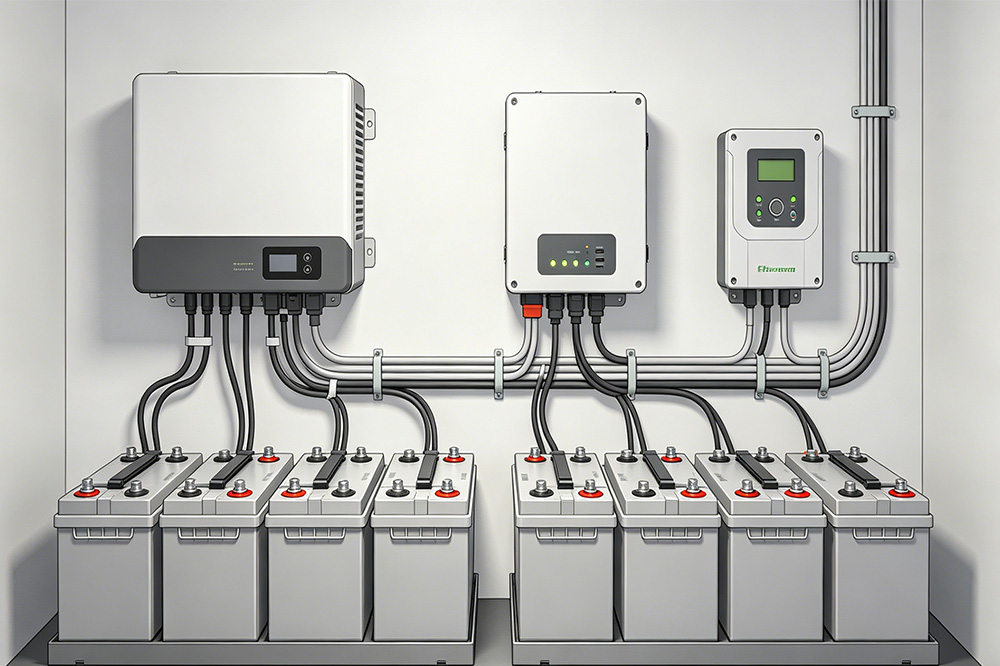
A single 12V 100Ah LiFePO4 battery is easy to understand.
But once you start building a real system — solar, RV, or off-grid — things get a bit more complicated.
Questions usually come up like:
- Should I connect batteries in series or parallel?
- How many do I actually need?
- What happens if I mix them later?
This article isn’t theoretical. It’s based on how these systems are actually built in real projects.
Start with Load, Not the Battery
A common mistake is choosing batteries first.
A better approach:
start with how much power you actually use
Simple example:
- daily consumption = 3000Wh
- one 12V 100Ah battery ≈ 1280Wh
So realistically:
you need at least 3 batteries (and usually a bit more buffer)
If you skip this step, the system will always feel “too small.”
Parallel Connection: The Most Common Setup
Parallel is what most small systems use.
What it does:
- keeps voltage at 12V
- increases total capacity
Example:
- 1 battery → 12V 100Ah
- 2 batteries → 12V 200Ah
- 4 batteries → 12V 400Ah
When to use:
- RV systems
- small solar setups
- marine applications
It’s simple, flexible, and easy to expand later.

Series Connection: When Voltage Needs to Increase
For larger systems, 12V is not always ideal.
That’s where series connection comes in.
What it does:
- increases voltage
- keeps capacity the same
Example:
- 2 batteries → 24V 100Ah
- 4 batteries → 48V 100Ah
Why it matters:
- higher voltage = lower current
- better efficiency
- less heat and cable loss
This is why most larger solar systems move to 24V or 48V.
Series + Parallel: Real-World Systems
Most practical setups combine both.
Example:
- 4 batteries in series → 48V 100Ah
- 2 of those groups in parallel → 48V 200Ah
This gives you:
- higher voltage
- larger capacity
- scalable structure
It’s a common approach for off-grid homes and commercial setups.

The Part That Causes Problems: Mixing Batteries
This is where a lot of systems go wrong.
Things to avoid:
- mixing old and new batteries
- mixing different brands
- mixing different internal resistance levels
Even if specs look the same, performance may not be.
Over time, this leads to:
- imbalance
- reduced lifespan
- unstable performance
Why Consistency Matters in Bulk Systems
If you’re building systems or sourcing in quantity, consistency becomes critical.
You want batteries that behave the same across the board.
A product like this
12V 100Ah LiFePO4 battery
is typically designed for:
- stable cell matching
- predictable performance in parallel setups
- scalability for larger systems
That makes system design much easier, especially when you’re repeating installations.
Wiring and Practical Setup Tips
A few things that are often overlooked:
1. Keep Cable Lengths Equal
Uneven cables can cause uneven current distribution.
2. Use Proper Busbars or Connectors
Don’t rely on random wiring when dealing with multiple batteries.

3. Plan for Expansion
Leave space for additional batteries if the system might grow.
4. Don’t Push Everything to the Limit
Running at 100% all the time shortens lifespan.
A Simple Way to Think About System Design
Instead of trying to get everything perfect from day one:
build a system that can grow
Start with:
- a base capacity
- a structure that allows expansion
Then scale based on actual usage.
This approach reduces both cost and risk.
Conclusion
Building a battery system isn’t just about connecting units together.
It’s about:
- matching your load
- choosing the right configuration
- using consistent components
12V 100Ah LiFePO4 batteries work well because they’re modular.
And if the system is planned properly, they can scale from a small setup to something much larger without starting over.


Leave a Reply