
Core Specs, Real-World Use Cases, and How Wholesale Buyers Should Decide
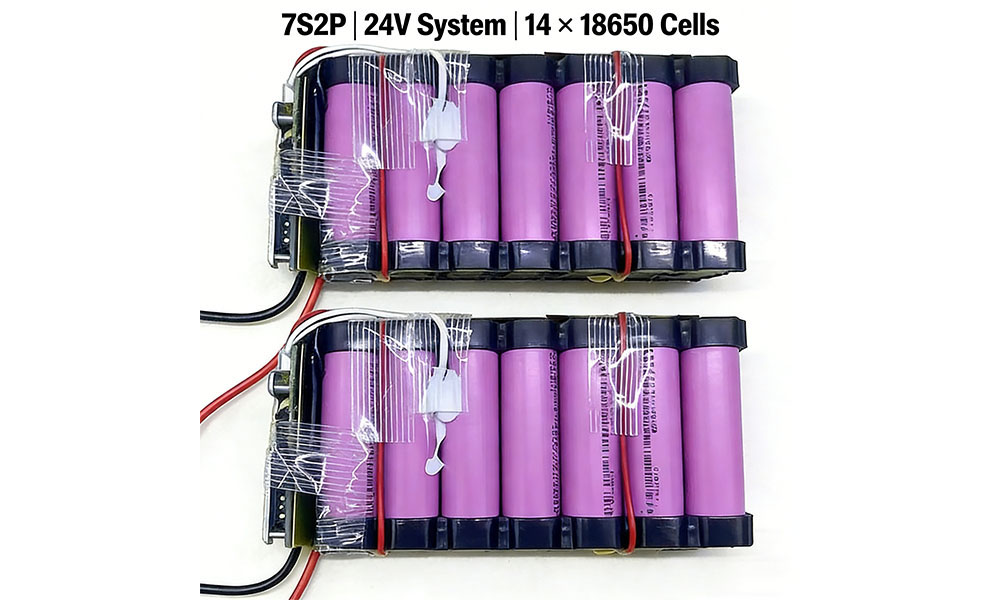
In many 24V device projects, the 7S2P 18650 battery pack has almost become a “default choice.”
Not because it’s new.
Not because it’s fancy.
But because it sits in a very comfortable middle ground — cost, size, power capability, and supply-chain maturity all balance out.
That comfort is exactly where problems start.
On paper, it looks standardized.
In real procurement, choosing the wrong version often leads to rework, returns, delayed launches, and uncomfortable phone calls.
This article looks at the 7S2P 24V battery pack from a wholesale buyer and project owner’s perspective, and breaks down what actually matters — clearly, and without overengineering the explanation.

1. What a 7S2P 24V 18650 Battery Pack Actually Is
Let’s start with the structure — no marketing language.
7S (7 in series)
Seven 18650 cells connected in series → this defines the voltage.
2P (2 in parallel)
Two cells in parallel per series string → this defines capacity and discharge capability.
So the complete pack looks like this:
- Nominal voltage: 25.9V (commonly referred to as a “24V system”)
- Fully charged voltage: 29.4V
- Total cell count: 14 × 18650 cells
- Typical capacity range: 4Ah–7Ah (depends on the individual cell)
This is not a lab-only configuration.
It’s a well-proven structure, validated by years of real devices and supported by an extremely mature supply chain.

2. The Core Specs That Actually Matter When You’re Buying
Below are the parameters that genuinely affect project outcomes — not the ones that just look good on a datasheet.
| Parameter | Typical Range | Why It Matters |
|---|---|---|
| Nominal voltage | 25.9V | Must match control boards, motors, and DC-DC modules |
| Max charge voltage | 29.4V | Determines charger and BMS compatibility |
| Actual energy (Wh) | 100–170Wh | Determines runtime — mAh alone is misleading |
| Continuous discharge | 15–30A | Determines whether the load can be driven reliably |
| Cell chemistry | NMC / NCA | Cost, energy density, and cycle life trade-offs |
| BMS current limit | Must match cells | Many failures are BMS-related, not cell-related |
| Cycle life | 500–1500 cycles | Directly affects warranty and replacement planning |
One procurement rule that saves money:
Don’t chase “maximum numbers.”
Make sure all parameters match as a system.

3. Why 7S2P Keeps Getting Chosen — Real Application Scenarios
1) Electric skateboards, e-bikes, low-speed EVs
This is the most common use case.
Many projects start with 24V lead-acid batteries — heavy, bulky, fast degradation.
Others test LiFePO₄ packs that end up too large or too expensive.
When switching to a 7S2P battery pack, buyers usually notice:
- Smaller physical size
- 30–40% weight reduction
- Higher efficiency at the same power level
- Better cost control at scale
But there’s a classic trap here:
Motor startup current.
If startup current spikes above 25A and the BMS is capped at 20A, you’ll see a strange symptom:
The battery shows power, but the vehicle won’t move.
In practice, 99% of these issues are BMS selection problems, not cell quality problems.
2) UPS systems, emergency power, backup power units
In these projects, the biggest advantage of 7S2P isn’t performance — it’s predictability.
Buyers usually care about:
- Stable cycle life
- Behavior under long-term float charging
- Batch-to-batch consistency
Thanks to the massive global 18650 supply chain, 7S2P packs — when built with genuine, non-regraded cells — are often more consistent than newer or less standardized designs.

Sometimes “boring” is exactly what a backup system needs.
3) Industrial mobile devices, AGVs, light-duty robots
Here, 7S2P is often used as:
- A validation-stage solution
- A first-generation production baseline
Later versions may scale to 7S3P or higher.
The reality is simple:
Most projects don’t go straight to mass production.
The value of 7S2P is that it allows teams to get the system running with minimal risk, gather data, and upgrade later with confidence.
4. A Simple Procurement Decision Logic
Ask these questions in order:
- Is the device fundamentally a 24V system?
↓ - Is the maximum working current ≤ 25A?
↓ - Is the required runtime within roughly 100–150Wh?
↓ - Do you need a mature supply chain and stable lead times?
↓ - Is future scaling to 7S3P or 7S4P likely?
If four out of five answers are “yes”, 7S2P is almost always a rational choice.
5. Supply Chain Realities Wholesale Buyers Can’t Ignore
Pricing is not linear with volume
| Annual Volume | Common Strategy |
|---|---|
| < 500 packs | Samples / pilot runs, consistency matters most |
| 500–3,000 packs | Pricing drops noticeably, good time to lock specs |
| > 5,000 packs | Annual agreements recommended, lock cell models |
Practical advice:
Avoid excessive customization early on.
Inventory risk often hurts more than you expect.

Final Thoughts
The 7S2P configuration is not a “one-size-fits-all” solution.
But it is one of the easiest solutions to calculate, manage, and control.
For wholesale buyers, the real risk is rarely insufficient performance.
The real risk is misjudging total cost, underestimating consistency issues, or losing control over batch quality.
The reason the 7S2P 24V 18650 battery pack keeps being used is simple:
It’s one of the few solutions where engineering logic, procurement logic, and supply-chain reality all align.
Related Products
-

12V 4400 mah Lithium ion 3S2P 18650 Battery Pack
-

18650 2000mAh 3.7 volt Lithium-ion Battery
-

18650 20V 3.0Ah Cordless Drill battery
-

18650 22.2V 7.8Ah 2600Mah 6S3P Rechargeable Battery Pack
-

18650 3.7V 10Ah Li-Ion Power Battery Pack
-

18650 3.7V 3300mah Rechargeable Lithium ion Battery
-

18650 7S7P 24V 14Ah Lithium ion Electric Scooter Battery Pack
-

18650 battery 3.7V 1500mAh Lithium-Ion Battery
-

18650 Electric Scooter 48V 13000mAh Lithium Battery
-

2600mAh 3S1P 11.1V 18650 Battery Packs
-

3.7V Li ion Rechargeable 3000mah 18650 Battery Cell
-

36V 5200mAh 10S2P 18650 Battery Pack
-

48v 4400mah 13S2P 18650 Rechargeable Battery Pack
-

7S2P 24V 18650 Lithium Battery Pack
-

Electric Scooter 36V 4400mAH 10S2P 18650 Battery Pack
-

ICR 18650 Battery 2200mah 3.7V
Leave a Reply