
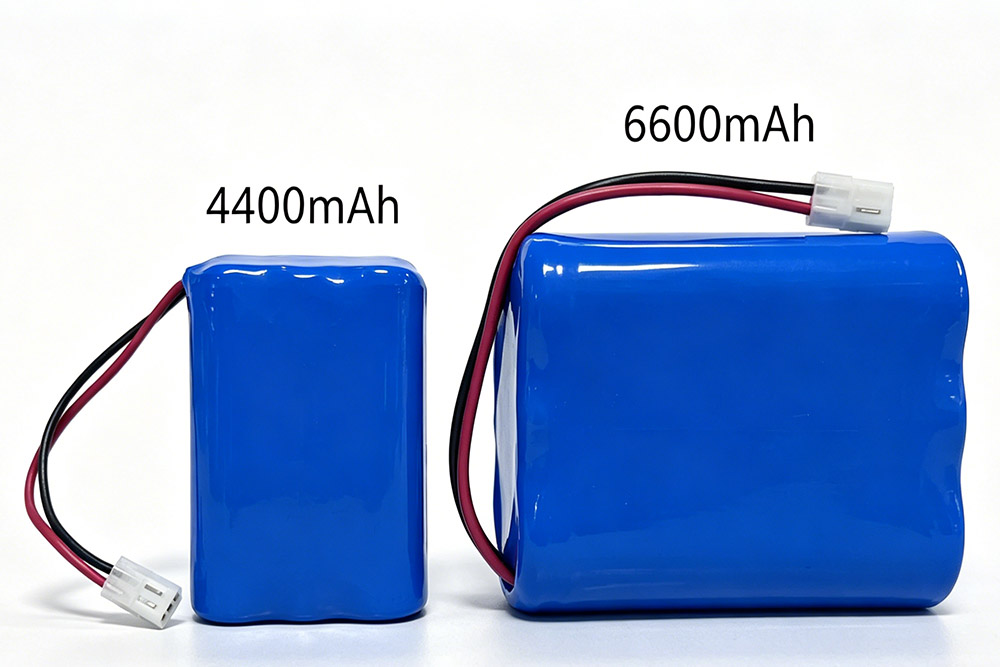
If you’re choosing between a 4400mAh and 6600mAh 12V 18650 battery pack, you’re already past the basic stage.
You’re not asking “what is a lithium battery.”
You’re asking:
Which one actually fits my product better?
This is where many buyers hesitate — because both options look similar on paper, but behave very differently in real use.
Let’s break it down in a practical way.
1. The Real Difference: It’s Not Just Capacity
A typical 4400mAh battery pack like this:3S2P 18650 battery packs
uses a 3S2P structure (6 cells)
While a 6600mAh battery pack is usually:
- 3S3P structure (9 cells)
That means:
- More cells
- More weight
- More space required
- Higher cost
So the decision is not just about “longer runtime” — it’s about whether your product can support it.
2. Runtime Difference (What Buyers Actually Care About)
In theory:
- 4400mAh → baseline runtime
- 6600mAh → ~50% longer
Example:
| Device | 4400mAh | 6600mAh |
|---|---|---|
| CCTV camera | 6–8 hours | 9–12 hours |
| LED lighting | 4–6 hours | 6–9 hours |
But here’s the catch:
Real runtime depends on:
- current draw
- efficiency
- BMS cut-off
So don’t rely only on “mAh number”.
3. Size & Installation: The Most Overlooked Problem
This is where many projects fail.
A 6600mAh battery pack:
- is significantly larger
- may not fit your enclosure
- may require redesign
Typical difference:
- 3S2P → compact rectangular pack
- 3S3P → thicker / longer layout
Many buyers switch to 6600mAh… then realize it doesn’t fit.
4. Cost Difference (What It Really Means for Your Margin)
Typical factory pricing:
- 4400mAh → $9–14
- 6600mAh → $13–20
That’s roughly 30–50% higher cost.
Now multiply that by:
- 500 units
- 1000 units
The difference becomes significant.
So the real question is:
Do you actually need that extra runtime?
5. Which One Fits Your Application?
Choose 4400mAh if:
- Your device is space-limited
- Runtime requirement is moderate
- You need better cost control
- You are producing at scale
Common uses:
- LED lighting
- CCTV backup
- portable electronics
Choose 6600mAh if:
- Longer runtime is critical
- Device size is flexible
- You want fewer charging cycles
- Your product is premium-positioned
Common uses:
- robotics
- outdoor equipment
- medical devices
6. Heat & Stability
More cells = more heat potential.
A 6600mAh pack:
- runs longer
- but also generates more heat if poorly designed
This makes BMS quality even more important.
If you go higher capacity, don’t go cheaper on BMS.

7. A Practical Way to Decide
Instead of guessing, do this:
Ask yourself 3 questions:
- How many hours do I really need?
- Do I have enough space?
- What is my target cost per unit?
If you can answer these, the decision becomes obvious.
Final Thought
Most buyers don’t choose the wrong battery because they don’t understand specs.
They choose wrong because:
- they overestimate runtime needs
- or underestimate size constraints
In many real-world projects:
4400mAh is already enough
6600mAh is only needed in specific cases
Not Sure Which One Fits Your Product?
Send us:
- your device power consumption
- working hours requirement
- available battery space
We’ll recommend the right configuration — and help you avoid redesign costs later.
Related Products
-

12V 4400 mah Lithium ion 3S2P 18650 Battery Pack
-

18650 2000mAh 3.7 volt Lithium-ion Battery
-

18650 20V 3.0Ah Cordless Drill battery
-

18650 22.2V 7.8Ah 2600Mah 6S3P Rechargeable Battery Pack
-

18650 3.7V 10Ah Li-Ion Power Battery Pack
-

18650 3.7V 3300mah Rechargeable Lithium ion Battery
-

18650 7S7P 24V 14Ah Lithium ion Electric Scooter Battery Pack
-

18650 battery 3.7V 1500mAh Lithium-Ion Battery
-

18650 Electric Scooter 48V 13000mAh Lithium Battery
-

2600mAh 3S1P 11.1V 18650 Battery Packs
-

3.7V Li ion Rechargeable 3000mah 18650 Battery Cell
-

36V 5200mAh 10S2P 18650 Battery Pack
-

48v 4400mah 13S2P 18650 Rechargeable Battery Pack
-

7S2P 24V 18650 Lithium Battery Pack
-

Electric Scooter 36V 4400mAH 10S2P 18650 Battery Pack
-

ICR 18650 Battery 2200mah 3.7V
Leave a Reply