
When designing a battery pack for cordless power tools, choosing the right 18650 cell is only the beginning.
A question that often appears during OEM projects is:
“Should we connect more cells in series or add more cells in parallel?”
At first glance, it looks like a simple electrical design choice.
But in real power tools, this decision affects almost everything — tool power, runtime, heat generation, charger design, and even the final product experience.
A battery pack that looks good on paper may behave very differently once it starts driving a grinder or impact wrench on a real job site.
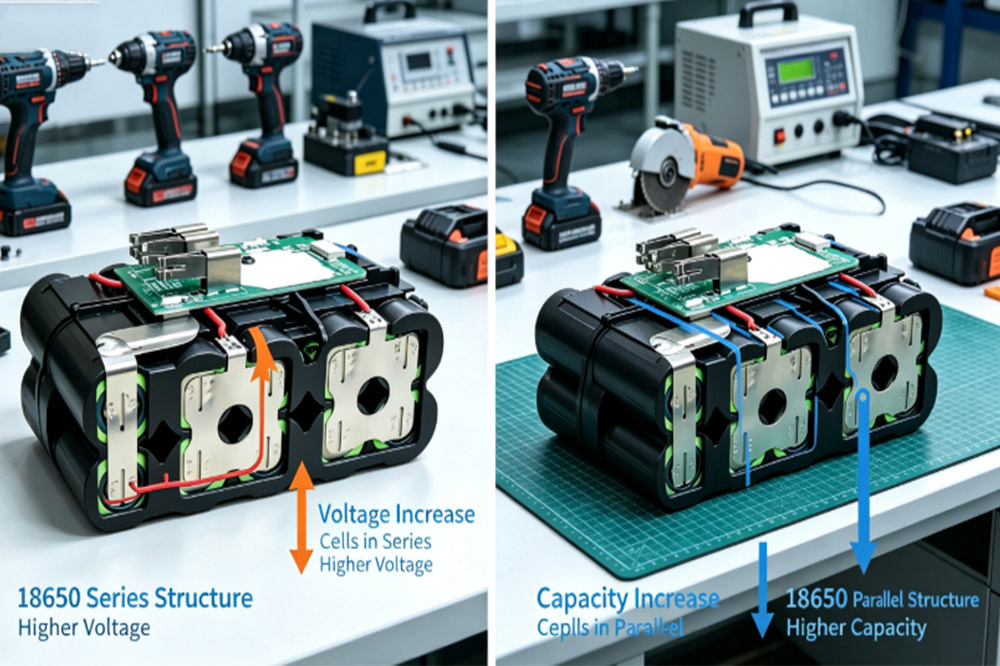
Series connection: increasing voltage for more power
When 18650 cells are connected in series, the voltage increases while the capacity remains similar.
For example:
- 3 cells in series (3S) create a higher voltage pack than a single cell
- 5 cells in series (5S) are commonly used for higher voltage applications
This approach is often used when the tool requires more electrical power.
Many cordless tools need higher voltage systems because motors perform better when they receive enough energy.
Typical applications include:
- Cordless drills
- Impact wrenches
- Angle grinders
- Circular saws
- Heavy-duty maintenance tools
A higher voltage pack allows the motor to achieve stronger torque and better performance.
However, series connection also creates a challenge.
Every cell needs to stay balanced.
If one cell performs differently from the others, the entire pack can be affected.

Parallel connection: increasing capacity and current capability
Parallel connection works differently.
When cells are connected in parallel, voltage stays the same, but capacity increases.
The benefits are usually:
- Longer operating time
- Higher available current
- Reduced stress on individual cells
For example, a battery pack using multiple cells in parallel allows current demand to be shared between cells.
This can help reduce:
- Heat buildup
- Individual cell stress
- Capacity loss over repeated cycles
In heavy-duty tools, parallel configurations are often used when the application requires longer runtime or higher current output.
Why power tool battery packs often use both
In real OEM production, manufacturers rarely choose only series or only parallel.
Most power tool battery packs combine both methods.
A common design is called an S-P configuration:
- Series determines voltage
- Parallel determines capacity and current capability
For example:
A 5S2P pack means:
- 5 groups connected in series
- Each group contains 2 cells connected in parallel
This creates a balance between voltage output, runtime, and discharge capability.
The exact configuration depends on the motor requirements and usage environment.
The tool application decides the battery structure
A battery pack for a small screwdriver and a battery pack for an industrial grinder should not be designed the same way.
Consider these examples:
Cordless screwdriver
The priority is usually:
- Compact size
- Lightweight design
- Moderate runtime
A smaller configuration may be enough.
Impact wrench
The battery needs:
- Strong current output
- Fast response during torque spikes
- Good thermal control
A higher-performance configuration is usually preferred.
Angle grinder
The challenge is different.
The tool may run continuously under heavy load, so the battery needs:
- Stable voltage
- Strong discharge capability
- Effective heat management
This is where pack design becomes more important than simply choosing higher-capacity cells.

Why OEM manufacturers pay attention to cell balance
One thing that is sometimes overlooked in battery projects is consistency between cells.
Imagine a pack with ten 18650 cells.
Nine cells perform normally, but one cell has higher resistance.
During operation, that single weak cell can influence:
- Voltage balance
- Charging efficiency
- Overall pack lifespan
This is why professional battery factories usually perform:
- Capacity testing
- Internal resistance testing
- Cell matching
- Pack cycle testing
A good design starts before assembly begins.
Series vs parallel: what matters for wholesale buyers
For distributors and OEM customers, the important question is not:
“Which configuration is better?”
The better question is:
“What configuration matches the tool?”
A high-voltage pack is not automatically better.
A larger capacity pack is not automatically better.
The correct design depends on:
- Motor power requirements
- Working time
- Current demand
- Weight limitations
- Product positioning
A professional supplier usually starts from the application instead of forcing a standard battery solution.
A practical example from industrial use
Imagine two customers buying cordless tools.
The first customer uses drills for furniture assembly.
The second customer uses impact wrenches for vehicle maintenance.
Both may request an “18V battery.”
But their actual requirements are different.
The assembly worker may prefer lighter weight and longer runtime.
The maintenance technician may need stronger current delivery for repeated high torque operations.
Same voltage.
Different battery design.
Choosing the right 18650 pack design for OEM projects
For power tool manufacturers, battery design is a balance between performance and production reliability.
A successful 18650 battery pack usually combines:
- Correct series/parallel structure
- Suitable discharge cells
- Reliable BMS protection
- Proper thermal design
- Stable manufacturing process
The goal is not simply to fit more cells into a case.
The goal is creating a battery that performs consistently every day.
-

12V 4400 mah Lithium ion 3S2P 18650 Battery Pack
-

18650 2000mAh 3.7 volt Lithium-ion Battery
-

18650 20V 3.0Ah Cordless Drill battery
-

18650 22.2V 7.8Ah 2600Mah 6S3P Rechargeable Battery Pack
-

18650 2600mAh Rechargeable Lithium-Ion Battery 3.7V
-

18650 3.7V 10Ah Li-Ion Power Battery Pack
-

18650 3.7V 3300mah Rechargeable Lithium ion Battery
-

18650 7S7P 24V 14Ah Lithium ion Electric Scooter Battery Pack
-

18650 battery 3.7V 1500mAh Lithium-Ion Battery
-

18650 Battery 3500 mah Rechargeable Battery Cells
-

18650 Electric Scooter 48V 13000mAh Lithium Battery
-

2600mAh 3S1P 11.1V 18650 Battery Packs
-

3.7V Li ion Rechargeable 3000mah 18650 Battery Cell
-

36V 5200mAh 10S2P 18650 Battery Pack
-

48v 4400mah 13S2P 18650 Rechargeable Battery Pack
-

7S2P 24V 18650 Lithium Battery Pack
-

Electric Scooter 36V 4400mAH 10S2P 18650 Battery Pack
-

ICR 18650 Battery 2200mah 3.7V
Leave a Reply