
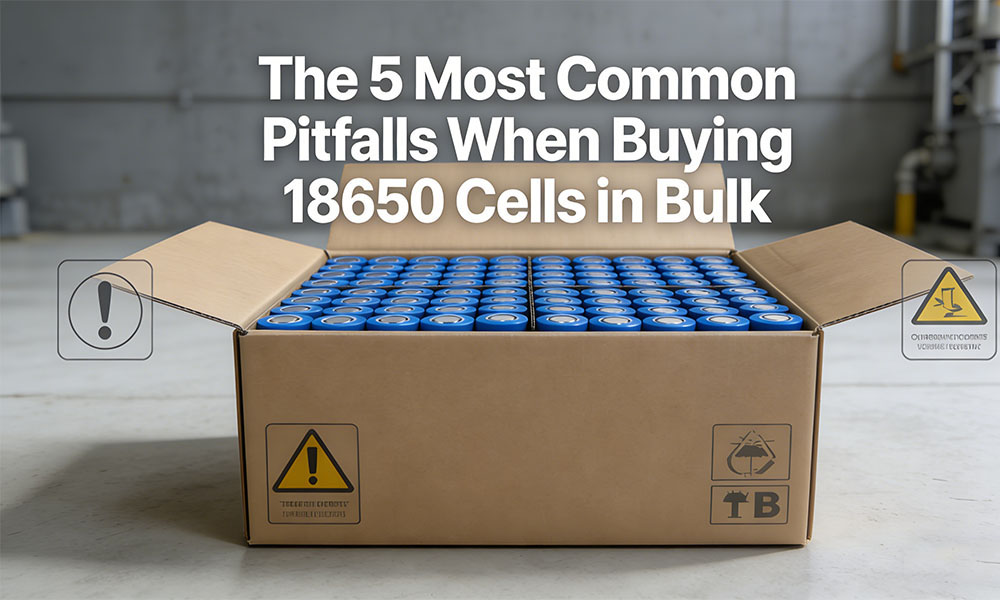
Honestly, the first time I bought 18650 cells in large quantities, I made quite a few mistakes. Some came from lack of experience, some from trusting numbers too easily, and some simply from not understanding how messy this market can be.
These five pitfalls below are the ones I see most often — and they’re also the checkpoints I now review every single time before placing a bulk order.
1. Only Looking at Rated Capacity, Not Real Usable Capacity
A lot of buyers focus on the number printed on the spec sheet. Bigger capacity looks better on paper — simple as that. But once you actually test the cells, reality can be very different.
The capacity itself isn’t the problem. The real question is how that capacity was measured. Was it tested at 0.2C, 0.5C, or 1C? Under different discharge conditions, the usable capacity can vary a lot.
For bulk orders, sample testing or third-party test reports are not optional. Otherwise, a 20–30% gap between rated and actual performance is completely possible.

2. Ignoring Discharge Capability (C-Rate)
Capacity alone doesn’t tell the whole story. Discharge capability matters just as much, especially for applications that need higher current.
You’ll often see high-capacity options like 3000mAh 18650 battery cells:
They look great on paper, but if the C-rate is low, voltage drop under load can be significant. In some cases, protection circuits may even trigger earlier than expected.
The key is matching the cell to the real application. Low-rate, long-runtime devices need something very different from high-power or pulse-load products. Always make that clear to the supplier.
3. Overlooking Cell Consistency
This is a classic mistake — I’ve made it myself. You receive a batch of cells that all look identical on the spec sheet, but once you start building packs, the differences show up.
Capacity spread, internal resistance variation, uneven aging — all of these make pack assembly harder and reduce overall lifespan.
If possible, confirm whether the supplier performs consistency grading. If not, be prepared to do sorting and matching yourself. Poor consistency will cost you time, money, and long-term reliability.

4. Chasing the Lowest Price and Ignoring Supply Stability
18650 pricing fluctuates a lot. It’s tempting to jump on a very cheap offer — for example, a 2000mAh 18650 battery cell like this one:
But cheap pricing often comes with hidden costs:
- Longer-than-promised lead times
- Inconsistent quality between batches
- Substituted models that weren’t agreed on
Bulk purchasing isn’t a one-time deal. It’s an ongoing supply relationship. A stable, reliable supplier is usually worth far more than a slightly lower unit price.
5. Neglecting Safety and Certification Requirements
18650 cells are lithium-ion batteries — safety is non-negotiable. Yet many buyers overlook certifications like UL, UN38.3, or CE.
These certifications aren’t just paperwork. They directly affect transportation, compliance, and downstream sales. If your batteries are going into products that will be resold or exported, missing certifications can turn into serious legal and financial risks.
One incident can push responsibility all the way back through the supply chain — including you.

Final Thoughts
Buying 18650 cells in bulk looks simple on the surface, but the details matter a lot:
- Don’t trust capacity numbers blindly
- Match discharge performance to real use cases
- Consistency is critical for pack quality
- Supplier reliability matters more than short-term savings
- Safety certifications should never be optional
Most of these lessons are learned the hard way. If you can avoid even one of these pitfalls early on, you’ll save yourself a lot of trouble later.
Related Products
-

12V 4400 mah Lithium ion 3S2P 18650 Battery Pack
-

18650 2000mAh 3.7 volt Lithium-ion Battery
-

18650 20V 3.0Ah Cordless Drill battery
-

18650 22.2V 7.8Ah 2600Mah 6S3P Rechargeable Battery Pack
-

18650 2600mAh Rechargeable Lithium-Ion Battery 3.7V
-

18650 3.7V 10Ah Li-Ion Power Battery Pack
-

18650 3.7V 3300mah Rechargeable Lithium ion Battery
-

18650 7S7P 24V 14Ah Lithium ion Electric Scooter Battery Pack
-

18650 battery 3.7V 1500mAh Lithium-Ion Battery
-

18650 Battery 3500 mah Rechargeable Battery Cells
-

18650 Electric Scooter 48V 13000mAh Lithium Battery
-

2600mAh 3S1P 11.1V 18650 Battery Packs
-

3.7V Li ion Rechargeable 3000mah 18650 Battery Cell
-

36V 5200mAh 10S2P 18650 Battery Pack
-

48v 4400mah 13S2P 18650 Rechargeable Battery Pack
-

7S2P 24V 18650 Lithium Battery Pack
-

Electric Scooter 36V 4400mAH 10S2P 18650 Battery Pack
-

ICR 18650 Battery 2200mah 3.7V
Leave a Reply