
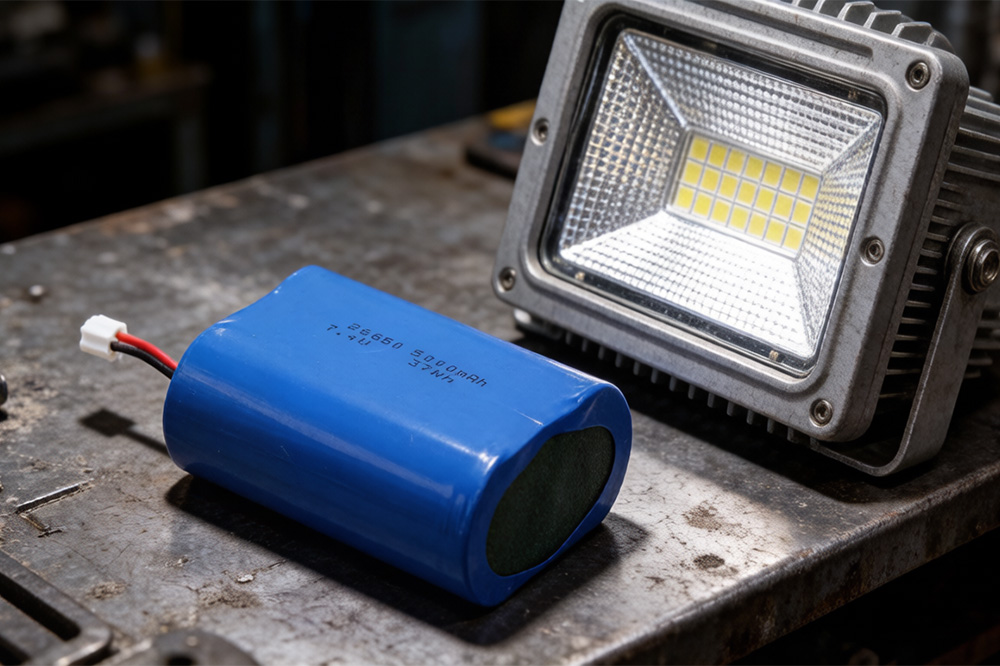
The 26650 rechargeable battery 7.4 volt setup is one of those battery configurations that quietly powers a lot of equipment people use every day without paying much attention to what’s inside.
You’ll see these battery packs in large LED flashlights, portable floodlights, outdoor gear, emergency lighting, and all kinds of custom electronic projects. The reason is pretty simple: they offer more runtime and better power handling than smaller lithium-ion batteries, while still staying portable enough for handheld devices.
For applications that need dependable power over longer periods, 26650 cells have become a solid option.
What Is 7.4V 26650 Battery Pack?
A single 26650 lithium-ion cell normally runs at:
- 3.7V nominal voltage
- 4.2V when fully charged
When two cells are connected in series, the voltage doubles:
- 7.4V nominal voltage
- 8.4V fully charged voltage
This type of setup is commonly called a 2S battery pack.
Most 7.4V 26650 packs also include a protection board to help manage charging and discharging safely.
Depending on the application, the pack may come with:
- JST connectors
- DC plugs
- XT connectors
- Custom wiring
- Heat shrink wrapping or hard casing

Why People Choose 26650 Batteries
The biggest advantage of a 26650 battery is capacity.
Because the cell is physically larger than an 18650, it can store more energy. Many 26650 cells are rated around 5000mAh, which makes a noticeable difference in devices that stay on for long periods.
That’s one reason they’re popular in high-output lighting equipment. A powerful flashlight or floodlight drains batteries fast, and larger cells simply handle that workload better.
Another benefit is thermal performance.
26650 cells generally manage heat more comfortably under sustained load, which helps in devices that run continuously or pull higher current.
Common Uses for 7.4V 26650 Battery Packs
Portable Floodlights and Flashlights
This is probably the most common use case.
Large rechargeable lights need:
- Stable voltage
- Decent runtime
- Reliable discharge performance
A 7.4V 26650 battery pack checks all three boxes.
That’s why many outdoor lighting systems use this setup instead of smaller battery formats.
Outdoor and Emergency Gear
Camping equipment, portable work lights, emergency backup lighting, and mobile power systems often rely on 26650 packs because they last longer between charges.
For people using equipment outdoors, runtime matters more than shaving off a little extra battery weight.
DIY Electronics and Robotics
Hobby builders also like 26650 cells because they can deliver stronger current without needing oversized battery packs.
They’re commonly used in:
- Robotics projects
- Portable electronics
- Embedded systems
- Custom battery builds

Why the 26650 Lithium Battery Is Still Used in High-Power Equipment
Although newer cell formats are becoming more common, the 26650 lithium battery is still widely used in products that need stable power output and long operating time. Its larger size allows it to store more energy than smaller cylindrical cells while handling higher discharge currents in many applications.
You’ll often find a 26650 lithium battery inside battery packs for portable lighting, industrial tools, energy storage equipment, emergency backup systems, and some electric mobility products. For manufacturers, another advantage is that fewer cells are needed to build a battery pack with the same capacity, which can simplify pack design and reduce the number of welding points.
When selecting 26650 cells, experienced buyers usually look beyond the capacity printed on the label. Consistent internal resistance, cycle life, and batch-to-batch quality have a much bigger impact on the finished battery pack. A well-matched group of cells generally delivers more reliable performance than mixing cells with different characteristics, even if their rated capacity appears to be the same.
For OEM projects, it’s also important to choose a supplier that can provide stable production, technical support, and consistent cell specifications over time. This helps avoid unexpected changes during production and keeps battery pack performance consistent from one shipment to the next.
Choosing the Right Rechargeable 26650 Battery for Custom Applications
A rechargeable 26650 battery is a popular choice for manufacturers who need a balance between high capacity, stable output, and long service life. Compared with smaller cylindrical cells, the larger 26650 format provides more internal space for active materials, allowing it to deliver higher energy storage and better heat control during continuous operation.
For OEM projects, selecting the right rechargeable 26650 battery is not only about capacity. Battery suppliers and product designers should also consider discharge performance, cycle life, operating temperature, and battery consistency. A reliable 26650 cell can help improve the performance of applications such as portable power stations, LED lighting systems, electric tools, medical devices, and customized battery packs.
When building a 7.4V battery pack, two 26650 lithium-ion cells are typically connected in series (2S configuration) to achieve the required voltage output. For higher capacity requirements, multiple cells can be combined with proper battery management systems (BMS) to improve safety, charging control, and overall reliability.
For businesses sourcing batteries in bulk, working with an experienced rechargeable 26650 battery manufacturer can simplify the customization process. Professional suppliers can provide different capacities, protection solutions, and pack configurations based on the specific power requirements of the final product.
Runtime Is One of the Main Selling Points
A good 7.4V 26650 battery pack can run noticeably longer than smaller lithium-ion setups.
Of course, runtime depends on the device itself. A high-power floodlight will drain batteries much faster than a small monitoring device.
But in general, higher-capacity 26650 cells reduce how often the device needs charging, which is exactly what most users want.
That’s especially useful for:
- Outdoor work
- Camping
- Emergency equipment
- Long operating sessions
Protection Boards Are Important
Most quality lithium-ion battery packs include a protection circuit, and for good reason.
The board helps prevent:
- Overcharging
- Over-discharging
- Short circuits
- Excessive current draw
Some battery packs also include temperature monitoring to help control heat during charging and use.
It’s one of those features people rarely think about until they buy a low-quality battery pack that doesn’t have proper protection.
Not Every Battery Pack Is Built the Same
This is where a lot of buyers get caught.
Two battery packs may look almost identical online, but internally the quality can be completely different.
Things that usually separate a better pack from a cheap one include:
- Real cell capacity
- Cell matching quality
- Stable welding
- Reliable protection circuitry
- Consistent assembly standards
Some low-cost packs advertise unrealistic capacities that simply don’t match real-world performance.
For that reason, many industrial buyers prefer sourcing from established battery manufacturers instead of buying generic packs with unknown cells.
One example is the 3.7V 5000mAh 26650 Battery, which is commonly used as the core cell for custom 7.4V lithium-ion battery pack configurations.
26650 vs 18650 Batteries
People often compare 26650 and 18650 cells because both are widely used in rechargeable battery packs.
The difference mostly comes down to priorities.
26650 Batteries
- Higher capacity
- Longer runtime
- Better high-drain handling
- Larger physical size
18650 Batteries
- Smaller and lighter
- Easier to fit into compact devices
- More widely available
If runtime and power matter more than compact size, 26650 cells are often the better choice.

Final Thoughts
The reason the 26650 rechargeable battery 7.4 volt format is still widely used comes down to practicality.
It provides a good balance of:
- Runtime
- Stable voltage
- High-drain capability
- Portability
That combination works especially well for lighting equipment, outdoor electronics, and portable systems that need dependable rechargeable power without moving to much larger battery setups.
Extended Reading
If you want a deeper look at 26650 lithium battery performance and applications, this article is worth checking out:
Related Products
-

18650 2200Mah 10S3P 36V 6.6Ah Electric Scooter Lithium Battery
-

18650 2600Mah 10S3P 36V 7.8ah Scooter Battery
-

18650 36V 5.2Ah Electric Bicyle Battery
-

1S2P 3.7V 1600mAh 14500 Lithium Battery
-

2000Mah 18650 Battery Cell 6Ah 36V Scooter Battery
-

21700 3.7V 4800mAh Rechargeable Lithium-Ion Battery
-

3.7V 21700 Rechargeable Lithium Battery Cells 5000mah
-

3.7V 5000mah 26650 Battery
-

32140 LiFePO4 Battery Cell 3.2V – 10000mAh / 15000mAh
-

32700 Lifepo4 3.2V 6000mah Lithium Battery
-

48V 15ah 720wh Ebike Battery
-

60V 21Ah 18650 16S7P E Bike Battery
-

Customized 48V-72V Triangle Ebike Lithium Battery Pack | 52V 30Ah
Leave a Reply