
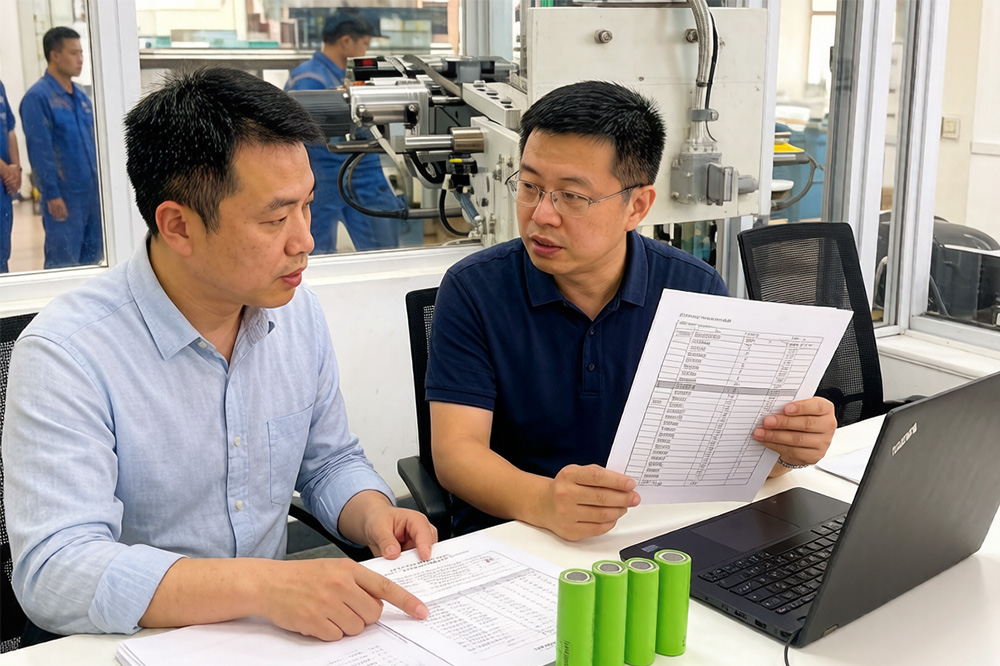
When people start looking for a lithium battery supplier, the first impression is often misleading.
At the beginning, most suppliers look almost identical.
Similar product pages.
Similar specifications.
Even similar pricing structure.
But after a few rounds of communication, things start to feel different.
Some reply fast but stay vague.
Some give low prices but avoid technical questions.
Some look very professional on paper, but the communication doesn’t feel “factory-like”.
It’s hard to explain at first, but the difference becomes more obvious as you go deeper.
18650 battery suppliers: the surface looks standardized, but the reality is not
When you first contact a 18650 battery factory, it may feel like everything is standardized:
- 2000mAh / 2600mAh / 3000mAh options
- clear voltage range
- neat specification sheets
But in real production, consistency is not always the same.
Even under the same “3000mAh label”, suppliers can behave differently:
- some focus on tight batch consistency
- some prioritize cost efficiency over strict sorting
- some mix different internal grades depending on order type
You usually don’t notice this immediately.
It shows up later in real applications.
Choosing a supplier is not really about “lowest price”
Many first-time buyers start with one question:
“What is your price per 18650 cell?”
But after a few real orders, most people realize this is not the main decision point.
Because pricing alone does not reflect:
- internal resistance consistency
- whether A/B grade cells are mixed
- whether proper sorting is actually done
- whether real aging tests are performed before shipment
These details are rarely visible in a simple quotation.
Communication differences that often reveal supplier type
From what I’ve seen, supplier behavior usually falls into a few patterns.
Some suppliers are very technical:
- they can share discharge curves
- they explain grading standards clearly
- they ask about your actual application (tools, storage, mobility, etc.)
Others are more sales-driven:
- specifications are complete but shallow
- pricing is flexible, but testing details are limited
- production explanation stays at a general level
Both can be factories, but they don’t operate the same way.
One thing OEM buyers often underestimate
When the project moves from cells to battery packs (12V / 24V / 48V systems), supplier capability differences become more obvious.
Because at that point, it’s no longer just “selling batteries”.
It becomes a system-level product:
- cell matching and consistency control
- BMS configuration and compatibility
- welding stability (spot welding process)
- structural design (housing, insulation, shock resistance)
Some suppliers are strong in cells but weaker in pack assembly.
Some are the opposite.
This gap is not always visible in early communication.
A common issue: the question is often incomplete
For example:
“How much is your 18650 battery?”
This sounds simple, but factories usually cannot answer it directly without context.
Because they will naturally ask back:
- What application is it for?
- Required discharge rate?
- Single cell or battery pack?
- Any certification requirements?
Without these details, pricing is only an estimate, not a real quotation.
What I personally pay attention to when checking suppliers
Not a strict rule, just observation from many discussions:
- whether they provide real test data instead of only specifications
- whether they can repeat the same quality across batches
- whether they understand application scenarios, not just product names
- whether communication feels engineering-based or purely sales-based
Sometimes you can feel the difference quite early, but it’s not always perfect.

MOQ and cooperation reality
Another practical factor is MOQ (minimum order quantity).
Different suppliers behave differently:
- some support small trial orders but weaker long-term stability
- some focus on steady monthly volume customers
- some are flexible trading-style suppliers
This is not always obvious in early negotiation, but it affects long-term supply stability.
Conclusion
Choosing a lithium battery supplier is less about picking a product, and more about selecting a production system.
Some suppliers are better for sampling and testing stages.
Some are better for long-term OEM production.
Some are better for price-driven markets.
It’s not about right or wrong — it’s about fit.
-

12V 4400 mah Lithium ion 3S2P 18650 Battery Pack
-

18650 2000mAh 3.7 volt Lithium-ion Battery
-

18650 20V 3.0Ah Cordless Drill battery
-

18650 22.2V 7.8Ah 2600Mah 6S3P Rechargeable Battery Pack
-

18650 2600mAh Rechargeable Lithium-Ion Battery 3.7V
-

18650 3.7V 10Ah Li-Ion Power Battery Pack
-

18650 3.7V 3300mah Rechargeable Lithium ion Battery
-

18650 7S7P 24V 14Ah Lithium ion Electric Scooter Battery Pack
-

18650 battery 3.7V 1500mAh Lithium-Ion Battery
-

18650 Battery 3500 mah Rechargeable Battery Cells
-

18650 Electric Scooter 48V 13000mAh Lithium Battery
-

2600mAh 3S1P 11.1V 18650 Battery Packs
-

3.7V Li ion Rechargeable 3000mah 18650 Battery Cell
-

36V 5200mAh 10S2P 18650 Battery Pack
-

48v 4400mah 13S2P 18650 Rechargeable Battery Pack
-

7S2P 24V 18650 Lithium Battery Pack
-

Electric Scooter 36V 4400mAH 10S2P 18650 Battery Pack
-

ICR 18650 Battery 2200mah 3.7V
Leave a Reply