
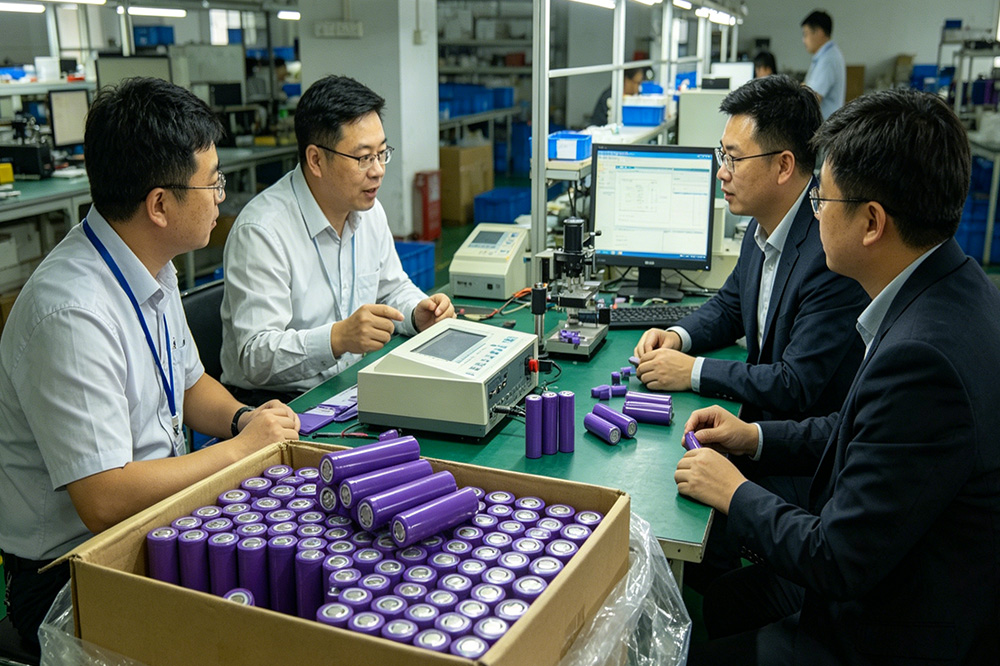
There’s a pattern I keep seeing in conversations with buyers—especially those coming in with a “first China sourcing experience.”
At the beginning, they usually ask very direct things:
- “What’s your capacity?”
- “What’s your price per cell?”
- “Can it handle power tools?”
But after one or two rounds of samples, the questions shift. Quietly, almost without noticing, they start asking things like:
- “Why does this batch feel slightly different?”
- “Can we reduce variation next time?”
- “Is this discharge curve stable under load?”
That shift is actually the real story behind sourcing 18650 batteries from China.
Not the spec sheet. The behavior after scale.
China suppliers are not “one type”—this is where many buyers misread the market
A common misunderstanding (especially in early sourcing guides) is treating “China 18650 suppliers” as a single category.
In reality, it’s closer to layers:
- raw cell manufacturers
- pack assembly factories
- trading companies with mixed sourcing
- niche factories focusing on high-drain cells for tools or EV use
On paper, they may all offer “18650 cells for power tools.”
But what they actually control is very different.
Some control production consistency.
Some control only packaging.
Some rely heavily on upstream cell sourcing and sorting.
This is where first-time buyers often feel confused: the samples look fine, but bulk shipment behaves differently.
Not always worse—just less predictable.

The uncomfortable truth about “cheap cells”
In buyer communities and sourcing discussions, there’s a repeating debate that never fully settles:
Are low-cost 18650 cells worth it for power tools?
The answer usually depends on what failure means for you.
Because in real usage:
- a cheap cell might still “work”
- but it may lose stability under repeated high load
- or show uneven performance in multi-cell packs
- or degrade faster in real working environments
What makes this tricky is that early testing often looks fine. Voltage, capacity, even short discharge tests can pass.
But once tools are used continuously—construction sites, outdoor work, long torque cycles—that’s where differences show up.
So buyers don’t usually fail at purchase stage.
They fail at “field behavior stage.”
Supplier selection is less about “best factory” and more about control level
Many guides suggest choosing suppliers based on certification, production scale, or catalog range.
In practice, experienced buyers look at something slightly different:
how tightly the supplier controls consistency.
Not just:
- capacity range
- discharge rating
- chemistry type
But more like:
- internal resistance grouping ability
- batch-to-batch stability
- how samples are selected (random or pre-sorted)
- whether they can match cells for pack assembly
One buyer once described it like this (not exact quote, but close to the sentiment):
“I don’t need perfect cells. I need cells that behave the same way every time I reorder.”
That line probably explains the entire China sourcing experience better than most guides.

A small but important detail: power tool batteries are unforgiving
Power tools don’t behave like storage systems or low-drain devices.
They create sudden, uneven loads:
- start-stop torque bursts
- partial discharge cycles
- heat accumulation inside compact packs
This is why two 3000mAh cells can feel completely different in real use.
One may hold voltage steady under load.
The other drops slightly, enough that users feel “less power.”
Not a failure, just a different curve.
And users rarely describe it in technical terms—they just say:
“It feels weaker after a while.”
Ordering from China: what experienced buyers quietly change in their process
At some point, buyers who have done a few shipments usually adjust their workflow without announcing it:
- they start asking for smaller pilot batches
- they test cells under real tool load instead of lab-only testing
- they request tighter internal resistance grouping
- they compare not just samples, but random units from bulk cartons
And maybe most importantly:
they stop trusting “single sample approval.”
Because one perfect sample doesn’t guarantee batch behavior.
This is something that’s not always emphasized in guides, but becomes obvious after the first scaling issue.
The factory visit moment
There’s a familiar scene that happens during supplier visits:
Everything looks solid on paper. Equipment is fine. Packaging is neat. Staff is confident.
Then a buyer asks:
“Can we test random cells from three different boxes?”
That moment usually reveals more than any datasheet.
Sometimes results are consistent. Sometimes not perfectly aligned. And sometimes variation appears only when you test deeper batches.
That’s when sourcing decisions become less emotional and more structural.
Why “supplier trust” in China often means “process transparency”
One thing that stands out across experienced buyer discussions is this:
Trust is rarely about brand or size.
It’s about whether the supplier can explain:
- how cells are graded
- how consistency is maintained
- how defective units are handled
- how batches are separated or mixed
If answers are vague, buyers usually feel it later in production.
If answers are specific—even if not perfect—buyers tend to stay longer.
It’s not about perfection. It’s about traceability.

A realistic scenario: what goes wrong is rarely what you expect
Imagine this situation:
A buyer orders 18650 cells for power tool packs. Samples test fine. First shipment passes basic inspection.
But after assembly:
- a portion of packs runs slightly uneven
- some tools heat faster than expected
- runtime varies across batches
Nothing is dramatically broken. But performance inconsistency appears.
When traced back, the issue is often not chemistry—but mixing of slightly different internal resistance groups.
This is subtle enough that it rarely shows in early checks.
But obvious enough in real usage.
Conclusion
After working with multiple China suppliers, most buyers don’t end up searching for “best cell” anymore.
They start searching for:
- stable sourcing process
- repeatable batch behavior
- predictable discharge performance
- controlled variation across shipments
And that shift usually changes how they evaluate suppliers entirely.
If you are currently comparing 18650 power tool battery suppliers in China, it may help to slightly change the question you’re asking.
Not “who is the cheapest?”
but “who can keep the performance consistent when I scale?”
Because in real production, scaling is where most surprises show up.
-

12V 4400 mah Lithium ion 3S2P 18650 Battery Pack
-

18650 2000mAh 3.7 volt Lithium-ion Battery
-

18650 20V 3.0Ah Cordless Drill battery
-

18650 22.2V 7.8Ah 2600Mah 6S3P Rechargeable Battery Pack
-

18650 2600mAh Rechargeable Lithium-Ion Battery 3.7V
-

18650 3.7V 10Ah Li-Ion Power Battery Pack
-

18650 3.7V 3300mah Rechargeable Lithium ion Battery
-

18650 7S7P 24V 14Ah Lithium ion Electric Scooter Battery Pack
-

18650 battery 3.7V 1500mAh Lithium-Ion Battery
-

18650 Battery 3500 mah Rechargeable Battery Cells
-

18650 Electric Scooter 48V 13000mAh Lithium Battery
-

2600mAh 3S1P 11.1V 18650 Battery Packs
-

3.7V Li ion Rechargeable 3000mah 18650 Battery Cell
-

36V 5200mAh 10S2P 18650 Battery Pack
-

48v 4400mah 13S2P 18650 Rechargeable Battery Pack
-

7S2P 24V 18650 Lithium Battery Pack
-

Electric Scooter 36V 4400mAH 10S2P 18650 Battery Pack
-

ICR 18650 Battery 2200mah 3.7V
Leave a Reply