
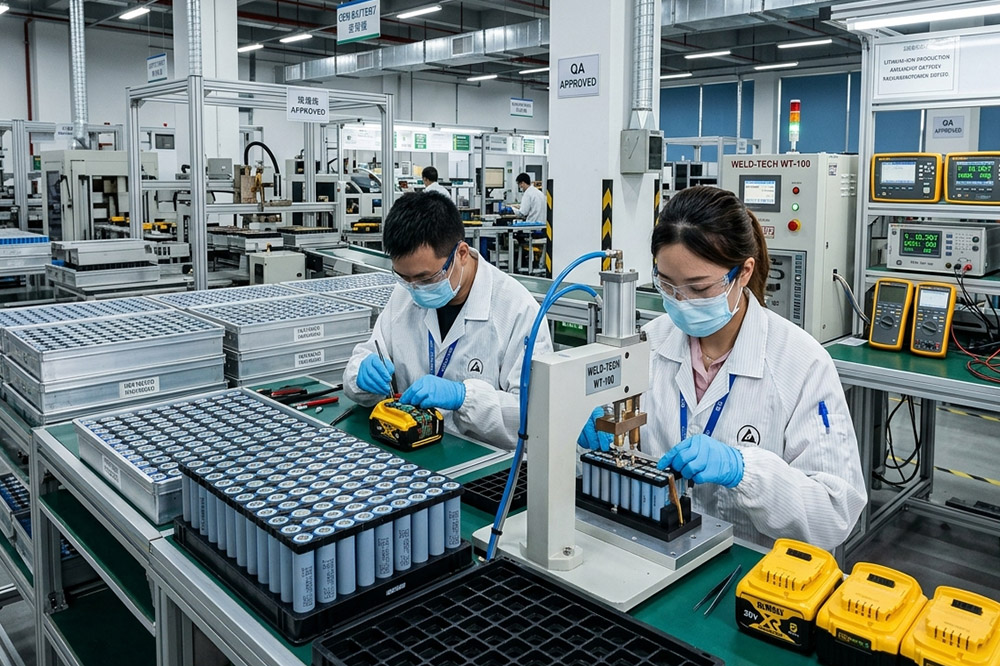
When customers ask about 18650 power tool battery pack, many only focus on the final specifications:
“Is it 18V?”
“How many Ah?”
“What is the discharge current?”
These numbers are important, but they do not tell the whole story.
A battery pack used in a cordless drill, impact wrench, or grinder goes through many steps before it reaches the market. From selecting individual 18650 cells to final aging tests, every process can influence the final performance.
After seeing different battery projects, one thing becomes clear: two battery packs with the same voltage and capacity can perform very differently in real applications.
The difference often comes from the manufacturing process.
The Process Starts Before Assembly: Selecting 18650 Cells
Inside a battery factory, production does not begin with welding.
It starts with cell inspection.
For power tool applications, manufacturers usually do not randomly pick 18650 cells from inventory. Each cell needs to match the requirements of the application.
The factory team normally checks:
- Cell capacity
- Internal resistance
- Voltage consistency
- Discharge performance
- Physical appearance
This step sounds simple, but it matters a lot.
Imagine hundreds of cells connected inside a battery pack. If one cell has different characteristics from the others, it may affect the entire pack performance.
For high-power tools, especially grinders or professional drills, consistency between cells is often more important than chasing the highest capacity number.

Cell Sorting: A Step Many Buyers Do Not See
After incoming inspection, qualified cells enter the sorting process.
A professional battery factory usually groups cells with similar performance together.
For example, if a customer needs a 10S3P battery pack, the factory needs to make sure the 30 cells inside the pack work together properly.
Poor matching can create problems later:
- Uneven charging
- Reduced runtime
- Faster capacity loss
- Battery protection triggering earlier
In some lower-cost production environments, this step may receive less attention because it increases labor time.
However, for OEM customers who care about product reliability, this is where manufacturing experience becomes valuable.
Building the 18650 Battery Pack Structure
Once the cells are prepared, the assembly process begins.
Workers or automated machines arrange the 18650 cells according to the required battery design.
Common configurations include:
- 5S2P
- 7S3P
- 10S3P
- 13S4P
The “S” represents cells connected in series to increase voltage.
The “P” represents cells connected in parallel to increase capacity and current capability.
The battery structure depends on the tool requirement.
A compact handheld screwdriver may need a lightweight design.
A heavy-duty construction tool may require more parallel cells to handle higher current demand.
There is usually no single “best” configuration. The right design depends on how the tool will actually be used.

Spot Welding: Connecting Cells Without Damaging Them
One of the most important steps in 18650 battery production is spot welding.
Unlike traditional soldering, spot welding uses controlled electrical pulses to connect nickel strips to battery terminals.
Why is this important?
Because excessive heat can damage lithium cells.
A good welding process needs to balance:
- Strong electrical connection
- Low resistance
- Minimal heat impact
- Reliable mechanical strength
For power tool batteries, connection quality directly affects current flow.
When a tool suddenly demands high power, weak connections may create additional resistance and generate unnecessary heat.
Installing the BMS Protection System
After the cells are connected, the battery management system (BMS) is installed.
The BMS works like the battery’s control center.
It monitors:
- Overcharge protection
- Over-discharge protection
- Short circuit protection
- Temperature protection
- Cell balancing
For simple consumer products, a basic BMS may be enough.
But power tool batteries often experience strong current changes, so the BMS design needs to match the application.
A battery pack designed for a drill motor is different from one designed for a low-power electronic device.
Quality Testing Before Shipment
Before leaving the factory, every battery pack should go through testing.
Typical tests include:
Charging Test
The battery is charged to check voltage stability and charging performance.
Discharge Test
The factory checks whether the battery can deliver the expected current output.
Protection Test
The BMS functions are tested under different conditions.
Aging Test
Some battery packs are stored and monitored for a period of time to confirm stability.
In real production, this stage sometimes reveals issues that cannot be found during assembly.
A battery may look perfect outside but show abnormal behavior during charging or high-current discharge.

Why OEM Buyers Need More Than a Battery Supplier
For companies developing cordless tools, the battery is not just an accessory.
It affects:
- Product performance
- Customer experience
- Warranty rate
- Brand reputation
A battery supplier should understand the complete product requirement, not only provide cells.
For example, an OEM customer developing a new cordless drill may need:
- Custom voltage design
- Specific battery size
- High discharge cells
- Customized connectors
- BMS programming
- Certification support
This is why many tool manufacturers prefer working directly with battery pack factories instead of buying standard batteries.
Choosing the Right 18650 Battery Manufacturing Partner
A reliable 18650 power tool battery factory is not only measured by production capacity.
Manufacturing experience, quality control process, engineering support, and customization ability are equally important.
A good supplier can help customers avoid common problems such as:
- Insufficient runtime
- Battery overheating
- Unstable discharge
- Short cycle life
From prototype samples to mass production, battery development is usually a process of adjustment and improvement.
The first design is not always perfect. But with proper testing and engineering communication, the final battery pack can match the real working environment much better.
-

12V 4400 mah Lithium ion 3S2P 18650 Battery Pack
-

18650 2000mAh 3.7 volt Lithium-ion Battery
-

18650 20V 3.0Ah Cordless Drill battery
-

18650 22.2V 7.8Ah 2600Mah 6S3P Rechargeable Battery Pack
-

18650 2600mAh Rechargeable Lithium-Ion Battery 3.7V
-

18650 3.7V 10Ah Li-Ion Power Battery Pack
-

18650 3.7V 3300mah Rechargeable Lithium ion Battery
-

18650 7S7P 24V 14Ah Lithium ion Electric Scooter Battery Pack
-

18650 battery 3.7V 1500mAh Lithium-Ion Battery
-

18650 Battery 3500 mah Rechargeable Battery Cells
-

18650 Electric Scooter 48V 13000mAh Lithium Battery
-

2600mAh 3S1P 11.1V 18650 Battery Packs
-

3.7V Li ion Rechargeable 3000mah 18650 Battery Cell
-

36V 5200mAh 10S2P 18650 Battery Pack
-

48v 4400mah 13S2P 18650 Rechargeable Battery Pack
-

7S2P 24V 18650 Lithium Battery Pack
-

Electric Scooter 36V 4400mAH 10S2P 18650 Battery Pack
-

ICR 18650 Battery 2200mah 3.7V
Leave a Reply