
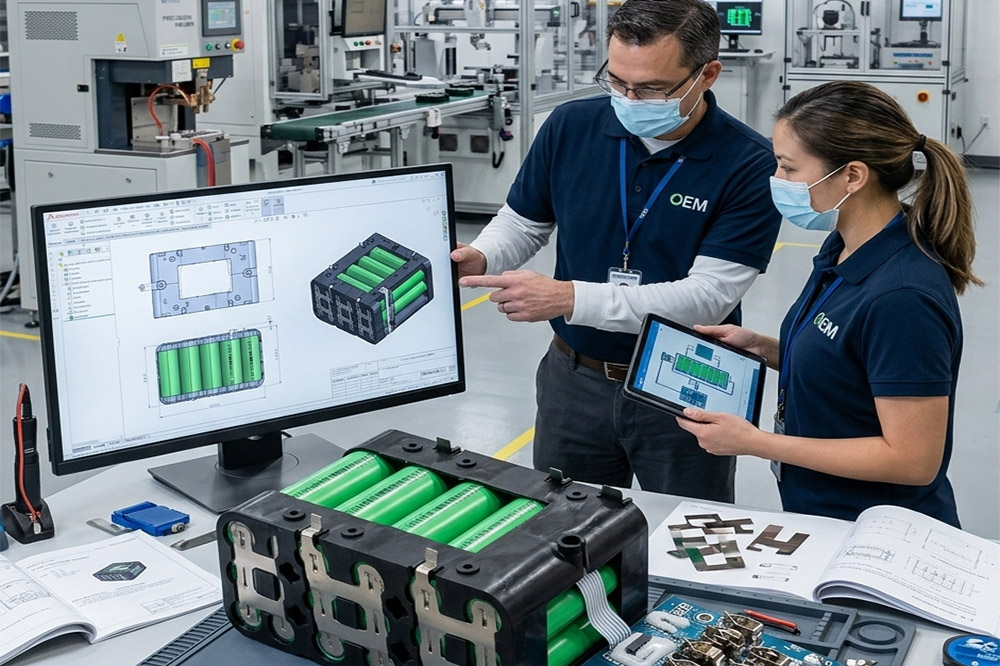
When power tool company starts developing a new cordless product, the battery is often one of the parts that creates the most discussion.
At first, many customers think the battery choice is simple:
“Find a few 18650 cells, connect them together, and put them inside the housing.”
In reality, it is not that straightforward.
A battery pack that works well in a small screwdriver may not perform well in a high-torque impact wrench. A pack that provides long runtime in testing may overheat when used continuously on a construction site.
This is why more tool manufacturers are looking for OEM/ODM 18650 battery pack solutions instead of using standard replacement batteries.
The battery needs to match the tool, not the other way around.
Understanding OEM and ODM Battery Pack Development
In battery manufacturing, OEM and ODM are often mentioned together, but they represent different cooperation methods.
OEM usually means the customer provides the product requirements, while the battery manufacturer produces according to those specifications.
ODM goes further.
The battery supplier may help with:
- Battery structure design
- Cell selection
- Electrical solution
- BMS development
- Prototype improvement
For companies entering a new power tool market, ODM support can save a lot of development time.
Sometimes customers already know the voltage and size they need, but they are unsure about which cells or configuration can achieve the expected performance.
That is where battery engineering experience becomes useful.

Selecting the Right 18650 Cells for Power Tools
Not every 18650 cell is suitable for power tools.
This is one of the most common misunderstandings we see.
Power tools require high current output because motors can suddenly demand large amounts of energy.
For example, a drill may work normally while tightening screws, but when drilling into harder materials, current demand increases quickly.
A suitable power tool battery pack usually needs:
- High discharge capability
- Low internal resistance
- Stable voltage output
- Long cycle life
Some customers initially focus only on capacity.
They ask:
“Can we use a higher mAh cell to make the battery last longer?”
Sometimes yes, but not always.
A higher capacity cell designed for low-current applications may not deliver the same experience as a slightly lower capacity high-drain cell.
Battery selection is always about balance.
Custom Battery Configuration Based on Tool Requirements
Different power tools need different battery structures.
Common 18650 battery pack configurations include:
- 3S2P
- 5S3P
- 7S3P
- 10S4P
- 13S3P
The series connection determines voltage.
The parallel connection affects capacity and current output.
For example:
A compact cordless screwdriver may need a lightweight 12V battery pack.
A professional grinder may require a higher voltage design with more parallel cells to handle heavy loads.
There is no universal battery solution.
A good design considers:
- Motor power
- Working time
- Battery size limitation
- Product weight
- Charging requirements
Sometimes adding more cells improves runtime, but it also makes the tool heavier. For portable tools, that trade-off matters.

BMS Design: The Part That Controls Battery Safety
Inside every reliable lithium battery pack, the BMS plays an important role.
It is not just a protection board.
A properly designed BMS helps manage:
- Overcharging
- Over-discharging
- Overcurrent protection
- Temperature monitoring
- Cell balancing
For power tools, current protection settings are especially important.
If the protection limit is too low, the battery may shut down during heavy work.
If the protection design is not suitable, the battery may experience unnecessary stress.
During OEM projects, battery engineers usually adjust BMS parameters according to the actual tool performance.
A drill, a saw, and a garden tool may all use 18V batteries, but their working conditions are different.
From Prototype Samples to Mass Production
Most custom battery projects do not go directly from drawing to thousands of units.
Usually, the process includes:
Prototype Stage
The battery factory builds sample packs according to the customer’s requirements.
Engineers check:
- Size compatibility
- Connector position
- Performance
- Charging behavior
Testing Stage
The battery pack goes through:
- Charge and discharge testing
- High current testing
- Temperature testing
- Cycle testing
Mass Production
After approval, production begins with controlled manufacturing processes.
In real projects, small adjustments often happen during this stage.
For example, a customer may find that the battery fits perfectly but the heat distribution needs improvement.
These details are difficult to predict only from drawings.

Why Power Tool Brands Choose Custom Battery Manufacturers
For many tool companies, the battery is directly connected to their product reputation.
A poor battery experience can affect customer reviews even if the tool itself works well.
Common problems caused by unsuitable batteries include:
- Short working time
- Sudden shutdown
- Excessive heat
- Reduced battery life
Working with an experienced OEM/ODM battery manufacturer allows companies to develop batteries that fit their products from the beginning.
A custom solution can include:
- 18650 cell selection
- Battery pack structure
- BMS customization
- Connector design
- Housing design
- Certification support
This is especially valuable for brands developing new cordless tools or replacing older battery platforms.
Choosing OEM/ODM 18650 Battery Partner
The cheapest battery pack is not always the lowest-cost solution.
A battery problem after mass production can create much higher costs through returns, warranty claims, and customer complaints.
When choosing a battery supplier, companies usually look beyond price.
Important factors include:
- Engineering support
- Production capability
- Quality control system
- Testing process
- Customization experience
A reliable battery partner should understand both lithium battery technology and the application environment.
Because in the end, the battery is not only a power source.
It is part of the tool’s performance.
-

12V 4400 mah Lithium ion 3S2P 18650 Battery Pack
-

18650 2000mAh 3.7 volt Lithium-ion Battery
-

18650 20V 3.0Ah Cordless Drill battery
-

18650 22.2V 7.8Ah 2600Mah 6S3P Rechargeable Battery Pack
-

18650 2600mAh Rechargeable Lithium-Ion Battery 3.7V
-

18650 3.7V 10Ah Li-Ion Power Battery Pack
-

18650 3.7V 3300mah Rechargeable Lithium ion Battery
-

18650 7S7P 24V 14Ah Lithium ion Electric Scooter Battery Pack
-

18650 battery 3.7V 1500mAh Lithium-Ion Battery
-

18650 Battery 3500 mah Rechargeable Battery Cells
-

18650 Electric Scooter 48V 13000mAh Lithium Battery
-

2600mAh 3S1P 11.1V 18650 Battery Packs
-

3.7V Li ion Rechargeable 3000mah 18650 Battery Cell
-

36V 5200mAh 10S2P 18650 Battery Pack
-

48v 4400mah 13S2P 18650 Rechargeable Battery Pack
-

7S2P 24V 18650 Lithium Battery Pack
-

Electric Scooter 36V 4400mAH 10S2P 18650 Battery Pack
-

ICR 18650 Battery 2200mah 3.7V
Leave a Reply