
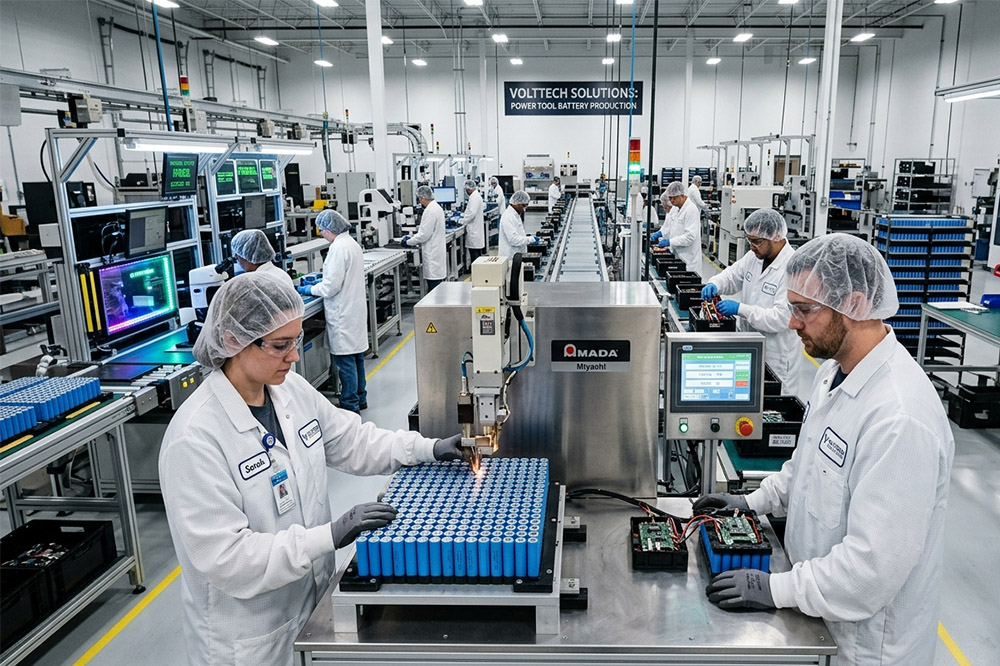
When people buy cordless drill or professional power tool, they usually see only the finished battery pack. The plastic housing, the charging port, and the battery indicator are the parts visible to users.
But inside that compact battery pack are dozens of small decisions made during manufacturing.
The choice of 18650 cells, welding method, BMS design, temperature control, and testing process all affect how the battery performs after months of use.
Walking through a 18650 battery factory, you quickly notice that battery production is not simply putting cells together. A good battery pack needs engineering control at every stage.
For power tool manufacturers and distributors, understanding this process helps when choosing a reliable OEM battery supplier.
It Starts With Battery Cell Selection, Not Assembly
Before production begins, the factory needs to confirm which 18650 battery cells match the application.
This step is often underestimated.
A power tool battery used for a home screwdriver has different requirements from a professional impact wrench used on a construction site.
For example, a high-torque tool may require:
- Higher discharge current
- Lower internal resistance
- Better heat control
- Stable voltage under heavy load
A battery factory usually evaluates cell parameters such as capacity, discharge rate, cycle life, and consistency between individual cells.
In real projects, customers sometimes request “the highest mAh battery.” However, the highest capacity cell is not always the best choice.
A 3500mAh cell may provide longer runtime in light applications, while a high-drain 2500mAh or 3000mAh cell could perform better in a tool that suddenly demands high current.
The final choice depends on how the tool is actually used.

Cell Sorting: Small Differences Matter
After the cells arrive at the factory, they are usually tested and sorted.
At first glance, hundreds or thousands of 18650 cells may look exactly the same. But small differences in voltage, resistance, and capacity can affect the finished battery pack.
Imagine assembling a team where every person has slightly different speed and strength. The result may still work, but the performance will not be consistent.
Battery packs work in a similar way.
Factories often group cells with similar characteristics together before assembly.
This helps improve:
- Battery balance
- Charging efficiency
- Pack lifespan
- Overall reliability
For customers ordering custom battery packs, cell matching is one of the hidden details that separates a professional manufacturer from a simple assembler.
Building the Battery Pack: From Individual Cells to Power System
Once the cells are prepared, production moves into the assembly stage.
The 18650 cells are arranged according to the required voltage and capacity.
For example:
- Series connection increases voltage
- Parallel connection increases capacity and current capability
A 5S battery pack, for example, uses five cell groups connected in series to achieve a higher voltage output.
A power tool manufacturer may require an 18V, 24V, or 36V battery solution depending on the motor design.
After the arrangement is confirmed, nickel strips are welded onto the cells.
Most professional factories use spot welding instead of traditional soldering because direct heat can damage lithium cells.
During this process, workers and machines monitor welding strength carefully. Weak welding points may create resistance problems later, while excessive welding force can damage the cell surface.

Adding the BMS: The Battery’s Protection System
The Battery Management System, usually called BMS, is one of the most important components inside a lithium battery pack.
Many people think the cells are the whole battery. Actually, the BMS plays a major role in safety and performance.
A BMS controls:
- Overcharge protection
- Over-discharge protection
- Over-current protection
- Temperature monitoring
- Cell balancing
For power tools, current protection settings need careful adjustment.
If the protection is too sensitive, the tool may stop during heavy operation even though the battery still has energy remaining.
If protection is too weak, the battery may face unnecessary stress.
This is why experienced battery manufacturers usually test the battery together with the actual power tool application.
Battery Pack Housing and Final Assembly
After the electrical parts are completed, the battery pack moves to the housing assembly stage.
The factory installs:
- Outer plastic shell
- Connectors
- Battery indicator
- Labels
- Screws or locking structures
For power tools, mechanical design is also important.
A battery pack may experience vibration, impact, dust, and temperature changes during daily use.
A battery that performs well in a laboratory but fails after repeated drops is not a successful product.
Some OEM customers spend more time testing the housing structure than expected because durability directly affects customer reviews.
Testing Before Shipment: The Stage That Cannot Be Skipped
Before leaving the factory, each battery pack needs quality inspection.
Common tests include:
Voltage Testing
Checking whether the battery output matches the design specification.
Capacity Testing
Confirming whether the battery can deliver the expected energy.
Charging Test
Ensuring the battery communicates correctly with the charger.
Discharge Test
Checking performance under real working conditions.
Safety Inspection
Looking for abnormal temperature rise, protection failures, or assembly issues.
For bulk orders, factories normally perform sampling tests and production monitoring.
A reliable supplier should be able to provide test reports and certification documents when required.

A Real Production Difference Customers Usually Notice
From the outside, two battery suppliers may offer similar 18650 battery packs.
The appearance can be almost identical.
But after several months of use, differences appear.
One battery may lose capacity quickly, heat up during operation, or have inconsistent charging performance.
Another battery may continue working normally because the manufacturer controlled the details during cell selection, welding, and testing.
This is why many professional power tool companies do not choose suppliers only based on price.
The battery becomes part of their brand reputation.
Choosing 18650 Battery Factory for OEM Projects
For companies looking for wholesale or custom power tool batteries, several questions are worth asking:
- Does the factory support custom battery pack design?
- Can they recommend suitable 18650 cells?
- Do they test battery packs under load conditions?
- Can they provide certifications such as UN38.3, CE, RoHS, or UL-related documents?
- Do they have experience with power tool applications?
A capable battery manufacturer should work as an engineering partner, not only as a production supplier.
For new power tool projects, the battery design stage is often where future product performance is decided.
Conclusion
A 18650 power tool battery factory is not just a place where cells are assembled together.
Behind every battery pack are many small processes: selecting the right cells, matching performance, controlling welding quality, installing protection systems, and testing before shipment.
For OEM buyers, importers, and power tool brands, choosing the right manufacturing partner can make a significant difference in product reliability and customer satisfaction.
A good battery is built long before it reaches the tool.
-

12V 4400 mah Lithium ion 3S2P 18650 Battery Pack
-

18650 2000mAh 3.7 volt Lithium-ion Battery
-

18650 20V 3.0Ah Cordless Drill battery
-

18650 22.2V 7.8Ah 2600Mah 6S3P Rechargeable Battery Pack
-

18650 2600mAh Rechargeable Lithium-Ion Battery 3.7V
-

18650 3.7V 10Ah Li-Ion Power Battery Pack
-

18650 3.7V 3300mah Rechargeable Lithium ion Battery
-

18650 7S7P 24V 14Ah Lithium ion Electric Scooter Battery Pack
-

18650 battery 3.7V 1500mAh Lithium-Ion Battery
-

18650 Battery 3500 mah Rechargeable Battery Cells
-

18650 Electric Scooter 48V 13000mAh Lithium Battery
-

2600mAh 3S1P 11.1V 18650 Battery Packs
-

3.7V Li ion Rechargeable 3000mah 18650 Battery Cell
-

36V 5200mAh 10S2P 18650 Battery Pack
-

48v 4400mah 13S2P 18650 Rechargeable Battery Pack
-

7S2P 24V 18650 Lithium Battery Pack
-

Electric Scooter 36V 4400mAH 10S2P 18650 Battery Pack
-

ICR 18650 Battery 2200mah 3.7V
Leave a Reply