
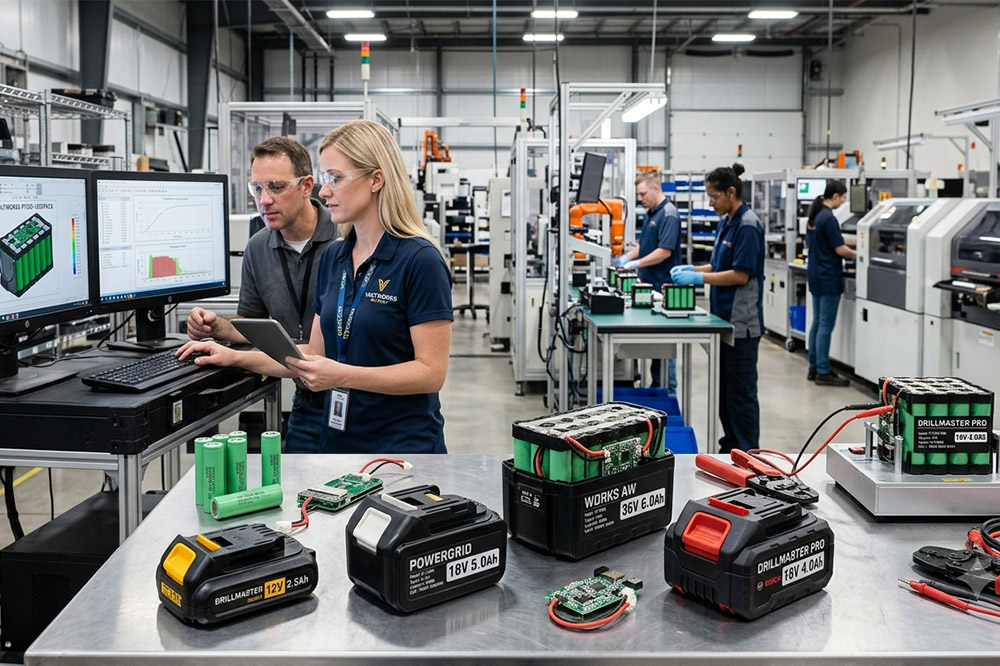
When power tool company starts developing a new product, the battery is often one of the parts that creates the most challenges.
The motor may already be ready. The housing design may already be finished. But when the first prototype battery is installed, problems can appear quickly.
The tool may lose power under heavy load. The battery may become too hot. The runtime may not match the marketing claim.
This is why many professional tool manufacturers do not simply buy standard batteries. They look for an OEM/ODM 18650 battery pack supplier who can adjust the battery design according to their actual product requirements.
A good battery solution is not only about putting more cells inside a plastic case. It is about matching the battery with the tool.
Why Power Tool Companies Choose Custom 18650 Battery Packs
18650 cells have been used in power tools for many years, and there is a reason they remain popular.
They offer a practical balance between:
- Energy density
- Discharge performance
- Cost control
- Supply availability
- Flexible pack design
For an OEM customer, this flexibility matters.
A company producing cordless drills may need an 18V battery pack with a compact size. Another customer developing industrial cutting tools may need a higher current 36V solution.
Both products may use 18650 battery cells, but the battery design will be completely different.
From a manufacturing perspective, one battery configuration rarely fits every application.
The Custom Battery Design Process Starts With the Tool
Before recommending a battery pack, experienced suppliers usually ask questions about the application.
Not only:
“How many mAh do you need?”
More important questions include:
- What is the motor voltage?
- What is the peak current?
- How long does the tool work continuously?
- What environment will it be used in?
- Does the battery need communication with the tool?
- What size limitations does the housing have?
For example, a customer producing cordless impact wrenches may focus on maximum torque output.
In this case, choosing a high discharge 18650 cell may be more important than selecting the highest capacity option.
On the other hand, a lightweight screwdriver used by technicians all day may need a different balance between weight and runtime.

Choosing the Right 18650 Cells for Different Tools
Not every 18650 cell is suitable for power tools.
A battery pack for professional equipment usually requires cells with:
High Discharge Capability
Power tools often create sudden current demand when starting or cutting hard materials.
A low-quality cell may show acceptable performance during normal testing but struggle during peak loads.
Low Internal Resistance
Lower resistance helps reduce heat generation and voltage drop.
Users may not notice the battery specification, but they definitely notice when the tool becomes weaker after several minutes.
Consistent Cell Performance
A battery pack contains multiple cells working together.
If one cell performs differently from the others, it can affect the entire pack.
For OEM projects, battery consistency is often more important than choosing the cheapest cell.
Custom Battery Pack Structure: More Than Just Adding Cells
The internal design of 18650 battery pack depends on the required voltage and capacity.
A manufacturer may design:
- 5S battery packs for around 18V applications
- 7S or 8S solutions for higher voltage tools
- 10S or 13S configurations for industrial equipment
The arrangement of cells affects:
- Output voltage
- Available capacity
- Current capability
- Battery size
For example, a 5S3P pack and a 5S5P pack may use the same cell model, but the working time and current output will be different.
This is where ODM services become valuable. The supplier can help optimize the design instead of only following a fixed battery model.

BMS Customization: The Part Many Buyers Forget
The BMS is one of the most important parts inside a lithium battery pack.
A customized battery pack may require different protection settings depending on the tool.
The BMS controls:
- Overcharge protection
- Over-discharge protection
- Over-current protection
- Temperature monitoring
- Cell balancing
For example, if a power tool requires a high starting current, the BMS needs to allow that demand.
A protection system that cuts off too early can create a poor user experience.
The battery still has energy, but the tool suddenly stops.
This is a common issue seen in poorly matched battery designs.
OEM/ODM Battery Manufacturing Includes Testing and Validation
A professional battery supplier does not send a design directly into mass production.
Usually, the process includes:
Prototype Development
The first samples are produced based on the customer’s tool requirements.
Performance Testing
Engineers test:
- Charging behavior
- Discharge performance
- Temperature rise
- Runtime
- Protection functions
Tool Compatibility Testing
The battery is tested together with the actual power tool.
This step is important because laboratory results do not always represent real usage.
A battery that looks good on paper may behave differently when attached to a drill working under heavy load.

Supporting Global Brands With Flexible Production
Many power tool companies do not need thousands of identical batteries immediately.
They may start with prototypes, small batch orders, and later increase production volume.
A capable OEM/ODM battery manufacturer should support different stages:
- Battery concept discussion
- Cell selection
- Prototype samples
- Certification support
- Mass production
- Custom packaging
This approach helps companies reduce development risk.
For distributors and importers, having a stable battery partner also makes it easier to develop their own branded power tool products.
What to Check Before Choosing an 18650 Battery Supplier
Before placing a bulk order, buyers should check:
- Battery manufacturing experience
- Production capacity
- Quality control process
- Certification availability
- Custom design ability
- After-sales technical support
Price is important, especially for wholesale projects.
But a cheaper battery that creates customer complaints can become much more expensive later.
Many successful tool brands treat battery suppliers as long-term partners because battery performance directly affects the reputation of the final product.

Custom 18650 Battery Pack Applications
OEM/ODM 18650 battery packs are commonly used for:
- Cordless drills
- Impact drivers
- Angle grinders
- Electric saws
- Welding tools
- Industrial inspection equipment
- Garden power tools
- Portable machines
Each application has different requirements.
The best battery design usually comes from cooperation between the tool engineer and the battery manufacturer.
Final Thoughts
A custom 18650 battery pack is not simply a group of lithium cells inside a case.
It is a complete power solution designed around the tool, the user, and the working environment.
For power tool brands, distributors, and engineering companies, choosing an experienced OEM/ODM battery supplier can make the difference between a battery that only works and a battery that performs reliably in real situations.
-

12V 4400 mah Lithium ion 3S2P 18650 Battery Pack
-

18650 2000mAh 3.7 volt Lithium-ion Battery
-

18650 20V 3.0Ah Cordless Drill battery
-

18650 22.2V 7.8Ah 2600Mah 6S3P Rechargeable Battery Pack
-

18650 2600mAh Rechargeable Lithium-Ion Battery 3.7V
-

18650 3.7V 10Ah Li-Ion Power Battery Pack
-

18650 3.7V 3300mah Rechargeable Lithium ion Battery
-

18650 7S7P 24V 14Ah Lithium ion Electric Scooter Battery Pack
-

18650 battery 3.7V 1500mAh Lithium-Ion Battery
-

18650 Battery 3500 mah Rechargeable Battery Cells
-

18650 Electric Scooter 48V 13000mAh Lithium Battery
-

2600mAh 3S1P 11.1V 18650 Battery Packs
-

3.7V Li ion Rechargeable 3000mah 18650 Battery Cell
-

36V 5200mAh 10S2P 18650 Battery Pack
-

48v 4400mah 13S2P 18650 Rechargeable Battery Pack
-

7S2P 24V 18650 Lithium Battery Pack
-

Electric Scooter 36V 4400mAH 10S2P 18650 Battery Pack
-

ICR 18650 Battery 2200mah 3.7V
Leave a Reply