
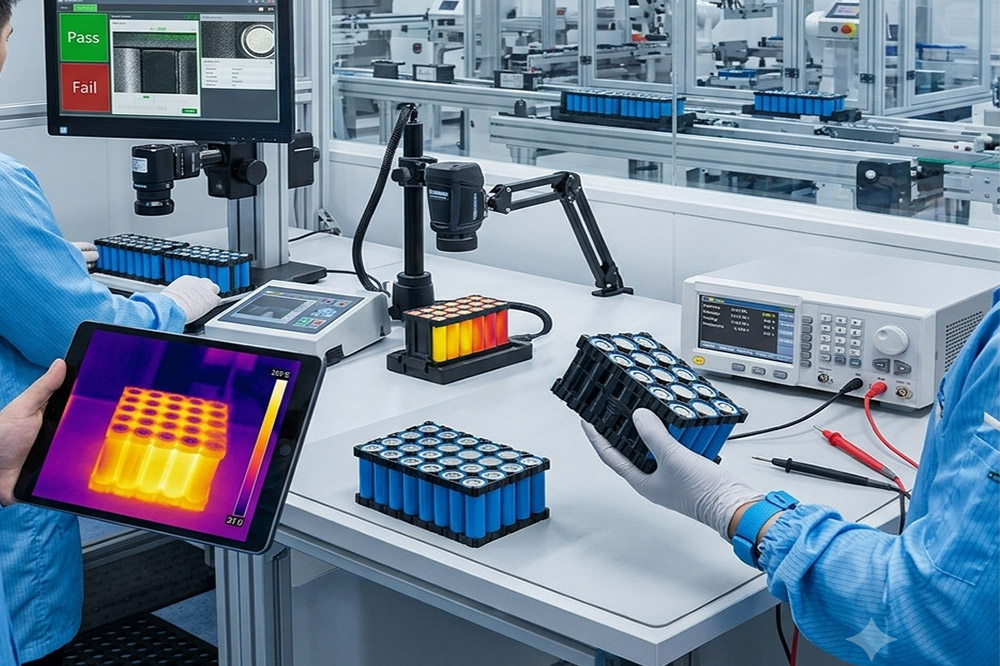
When people visit a battery factory for the first time, they’re usually impressed by the machines.
Rows of spot welders. Automatic testing stations. Conveyor lines moving hundreds of battery packs every hour.
But after spending some time inside a production workshop, something else becomes more interesting.
The machines are important, of course. Yet the real difference between two battery manufacturers often comes down to something customers can’t easily see—quality control.
A battery pack may look identical on the outside. Same plastic housing. Same voltage label. Even the specifications printed on the sticker can be almost the same.
Still, after six months on a construction site, one battery may continue working every day while another begins losing capacity or shutting down unexpectedly.
In many cases, that difference started long before the battery left the factory.
Quality Starts Before Production Begins
One misunderstanding is that quality inspection only happens after the battery pack is finished.
Actually, experienced manufacturers spend a surprising amount of time checking raw materials before assembly even starts.
For 18650 power tool batteries, incoming inspection usually includes:
- Cell voltage consistency
- Capacity verification
- Internal resistance measurement
- Appearance inspection
- Batch traceability
We’ve seen projects where customers only compared cell capacity when choosing suppliers.
Later, they discovered two cells with the same 3000mAh rating behaved very differently under high current.
That’s why factories serving industrial customers rarely rely on capacity alone.
For power tools, consistency is often more valuable than chasing the highest specification.

Cell Matching Is More Important Than Many Buyers Expect
Power tool batteries contain multiple cells connected together.
That sounds obvious, but here’s the challenge.
If one cell behaves differently from the others, it doesn’t quietly stay in the background. It affects the entire battery pack.
Good manufacturers sort cells into matched groups before assembly.
They compare:
- Capacity deviation
- Internal resistance
- Open circuit voltage
Only cells with similar characteristics are assembled together.
Skipping this step might save production time, but it can reduce battery life later.
A customer once described a problem like this:
“The battery still shows power, but the drill suddenly stops.”
After investigation, the issue wasn’t the motor.
One weaker cell inside the pack reached the protection limit earlier than the others.
Spot Welding Quality Matters More Than It Looks
After cell sorting, production moves to spot welding.
At first glance, every weld point looks almost identical.
The reality is different.
If welding pressure is too high, the cell may be damaged.
If energy is too low, electrical resistance increases.
Neither problem is immediately visible.
Professional factories usually monitor welding parameters continuously instead of relying only on visual inspection.
Some production lines even record welding data automatically for every battery pack.
That kind of traceability becomes valuable months later if customers have technical questions.

The BMS Needs Testing Too
Many people think quality inspection is only about checking the battery cells.
Actually, the Battery Management System deserves just as much attention.
Every BMS should be tested for:
- Overcharge protection
- Over-discharge protection
- Overcurrent response
- Temperature protection
- Short circuit protection
- Cell balancing
For power tools, protection settings cannot simply follow a standard template.
A battery designed for a lawn mower experiences different working conditions than one used inside an impact wrench.
Sometimes engineers even adjust BMS parameters several times after prototype testing.
That isn’t a sign something went wrong.
It’s simply part of matching the battery to the application.
Environmental Testing Reveals Problems Early
Factory testing doesn’t always happen at room temperature.
Industrial customers often ask for batteries that work outdoors, inside warehouses, or on construction sites.
Because of that, many manufacturers perform environmental testing.
Common tests include:
- High-temperature operation
- Low-temperature discharge
- Humidity testing
- Vibration testing
- Drop testing
One thing we’ve noticed is that vibration testing is frequently underestimated.
Power tools spend their entire lives vibrating.
Even a small connector issue may become a larger problem after thousands of working cycles.
Testing helps find these weaknesses before customers do.

Every Finished Battery Should Be Tested
Before packaging, finished battery packs usually go through another inspection stage.
Typical tests include:
- Charging verification
- Capacity testing
- High-current discharge
- Output voltage inspection
- Communication function (if applicable)
- Appearance inspection
Some manufacturers also perform random destructive testing on sample batteries from each production batch.
Although customers never receive those batteries, the information collected helps verify production consistency.
From a factory perspective, sacrificing a few samples is much cheaper than dealing with large-scale product returns later.
Documentation Is Part of Quality Control
Quality isn’t only measured with testing equipment.
Documentation matters too.
Reliable OEM manufacturers normally keep production records that include:
- Cell batch numbers
- Production dates
- Welding parameters
- Test results
- Operator records
- Final inspection reports
This traceability becomes especially useful for long-term industrial customers.
If a question appears one year later, engineers can often trace that battery back to its original production batch.
Not every supplier offers this level of documentation, but buyers working on large projects usually appreciate it.
What OEM Buyers Should Ask Before Choosing a Battery Factory
Price will always be part of the conversation.
Still, after seeing different battery projects, we’d probably ask a few other questions first.
For example:
- How are cells matched before production?
- What testing is performed after assembly?
- Can production records be traced?
- Is every battery pack tested before shipment?
- How is the BMS verified?
- What certifications can be provided?
These questions don’t guarantee a perfect supplier.
They do, however, reveal how seriously a manufacturer treats quality.
Reliable Quality Creates Long-Term Partnerships
For OEM power tool brands, battery quality isn’t simply about passing a factory inspection.
It affects customer satisfaction, warranty costs, and even future orders.
A battery pack that continues performing after hundreds of charge cycles rarely gets there by accident.
Behind it are dozens of inspection points, careful process control, and engineers who are willing to stop production if something doesn’t look right.
From our experience, that mindset usually matters more than having the newest production machine.
Looking for trusted OEM/ODM manufacturer for 18650 power tool battery packs?
We provide complete quality-controlled production, from cell matching and BMS integration to environmental testing and mass manufacturing. Whether you need a new battery platform or a custom replacement solution, our engineering team is ready to support your project from prototype to large-scale production.
-

12V 4400 mah Lithium ion 3S2P 18650 Battery Pack
-

18650 2000mAh 3.7 volt Lithium-ion Battery
-

18650 20V 3.0Ah Cordless Drill battery
-

18650 22.2V 7.8Ah 2600Mah 6S3P Rechargeable Battery Pack
-

18650 2600mAh Rechargeable Lithium-Ion Battery 3.7V
-

18650 3.7V 10Ah Li-Ion Power Battery Pack
-

18650 3.7V 3300mah Rechargeable Lithium ion Battery
-

18650 7S7P 24V 14Ah Lithium ion Electric Scooter Battery Pack
-

18650 battery 3.7V 1500mAh Lithium-Ion Battery
-

18650 Battery 3500 mah Rechargeable Battery Cells
-

18650 Electric Scooter 48V 13000mAh Lithium Battery
-

2600mAh 3S1P 11.1V 18650 Battery Packs
-

3.7V Li ion Rechargeable 3000mah 18650 Battery Cell
-

36V 5200mAh 10S2P 18650 Battery Pack
-

48v 4400mah 13S2P 18650 Rechargeable Battery Pack
-

7S2P 24V 18650 Lithium Battery Pack
-

Electric Scooter 36V 4400mAH 10S2P 18650 Battery Pack
-

ICR 18650 Battery 2200mah 3.7V
Leave a Reply