
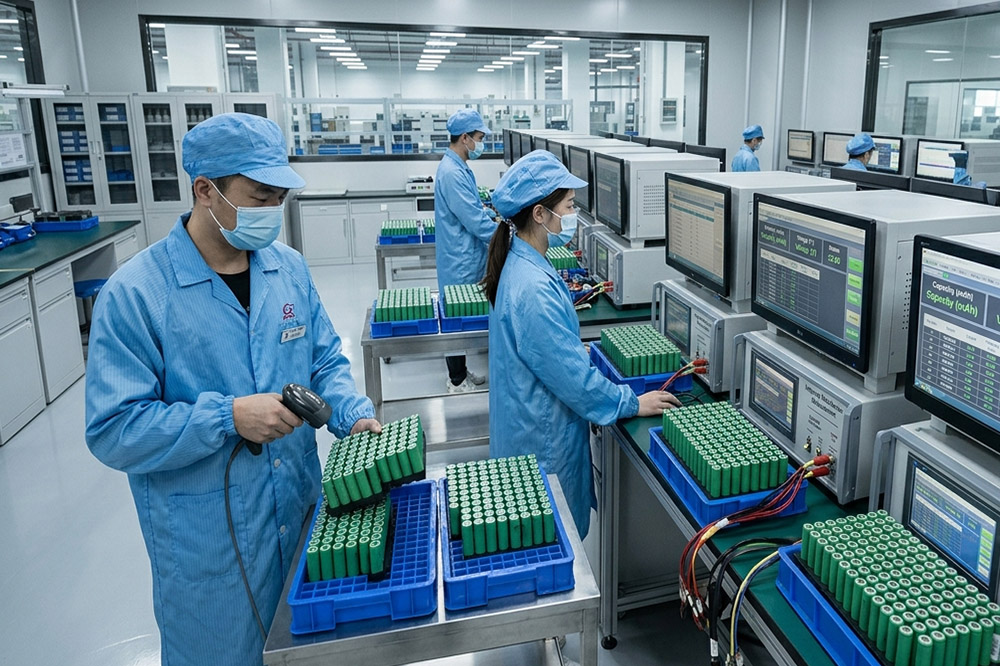
When overseas buyers visit a battery factory in China, the production line usually gets all the attention.
Automatic spot welders. Battery assembly stations. Aging rooms packed with finished battery packs.
Those machines certainly look impressive.
But if you ask an experienced production engineer where battery quality really begins, you’ll probably be taken somewhere much quieter—a room filled with battery analyzers rather than assembly equipment.
That’s where individual 18650 cells are tested before they ever become part of a power tool battery.
It may not be the most exciting area of the factory, but it’s often where the most important decisions are made.
Because once dozens of cells are welded together, fixing a weak cell is no longer simple.
Every Shipment of Cells Is Checked First
Most Chinese OEM battery manufacturers don’t immediately move newly arrived cells into production.
Even when the cells come from well-known suppliers, incoming inspection is still part of the process.
Engineers typically verify:
- Cell voltage
- Capacity
- Internal resistance
- Appearance
- Manufacturing batch information
Some buyers are surprised by this.
“If the cell supplier already tested everything, why test them again?”
The answer is fairly practical.
Transportation, storage conditions, or normal production variation can all affect battery consistency.
For companies building thousands of battery packs every month, confirming these details is usually worth the extra time.

Capacity Testing Isn’t Just About Reading the Label
Every 18650 cell has a rated capacity.
Still, manufacturers don’t simply trust the number printed on the wrapper.
Cells are charged, discharged, and measured using professional battery analyzers.
The goal isn’t only finding the highest capacity.
It’s understanding how closely each cell matches the others.
Imagine assembling a battery pack with thirty cells.
If twenty-nine perform almost identically but one stores noticeably less energy, that weaker cell may become the limiting factor for the entire pack.
For power tools, consistency usually matters more than chasing a few extra milliamp-hours.
That point is sometimes overlooked by buyers comparing only specification sheets.
Internal Resistance Can Reveal Problems Early
One measurement engineers pay close attention to is internal resistance.
This number isn’t particularly visible to end users, yet it tells a lot about how a cell may behave under load.
Lower internal resistance generally means:
- Better high-current performance
- Less heat generation
- Lower voltage drop
- Higher efficiency
Power tools rarely draw steady current.
A drill cutting soft wood behaves very differently from the same drill driving a large screw into hardwood.
Current demand changes quickly.
Cells with higher internal resistance often struggle during these sudden load increases.
Some factories reject cells with acceptable capacity simply because their resistance falls outside the target range.
It might sound strict, but that decision often improves long-term battery performance.

Cell Matching Is More Important Than Many Realize
After testing, cells are sorted into groups with similar characteristics.
Factories often compare:
- Capacity deviation
- Internal resistance
- Voltage difference
These matched groups move together into battery production.
We’ve occasionally seen customers ask why this step matters so much.
One simple comparison usually helps.
Imagine running a relay race where one runner is significantly slower than everyone else.
The entire team’s performance eventually depends on that one person.
Battery packs work in a similar way.
Even one inconsistent cell can influence charging balance, runtime, and cycle life.
High-Discharge Testing Simulates Real Working Conditions
Power tools don’t operate like laptops or portable speakers.
Their motors create sudden bursts of current.
Because of this, many Chinese manufacturers perform additional discharge testing on selected samples.
Instead of only measuring capacity, engineers observe how cells behave during higher current output.
Typical observations include:
- Voltage stability
- Temperature increase
- Discharge consistency
- Recovery after heavy load
One interesting thing we’ve noticed is that some cells look nearly identical during standard capacity testing.
The differences only become obvious once higher discharge currents are applied.
That’s exactly why industrial battery manufacturers pay close attention to this stage.
Not Every Cell Makes It Into Production
Many buyers assume all tested cells eventually become battery packs.
Actually, that’s not always true.
Cells falling outside factory standards may be:
- Re-tested
- Used in lower-demand products
- Returned according to supplier agreements
- Removed from production batches
Rejecting cells obviously increases production costs.
Still, many experienced OEM manufacturers consider that cheaper than handling customer complaints after shipment.
Quality control usually costs less than warranty service.

Alt Text:
High-discharge performance testing of 18650 lithium battery cells
Data Recording Has Become Part of Modern Manufacturing
Years ago, many factories relied heavily on manual inspection records.
Today, things look different.
Most professional production lines automatically store testing information, including:
- Cell barcode
- Capacity results
- Internal resistance
- Test date
- Production batch
- Operator information
For OEM customers, this traceability becomes especially useful.
If questions arise months later, engineers can often identify exactly which batch of cells was used in a particular battery pack.
That level of documentation is becoming increasingly common, especially among manufacturers supplying industrial equipment.
Why Overseas Buyers Should Care About Cell Testing
For companies importing custom power tool batteries, it’s easy to focus on the finished product.
Voltage.
Capacity.
Price.
Delivery time.
Those things obviously matter.
But after visiting several battery factories, one impression tends to stay with you.
The batteries that perform consistently over hundreds of charging cycles usually come from manufacturers that spend considerable time inspecting individual cells before production even begins.
It’s not the fastest part of manufacturing.
It probably isn’t the most exciting either.
Yet it’s often where long-term product reliability starts.
Choosing the Right Chinese Battery Manufacturing Partner
If you’re sourcing OEM or ODM 18650 battery packs for power tools, asking about cell testing procedures can reveal more than asking only about production capacity.
Questions worth discussing include:
- Are all incoming cells tested?
- How are cells matched before assembly?
- Is internal resistance measured?
- Are high-discharge tests performed?
- Can production records be traced by batch?
- How are rejected cells handled?
The answers won’t tell you everything about a supplier.
Still, they often give a clearer picture of how seriously that manufacturer approaches product quality.
Looking for reliable Chinese manufacturer for OEM/ODM 18650 power tool battery packs?
Our engineering team supports every stage of production—from cell testing and matching to BMS integration, performance verification, and large-scale manufacturing. If you’re developing a new cordless tool or upgrading an existing battery platform, we’re ready to help you build a solution that matches your product and your market.
Not Sure Whether Your Battery Cells Are Genuine?
Factory testing is important, but it assumes the incoming battery cells are authentic in the first place. For overseas buyers sourcing from China, verifying cell authenticity before production can prevent costly mistakes such as counterfeit cells, mixed production batches, or inflated capacity claims. Our article How to Verify Genuine Battery Cells from Chinese Suppliers shares practical inspection methods used by experienced importers and OEM buyers before placing large-volume orders.
-

12V 4400 mah Lithium ion 3S2P 18650 Battery Pack
-

18650 2000mAh 3.7 volt Lithium-ion Battery
-

18650 20V 3.0Ah Cordless Drill battery
-

18650 22.2V 7.8Ah 2600Mah 6S3P Rechargeable Battery Pack
-

18650 2600mAh Rechargeable Lithium-Ion Battery 3.7V
-

18650 3.7V 10Ah Li-Ion Power Battery Pack
-

18650 3.7V 3300mah Rechargeable Lithium ion Battery
-

18650 7S7P 24V 14Ah Lithium ion Electric Scooter Battery Pack
-

18650 battery 3.7V 1500mAh Lithium-Ion Battery
-

18650 Battery 3500 mah Rechargeable Battery Cells
-

18650 Electric Scooter 48V 13000mAh Lithium Battery
-

2600mAh 3S1P 11.1V 18650 Battery Packs
-

3.7V Li ion Rechargeable 3000mah 18650 Battery Cell
-

36V 5200mAh 10S2P 18650 Battery Pack
-

48v 4400mah 13S2P 18650 Rechargeable Battery Pack
-

7S2P 24V 18650 Lithium Battery Pack
-

Electric Scooter 36V 4400mAH 10S2P 18650 Battery Pack
-

ICR 18650 Battery 2200mah 3.7V
Leave a Reply