
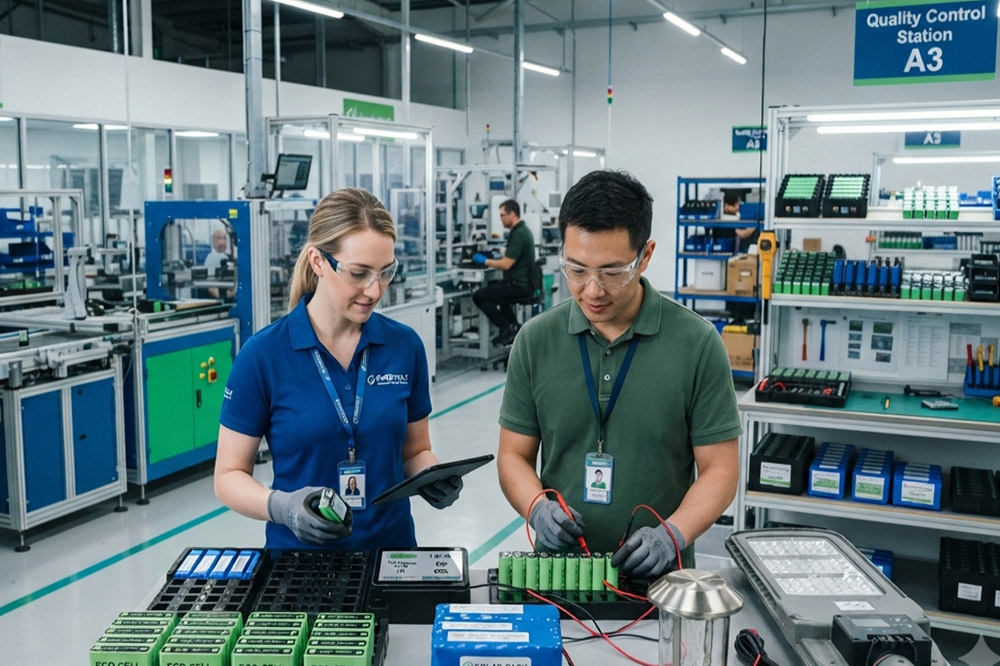
When people talk about solar lights, they often focus on the solar panel or LED brightness. In reality, the battery usually decides whether the product keeps customers happy after six months or ends up with poor reviews.
We’ve noticed something interesting over the past few years. More solar lighting brands, especially wholesalers and private-label companies, are moving away from off-the-shelf batteries. Instead, they’re asking for OEM rechargeable batteries for solar lights that are designed around their own products.
It makes sense. A garden light sold in Northern Europe doesn’t work under the same weather conditions as a landscape light installed in the Middle East. The battery inside has to match the application instead of simply fitting the housing.
Different Solar Lights Need Different Batteries
There isn’t a universal battery for every solar light.
A compact decorative garden light may only need a small battery with moderate capacity, while a commercial solar street light often requires much longer runtime and higher discharge capability.
Today, manufacturers mainly choose from three battery technologies.
- Lithium-ion batteries
- LiFePO4 batteries
- NiMH rechargeable batteries
Each has advantages. LiFePO4 performs well in demanding outdoor environments, while traditional NiMH batteries still appear in entry-level products because of their lower cost. Lithium-ion batteries, however, continue to dominate many OEM projects because they offer an attractive balance between energy density, weight, and production cost.
Why 18650 Battery Cell Is Still So Popular
Some buyers assume newer battery formats have completely replaced cylindrical cells. That hasn’t really happened.
A quality 18650 battery cell remains one of the most practical choices for solar lighting manufacturers. Good cells provide stable capacity, consistent voltage, and proven cycle life after thousands of charging cycles.
We’ve seen many OEM projects where customers initially wanted the lowest-priced cells. A few months later, after field testing, they returned asking for higher-grade cells because inconsistent battery performance caused brightness differences between products.
For outdoor lighting, battery consistency often matters more than chasing the lowest purchasing price.

When Custom 18650 Battery Packs Become the Better Option
Single cells work well for smaller products, but larger solar lighting systems usually need more energy storage.
That’s where custom 18650 battery packs become valuable.
Instead of connecting standard batteries after production, manufacturers can integrate exactly the capacity and voltage required for the product. Depending on the project, battery packs may include:
- Integrated BMS protection
- Waterproof connectors
- Customized cable lengths
- PVC or ABS housing
- Temperature protection
- Cell balancing functions
For example, a customer developing solar security lights wanted the product to continue operating through several cloudy days. Rather than redesigning the electronics, increasing the battery pack capacity solved the problem with relatively little change to the overall structure.
OEM Customization Makes a Bigger Difference Than Many Buyers Expect
One request we hear repeatedly is, “Can you simply copy our current battery?”
Sometimes that’s possible. More often, engineers recommend small improvements after reviewing the application.
Typical OEM customization includes:
- Capacity from 1200mAh to over 10000mAh
- 3.2V, 3.7V, 6V, 12V or custom voltage
- Waterproof battery assemblies
- Custom wire harnesses
- Connector replacement
- Battery housing redesign
- Logo and label printing
- PCM or smart BMS integration
These changes aren’t always dramatic, but they usually improve reliability during mass production.

Choosing the Right OEM Battery Manufacturer
Battery suppliers may appear similar on paper, yet manufacturing capability can vary quite a bit.
Before selecting an OEM partner, buyers usually check more than pricing.
Questions worth asking include:
- Where are the battery cells sourced?
- Are UN38.3 and IEC62133 available?
- Can the factory develop custom battery packs?
- Is every battery pack tested before shipment?
- Can production remain stable during large-volume orders?
Experienced manufacturers generally spend more time discussing the application before suggesting a battery solution. That conversation often prevents expensive design revisions later.
Supporting Solar Lighting Brands from Prototype to Mass Production
At ANPS Global, we work with OEM and ODM customers developing solar garden lights, landscape lighting, solar flood lights, security lighting, and commercial outdoor lighting.
Whether the project requires a single 18650 battery cell or fully customized 18650 battery packs, our engineering team helps optimize battery performance according to product size, operating temperature, runtime requirements, and production budget.
If you’re planning a new solar lighting project or looking for a more reliable battery supplier, discussing the application early usually saves both development time and manufacturing cost. Every lighting product has different requirements, and choosing the right battery from the beginning often becomes one of the easiest ways to improve long-term product quality.
-

12.8V 8Ah LiFePO4 Power Wall Battery
-

12V 100Ah LiFePO4 Solar Battery
-

18650 2200Mah 10S3P 36V 6.6Ah Electric Scooter Lithium Battery
-

18650 2600Mah 10S3P 36V 7.8ah Scooter Battery
-

18650 36V 5.2Ah Electric Bicyle Battery
-

1S2P 3.7V 1600mAh 14500 Lithium Battery
-

2000Mah 18650 Battery Cell 6Ah 36V Scooter Battery
-

21700 3.7V 4800mAh Rechargeable Lithium-Ion Battery
-

3.2V 280ah Lifepo4 Battery Cell
-

3.2V 320Ah LifePo4 Battery Cell
-

3.7V 21700 Rechargeable Lithium Battery Cells 5000mah
-

3.7V 5000mah 26650 Battery
-

32140 LiFePO4 Battery Cell 3.2V – 10000mAh / 15000mAh
-

32700 Lifepo4 3.2V 6000mah Lithium Battery
-

48V 15ah 720wh Ebike Battery
-

48V 200Ah LiFePO4 Battery Solar Power Wall
-

60V 21Ah 18650 16S7P E Bike Battery
-

Customized 48V-72V Triangle Ebike Lithium Battery Pack | 52V 30Ah
-

IP67 48V 100Ah Solid State LiFePO4 Battery
Leave a Reply