
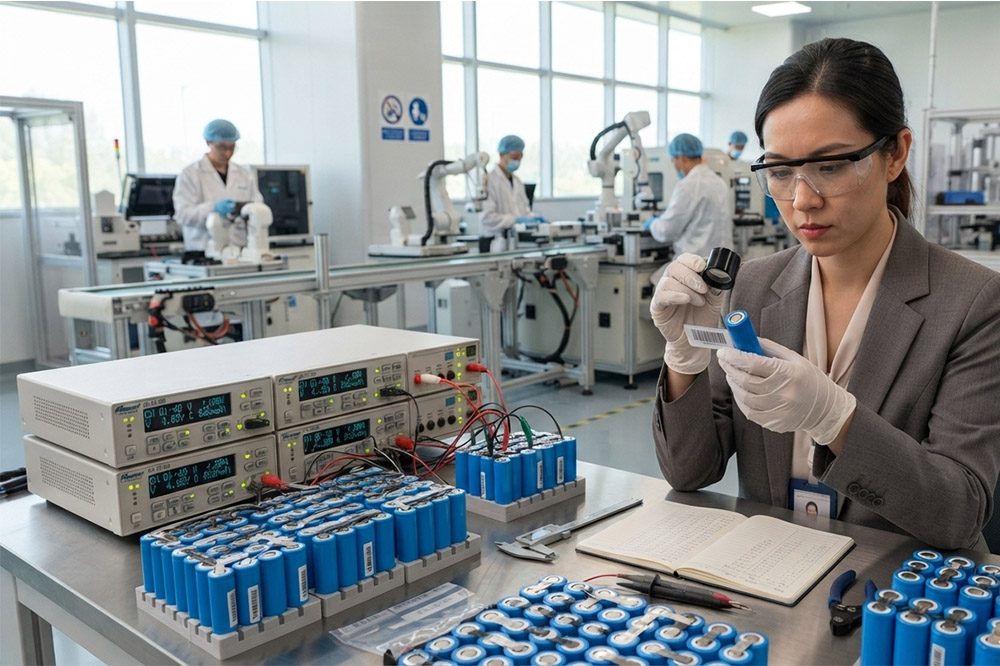
A few months ago, I received an email from a European customer that started with a sentence I’ve seen many times before.
“We’ve found three Chinese suppliers. Their quotations are almost identical. How can we tell which battery cells are genuine?”
Interestingly, he didn’t ask which supplier offered the lowest price.
He wasn’t even asking about delivery time.
His biggest concern was something much more expensive in the long run—buying battery cells that looked genuine but weren’t.
If you’ve sourced lithium batteries from China before, you’ll probably understand that feeling. China manufactures a huge percentage of the world’s lithium batteries, and many excellent suppliers are located here. At the same time, the market is large enough that buyers occasionally encounter rewrapped cells, mixed production batches, overstated capacities, or batteries that simply don’t match the specification sheet.
The good news is that genuine suppliers usually leave plenty of clues. You just need to know where to look.
The Biggest Risk Isn’t Buying from China
Sometimes people assume that buying from China itself is risky.
Personally, I don’t think that’s the real issue.
After working with overseas OEM customers for years, I’ve noticed something different.
Most purchasing problems don’t happen because the batteries were made in China.
They happen because buyers choose suppliers based almost entirely on price.
Imagine two quotations.
Supplier A is 12% cheaper.
Supplier B asks slightly more but immediately provides detailed testing reports, production batch information, and factory photos without being asked.
Quite honestly, I’d spend more time talking with Supplier B.
Because once battery packs enter your own products, replacing defective units later costs far more than the difference between those two quotations.
What Does “Genuine Battery Cell” Actually Mean?
This question sounds simple, but the answer isn’t always obvious.
A genuine battery cell isn’t just a cell carrying a famous brand name.
In professional purchasing, genuine usually means several things happen together.
The cell comes from the original manufacturer.
It belongs to the same production batch.
Its manufacturing date can be traced.
The electrical performance matches official specifications.
And perhaps most importantly, it hasn’t been recycled, rewrapped or relabeled.
We’ve occasionally seen batteries printed with well-known logos that looked convincing from the outside. Yet once engineers measured the actual capacity and internal resistance, the numbers told a very different story.
That’s why appearance alone is never enough.

1. Ask for Factory Test Reports Before You Discuss Price
This might sound backwards.
Many buyers negotiate pricing first.
I’d rather ask for quality documents first.
Professional battery suppliers usually have no problem sharing reports showing:
- Capacity testing
- Internal resistance
- Open circuit voltage
- Production date
- Batch number
If the supplier hesitates or sends screenshots with missing information, that’s worth paying attention to.
One experienced purchasing manager once told me,
“Good suppliers are proud of their testing data. Weak suppliers try to avoid talking about it.”
I think there’s some truth in that.
2. Every Production Batch Should Be Traceable
Battery manufacturing is surprisingly systematic.
Each production batch should have its own identity.
Ask for information like:
- Production lot number
- Manufacturing date
- Batch code
- Cell traceability records
Why does this matter?
Imagine receiving 30,000 battery cells.
A few months later, you discover a quality issue affecting only one shipment.
Without batch records, identifying the affected products becomes almost impossible.
Reliable factories prepare for that situation before it ever happens.
3. Don’t Be Afraid to Request Live Testing
Years ago, requesting a live battery test might have sounded unreasonable.
Today, it isn’t.
Many Chinese manufacturers are comfortable recording real-time videos showing:
- Capacity testing
- Charge and discharge cycles
- Internal resistance measurement
- Voltage inspection
Some even arrange live video calls during testing.
Personally, I like this approach because edited reports can sometimes leave questions.
Watching the actual equipment measure the cells gives buyers a different level of confidence.
It’s not perfect, of course, but it’s much harder to fake an entire testing process than a single spreadsheet.
4. Internal Resistance Often Reveals More Than Capacity
Interestingly, many new buyers focus only on capacity.
Capacity is important.
But experienced engineers usually ask another question almost immediately.
“What’s the internal resistance?”
Two battery cells may both deliver 3000mAh.
Yet if one has significantly higher internal resistance, it will generate more heat under load and age faster during repeated charging cycles.
That’s why reputable battery factories routinely measure internal resistance before production.
It’s one of the quickest ways to identify cells that don’t belong with the rest of the batch.
Recommended Reading
Verifying that your battery cells are genuine is only the first step in quality control. Even after purchasing authentic cells, professional manufacturers don’t immediately begin assembling battery packs. Every incoming shipment still goes through capacity grading, voltage matching, internal resistance testing, and aging inspection before entering production.
If you’re interested in what happens inside a professional battery factory after the cells arrive, read our guide “How Chinese Manufacturers Test 18650 Cells for Power Tools Before Production.” It explains why reputable OEM manufacturers continue testing every batch, even when sourcing from trusted suppliers, and how that process helps ensure long-term battery consistency and reliability.
5. Look Beyond the Wrapper
I’ve met buyers who could recognize a fake luxury watch from across a room but struggled to spot a questionable battery cell.
To be fair, it’s not easy.
Modern rewrapped cells can look surprisingly convincing.
Still, there are details worth checking before placing a large order.
Pay attention to:
- Laser engraving quality
- Positive terminal design
- Bottom vent pattern
- PVC wrapping consistency
- Printing clarity
- Surface scratches or welding marks
- Color consistency across the batch
One thing I always find interesting is that genuine production batches usually look remarkably consistent. Place fifty authentic cells side by side, and they almost appear identical.
Mixed batches rarely have that uniform appearance. Tiny differences in color, font, or wrapper texture often start showing up once you slow down and compare them carefully.
None of these signs alone prove a battery is counterfeit. But when several small inconsistencies appear together, it’s probably time to ask more questions.
6. Check the Weight—It Takes Less Than a Minute
This is probably one of the easiest checks buyers can perform.
A genuine high-capacity lithium cell contains a certain amount of active material. That material has weight.
Counterfeit cells often don’t.
If someone claims a cell delivers 3500mAh but it weighs noticeably less than similar products from reputable manufacturers, I’d be cautious.
We’ve occasionally seen customers receive samples that performed reasonably well during the first discharge test. Later, after weighing the cells and comparing them with original specifications, the difference became obvious.
A digital scale won’t reveal everything.
But it’s an inexpensive way to catch products that deserve a closer inspection.
7. Certifications Matter—Just Don’t Rely on Them Alone
Many buyers ask for documents like:
- UN38.3
- MSDS
- IEC62133
- CE
- RoHS
That’s good practice.
However, certifications don’t automatically prove every battery cell inside a shipment is genuine.
Think of them as part of the picture, not the entire picture.
A reliable supplier should be willing to explain:
- Which products the reports apply to
- When the testing was completed
- Which laboratory issued the certificates
- Whether the documents match the exact model you’re buying
If the paperwork and the product don’t seem connected, it’s worth slowing the purchasing process down.
A Few Red Flags I Wouldn’t Ignore
Over time, certain patterns keep appearing.
None of these automatically mean a supplier is dishonest, but together they should make buyers more careful.
For example:
- Prices are dramatically lower than the market average.
- Every famous battery brand is somehow “available.”
- Technical questions receive very general answers.
- Test reports arrive with missing pages or blurred information.
- Production dates can’t be explained.
- Sales staff avoid factory videos or live meetings.
- Delivery promises sound unrealistically fast for custom production.
One overseas distributor told me something that stayed with me.
“The supplier answered every question immediately—except the questions that actually mattered.”
That sentence probably summarizes many sourcing problems better than any inspection checklist.
Should You Hire a Third-Party Inspection Company?
For trial orders, maybe not.
For a container order worth tens of thousands of dollars?
I’d seriously consider it.
Independent inspection companies such as SGS, TÜV, Bureau Veritas, or Intertek can verify factory operations, inspect production batches, and confirm that products match purchase specifications before shipment.
Some buyers hesitate because inspection adds cost.
That’s understandable.
But compared with replacing defective battery packs after they reach overseas customers, inspection fees are usually relatively small.

What Professional Battery Manufacturers Do After Receiving the Cells
Here’s something many first-time buyers don’t realize.
Even reputable OEM battery manufacturers don’t simply trust incoming battery cells because they came from a well-known supplier.
The cells are tested again.
At Apsenx, incoming battery cells typically go through several inspection stages before they ever enter battery pack assembly.
These may include:
- Appearance inspection
- Open circuit voltage testing
- Internal resistance measurement
- Capacity verification
- Cell sorting and matching
- Aging tests
- Incoming Quality Control (IQC)
Some people ask why manufacturers repeat tests if suppliers have already provided reports.
The answer is fairly simple.
Production consistency depends on verification, not assumptions.
Even small differences between cells can affect battery balance, cycle life, and overall pack performance. Catching those differences early is much less expensive than discovering them after thousands of battery packs have been shipped.
If You’re Buying for OEM Projects, Ask Different Questions
Retail buyers often care about capacity and price.
OEM buyers usually need a much broader picture.
Before choosing a battery cell supplier, consider asking:
- Can you guarantee the same production batch for my order?
- How do you sort and match cells before assembly?
- Can you provide complete traceability records?
- What testing equipment do you use?
- Can I visit the factory remotely or in person?
- How do you handle quality issues if they occur?
In my experience, the quality of these conversations often tells you as much about the supplier as the answers themselves.
Factories that genuinely understand battery manufacturing usually enjoy discussing technical details.
Those that don’t often change the subject.
Looking for Reliable OEM Battery Partner?
Choosing genuine battery cells is only one part of building a reliable battery product.
The supplier behind those cells matters just as much.
At Apsenx, we support OEM and wholesale customers with:
- Grade A lithium battery cells
- Custom battery pack design
- Cell matching and grading
- BMS customization
- Incoming quality inspection
- UN38.3, IEC62133 and global certification support
- OEM & ODM manufacturing
Whether you’re developing power tools, medical devices, energy storage systems, robotics, or industrial equipment, our engineering team works with customers long before mass production begins. Sometimes a small design suggestion during sampling prevents a much larger problem later.
If you’re comparing suppliers and want a second opinion on battery specifications or testing reports, we’re always happy to discuss your project before you place a large-volume order.
Frequently Asked Questions
How can I tell if battery cells from China are genuine?
Request factory test reports, verify production batch numbers, review traceability records, check internal resistance, compare cell weight, and ask for live testing or factory videos before ordering.
Are all battery cells from China reliable?
No. China has many world-class battery manufacturers, but product quality varies between suppliers. Careful supplier verification is essential.
Can counterfeit battery cells pass capacity tests?
Sometimes they can pass an initial test, especially when new. That’s why professional buyers also evaluate internal resistance, batch consistency, traceability, weight, and long-term cycling performance.
Why do OEM manufacturers test battery cells again?
Incoming inspection confirms that every shipment matches production requirements. It helps identify damaged, mixed, or inconsistent cells before battery pack assembly begins.
-

12V 4400 mah Lithium ion 3S2P 18650 Battery Pack
-

18650 2000mAh 3.7 volt Lithium-ion Battery
-

18650 20V 3.0Ah Cordless Drill battery
-

18650 22.2V 7.8Ah 2600Mah 6S3P Rechargeable Battery Pack
-

18650 2600mAh Rechargeable Lithium-Ion Battery 3.7V
-

18650 3.7V 10Ah Li-Ion Power Battery Pack
-

18650 3.7V 3300mah Rechargeable Lithium ion Battery
-

18650 7S7P 24V 14Ah Lithium ion Electric Scooter Battery Pack
-

18650 battery 3.7V 1500mAh Lithium-Ion Battery
-

18650 Battery 3500 mah Rechargeable Battery Cells
-

18650 Electric Scooter 48V 13000mAh Lithium Battery
-

2600mAh 3S1P 11.1V 18650 Battery Packs
-

3.7V Li ion Rechargeable 3000mah 18650 Battery Cell
-

36V 5200mAh 10S2P 18650 Battery Pack
-

48v 4400mah 13S2P 18650 Rechargeable Battery Pack
-

7S2P 24V 18650 Lithium Battery Pack
-

Electric Scooter 36V 4400mAH 10S2P 18650 Battery Pack
-

ICR 18650 Battery 2200mah 3.7V
Leave a Reply