
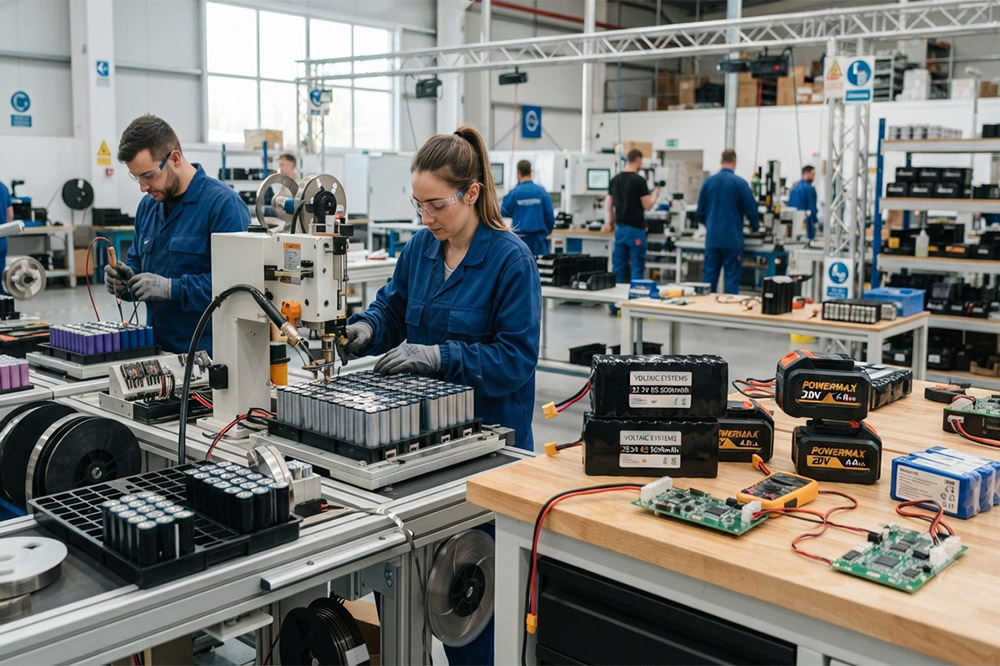
When people search for “how to make battery packs”, many are thinking about a DIY project with a few lithium cells, a spot welder, and a battery holder.
That is one side of the story.
But in the battery industry, making a battery pack is usually not just connecting cells together. A reliable battery pack requires cell matching, electrical design, protection systems, mechanical structure, and repeated testing.
From my experience working with battery projects, the biggest difference between a hobby battery pack and a commercial battery pack is not the appearance. It is what happens inside the pack after hundreds of charging cycles.
A battery pack that works on the first day is easy. A battery pack that still performs well after one year is where the real engineering starts.
What Parts Are Needed to Make Battery Pack?
A lithium battery pack usually consists of several important parts:
- Lithium battery cells
- Battery Management System (BMS)
- Nickel strips or busbars
- Insulation materials
- Wires and connectors
- Battery enclosure or shrink film
- Charging protection components
The battery cells are the core of the pack.
For example, many custom battery projects use popular cylindrical cells such as 18650 or 21700 lithium-ion cells because they offer a good balance between energy density, cost, and availability.
However, choosing cells is not simply about selecting the highest capacity number.
A 5000mAh cell does not automatically create a better battery pack. The discharge current, cycle life, temperature performance, and supplier consistency are equally important.
For companies purchasing battery packs in bulk, this is often the first place where quality differences appear.

Basic Steps of Making Battery Pack
1. Define Voltage and Capacity Requirements
Before assembling cells, the battery design needs clear specifications.
For example:
- Voltage requirement
- Capacity requirement
- Maximum discharge current
- Charging method
- Operating temperature
- Physical size limitation
A drone battery, power tool battery, and solar storage battery may all use lithium cells, but their designs are completely different.
A drone usually needs lightweight cells with higher discharge capability.
A solar lighting system may focus more on long cycle life and stable performance.
2. Arrange Cells in Series and Parallel
Battery cells are connected in two main ways:
Series connection increases voltage.
Parallel connection increases capacity and current capability.
For example:
A 3S battery pack uses three groups of cells connected in series.
A 4S2P pack means four series groups, with two cells connected in parallel in each group.
The final configuration depends on the application.
Many customers initially provide only “I need a 12V battery” or “I need a 24V battery”.
But for battery manufacturers, voltage alone is not enough. The working current and available installation space usually decide the final design.
3. Cell Matching and Quality Checking
This step is often ignored in small DIY projects.
Before assembling a professional battery pack, cells should be checked and matched.
Important testing items include:
- Voltage consistency
- Internal resistance
- Capacity difference
- Appearance inspection
Using cells with different performance levels can create imbalance during charging and discharging.
Over time, one weak cell can reduce the performance of the entire battery pack.
This is why battery factories usually test cells before they enter the assembly process.
4. Welding and Installing the BMS
Battery cells are usually connected through spot welding.
Direct soldering on lithium cells is generally avoided because excessive heat can damage internal structures.
After cell connection, a BMS is installed.
The BMS protects the battery from:
- Overcharging
- Over-discharging
- Overcurrent
- Short circuits
- Temperature problems
For commercial applications, the BMS selection is sometimes more important than people expect.
A battery pack used in an industrial device may need communication functions such as CAN or RS485, while a simple consumer product may only need basic protection.
5. Final Assembly and Testing
After electrical assembly, the battery pack needs final testing.
Common tests include:
- Charging test
- Discharge test
- Capacity verification
- Voltage balance check
- Safety inspection
A professional supplier will normally test every finished pack before shipment.
This is especially important for wholesale buyers because a small quality issue can become a large cost problem after thousands of units are delivered.

DIY Battery Pack vs Factory-Made Battery Pack
Making your own battery pack can be useful for learning or small projects.
However, for commercial products, factories usually provide better advantages:
DIY Battery Pack
- Suitable for personal projects
- Lower initial cost
- Limited testing capability
- Harder to guarantee consistency
Custom Factory Battery Pack
- Professional cell testing
- Automated production equipment
- Customized BMS solutions
- Stable batch quality
- Certification support
For businesses developing products such as drones, robots, medical devices, electric tools, or solar systems, working with an OEM battery manufacturer usually saves more time than building packs internally.
Choosing Battery Pack Manufacturer
When companies look for a battery supplier, price is usually the first comparison point.
But from a manufacturing perspective, several other factors matter:
- Does the supplier control cell quality?
- Can they provide customized structures?
- Do they support small trial orders?
- Can they provide safety certifications?
- Do they understand your application?
A cheap battery pack that fails after several months often costs more than a slightly higher-priced pack with stable performance.

Related Reading: Want to Understand 18650 Battery Pack Building Better?
If you are interested in the detailed process of building a lithium battery pack with 18650 cells, including cell arrangement, tools, and basic assembly methods, you can continue reading our previous guide:How to Make Your Own 18650 Battery Pack: A Complete DIY Guide
“For readers who want to see a more hands-on example of battery pack construction, our previous article explains the DIY 18650 battery pack process step by step, including cell selection and assembly details.”
Why Businesses Choose Custom Battery Packs
Different products have different power requirements.
A warehouse robot may need long runtime.
A drone may need lightweight high-power output.
A solar device may need thousands of charging cycles.
There is no single “best” battery pack for every application.
The right design usually comes from understanding the product first, then selecting the battery technology.
This is also why many companies work directly with battery manufacturers instead of buying standard batteries from the market.
-

12000mAh High-Rate Low-Temperature Power UAV Lithium Battery for Drones
-

12V 4400 mah Lithium ion 3S2P 18650 Battery Pack
-

18650 20V 3.0Ah Cordless Drill battery
-

18650 22.2V 7.8Ah 2600Mah 6S3P Rechargeable Battery Pack
-

18650 2200Mah 10S3P 36V 6.6Ah Electric Scooter Lithium Battery
-

18650 2600Mah 10S3P 36V 7.8ah Scooter Battery
-

18650 3.7V 10Ah Li-Ion Power Battery Pack
-

18650 36V 5.2Ah Electric Bicyle Battery
-

18650 7S7P 24V 14Ah Lithium ion Electric Scooter Battery Pack
-

18650 Electric Scooter 48V 13000mAh Lithium Battery
-

1S2P 3.7V 1600mAh 14500 Lithium Battery
-

2000Mah 18650 Battery Cell 6Ah 36V Scooter Battery
-

21700 3.7V 4800mAh Rechargeable Lithium-Ion Battery
-

22.2V 15000mAh 10C High-Rate 21700 Li-ion Drone Battery
-

2600mAh 3S1P 11.1V 18650 Battery Packs
-

3.7V 21700 Rechargeable Lithium Battery Cells 5000mah
-

3.7V 5000mah 26650 Battery
-

32140 LiFePO4 Battery Cell 3.2V – 10000mAh / 15000mAh
-

32700 Lifepo4 3.2V 6000mah Lithium Battery
-

36V 5200mAh 10S2P 18650 Battery Pack
-

48V 15ah 720wh Ebike Battery
-

48v 4400mah 13S2P 18650 Rechargeable Battery Pack
-

60V 21Ah 18650 16S7P E Bike Battery
-

6S 22.2V 12000mAh LiPo Drone Battery
-

6S 22.8V 25C 22000mAh Drone Battery
-

7S2P 24V 18650 Lithium Battery Pack
-

8000mAh 21700 6S2P 22.2V 10C High-Rate LiPo Battery for RC Aircraft and Drones
-

Customized 48V-72V Triangle Ebike Lithium Battery Pack | 52V 30Ah
-

Electric Scooter 36V 4400mAH 10S2P 18650 Battery Pack
Leave a Reply