
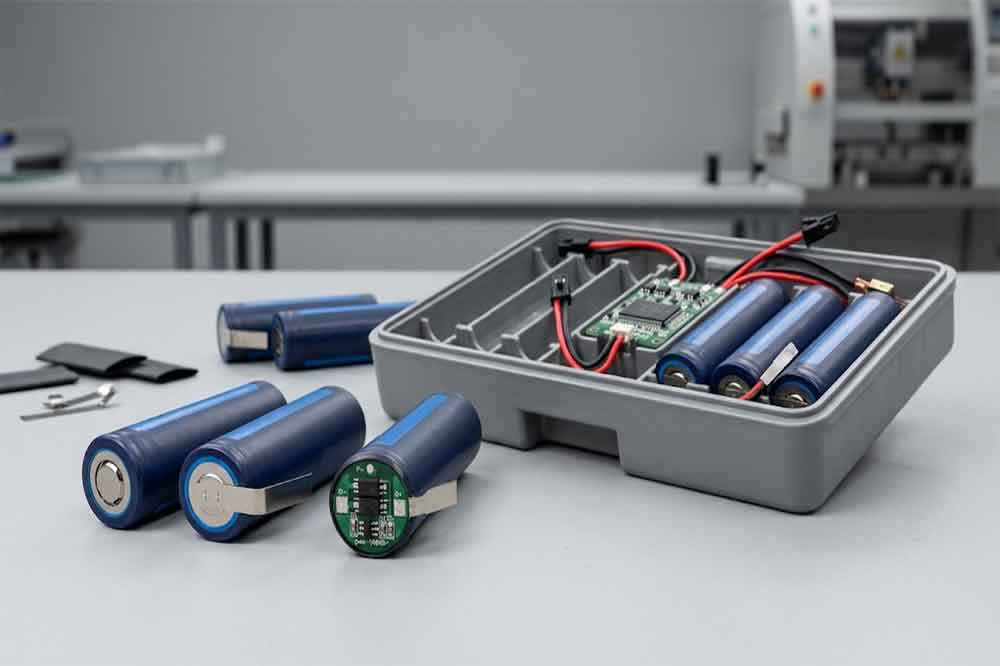
A protected 18650 battery may look like a straightforward choice for a custom battery pack. It already has a protection circuit, so it seems that adding several cells together should provide a safer power source. In practice, the answer depends on the cell design, pack configuration, operating current, and battery management system.
Protected 18650 cells can be used in some battery-pack applications, but they are not automatically suitable for every series or parallel arrangement. Their individual protection circuits may interrupt current independently, and their additional length can affect the available space inside the enclosure.
For equipment manufacturers and battery pack buyers, the important question is not simply whether protected cells can be connected together. It is whether the complete battery assembly can deliver the required voltage, current, runtime, and protection under real operating conditions.
For projects that require reliable backup power, it is also worth understanding how protected 18650 cells perform in backup power applications and how capacity requirements affect battery selection.
What Is Protected 18650 Battery?
18650 cell is a cylindrical lithium-ion cell measuring approximately 18 mm in diameter and 65 mm in length. A protected version includes a small protection circuit, commonly called a PCB, near one end of the cell.
This circuit generally monitors conditions such as overcharge, over-discharge, and excessive current. Depending on the design, it may disconnect the cell when a monitored condition exceeds its specified limit.
Protected 18650 batteries are often sold with an added circuit board and an extended outer sleeve. As a result, their overall dimensions can differ from those of standard unprotected 18650 cells.
What Does the Protection Circuit Actually Do?
The protection circuit provides a layer of electrical protection at the individual-cell level. It is not a complete replacement for a properly designed battery management system.
For example, a protected cell may disconnect its output when excessive current is detected. However, the circuit’s current threshold, response time, resistance, and recovery behavior depend on the specific product.
A cell marketed as protected should therefore be evaluated using its actual specifications rather than the word “protected” alone.
Protected Cells vs. Unprotected Cells
| Feature | Protected 18650 cell | Unprotected 18650 cell |
|---|---|---|
| Individual protection circuit | Usually included | Not included |
| Overall dimensions | Often longer | Usually closer to standard cell dimensions |
| Electrical resistance | Includes circuit-related resistance | Depends mainly on the cell and connections |
| Pack design flexibility | Limited by circuit compatibility | More flexibility for engineered pack designs |
| Typical engineering approach | Verify compatibility with pack protection | Design suitable pack-level protection |
Neither type is universally better. The correct choice depends on the application, electrical requirements, and protection architecture.
Can Protected 18650 Cells Be Connected in Series?
Yes, protected cells can sometimes be used in series, but compatibility must be confirmed before assembly.
A series connection increases voltage while keeping the nominal amp-hour capacity at approximately the capacity of one cell in the string. For example, four 3.6 V nominal cells connected in series form a battery with a nominal voltage of 14.4 V.
The main concern is that each protected cell may disconnect independently. If one cell reaches its protection threshold before the others, the entire series string can stop supplying power even when the remaining cells still have usable energy.
Potential Problems in a Series Pack
Consider a battery pack powering a portable instrument. During a high-load event, one cell reaches its overcurrent threshold and its protection circuit opens. The device may shut down unexpectedly, even though the other cells are operating normally.
Other concerns include:
- Different protection thresholds among cells.
- Unequal cell capacities or states of charge.
- Additional resistance from individual protection circuits.
- Incompatibility between cell-level protection and the pack BMS.
- Difficulty diagnosing which circuit caused a shutdown.
For a production battery pack, engineers should generally start with a matched set of cells and a pack-level BMS designed for the intended series count. The need for individual cell protection must be evaluated as part of the complete design.
Can Protected 18650 Cells Be Connected in Parallel?
Parallel connection is also possible in some designs, but it requires particular care.
When cells are connected in parallel, the nominal voltage remains the same while the available capacity increases. Two matched 3.6 V, 2500 mAh cells in parallel would provide approximately 3.6 V and 5000 mAh nominal capacity.
However, parallel connection does not guarantee that current will be shared equally. Differences in cell voltage, internal resistance, wiring resistance, and protection circuit characteristics can affect how current flows.
Choosing a battery for an industrial or medical device requires more than matching voltage and capacity. Engineers should also evaluate the protection architecture. Read our guide to 18650 battery pack protection design for details on BMS functions, current limits and validation requirements.
Why Individual Protection Circuits Can Cause Problems
Suppose two protected cells are connected in parallel and one protection circuit disconnects its cell during a load event. The other cell may then carry more of the load, potentially causing its own protection circuit to trip.
This can produce repeated shutdowns or unstable operation if the circuit design and load requirements are not compatible.
Before using protected cells in parallel, engineers should check:
- Whether the manufacturer permits parallel operation.
- Whether the cells have matching specifications and similar states of charge.
- Whether the protection circuits are designed for the intended current-sharing arrangement.
- Whether the total load and fault current remain within all component ratings.
- Whether the BMS and wiring provide suitable protection for the complete pack.
Never assume that connecting more protected cells in parallel automatically increases the safe discharge current by the same proportion.
Before selecting protected cells for a multi-cell design, it is worth evaluating the current limits, physical dimensions, and protection requirements of the complete system. Our guide explains [when to use protected 18650 cells in a battery pack] and when a dedicated BMS may be the more suitable option.
Should a Battery Pack Use Protected or Unprotected 18650 Cells?
For a custom battery pack, unprotected cells combined with a properly engineered pack-level BMS are often the more practical approach. This is particularly true when the design requires multiple series-connected cells, higher discharge current, compact dimensions, or tightly controlled electrical performance.
That does not mean protected cells should never be used in packs. They can be appropriate for certain low-power or specialized applications when their manufacturers explicitly support the intended configuration.
The distinction is between using a cell protection circuit as part of a known design and assuming that several independent protection circuits will automatically work together.
When Protected Cells May Be Suitable
Protected cells may be worth evaluating for low-current equipment, simple battery assemblies, or applications where individual-cell protection is part of the intended architecture.
The cell manufacturer must confirm that the selected model supports the required configuration. The protection circuit’s continuous current rating and trip behavior must also match the equipment’s operating profile.
When Unprotected Cells and a Pack BMS May Be Preferable
engineered pack using unprotected cells can offer more flexibility for applications such as industrial instruments, portable equipment, and customized power supplies.
The pack designer can select a suitable BMS for the series count, continuous and peak discharge current, charging method, temperature monitoring, and balancing requirements. Mechanical dimensions and electrical connections can also be optimized around the finished assembly.
The BMS itself must be correctly specified and integrated. Adding a BMS does not make mismatched cells, inadequate wiring, or poor mechanical construction acceptable.
Five Checks Before Building a Protected 18650 Battery Pack
1. Confirm the Overall Dimensions
A protected 18650 cell may be longer than a standard cell because of the protection circuit and additional wrapping. Measure the complete cell, including its terminals and insulation, before finalizing the holder or enclosure.
2. Check Continuous and Peak Current
Do not select cells based only on capacity. A 3000 mAh cell is not necessarily suitable for a device that draws a high current during startup.
Compare the cell’s discharge rating with the actual continuous load, peak load, and duration of each current surge. Include the ratings of the protection circuit, BMS, wiring, and connectors.
3. Verify Series and Parallel Compatibility
Ask the supplier whether the exact protected cell model is approved for the intended series or parallel arrangement. Confirm the protection thresholds and whether the circuit is compatible with the proposed pack architecture.
4. Match the Cells and Charging System
Cells used in a pack should have compatible specifications and be appropriately matched for capacity, internal resistance, and state of charge. The charging system must match the chemistry, series count, and required charging limits.
For example, a four-series lithium-ion pack using cells with a 4.2 V maximum charging voltage per cell typically requires a charging limit of 16.8 V. This example applies to compatible conventional 4.2 V-per-cell lithium-ion chemistry, not every lithium battery chemistry.
5. Validate the Finished Pack
Before production, evaluate the complete assembly under expected operating conditions. Testing should cover charging, discharge, temperature rise, protection behavior, mechanical integrity, and relevant fault conditions.
For commercial battery packs, qualification and transport requirements should be determined for the finished battery design and its intended market.

Choosing the Right 18650 Battery for a Custom Pack
The most suitable cell is the one that fits the application, not necessarily the one with the most built-in features.
For a battery pack project, provide the supplier with the required nominal voltage, capacity, continuous and peak discharge current, maximum dimensions, charging method, connector type, and expected operating environment.
Also explain whether the pack will use a series-parallel arrangement, whether a BMS is required, and whether the finished product needs custom wiring, insulation, a casing, or certification support.
These details allow the engineering team to determine whether a protected 18650 cell is appropriate or whether an unprotected cell with a custom pack-level protection system would be a better fit.
For OEM and ODM projects, it is worth confirming these requirements before ordering samples. A cell that works well in a single-cell device may not be the right starting point for a multi-cell pack.
Explore our 18650 lithium battery products to compare available options for custom battery projects.
Final Thoughts
Protected 18650 cells can be used in certain battery packs, but their individual protection circuits must be compatible with the electrical and mechanical design. Series and parallel connections introduce different challenges, and neither arrangement should be treated as automatically safe.
For manufacturers and project buyers, the best next step is to define the pack requirements first, then select cells and protection components as one coordinated system. That approach makes it easier to meet space constraints, avoid unexpected shutdowns, and deliver a battery pack that performs consistently in its intended application.
Frequently Asked Questions
Can I connect protected 18650 batteries in series?
Yes, if the specific cells and their protection circuits are suitable for the intended series configuration. Verify voltage limits, trip thresholds, charging compatibility, and pack-level BMS requirements before assembly.
Can protected 18650 batteries be connected in parallel?
Some models support parallel use, but compatibility must be confirmed. Unequal current sharing or independent protection trips can cause shutdowns, so follow the cell manufacturer’s instructions and validate the complete design.
Do protected 18650 cells still need a BMS?
Individual protection circuits do not necessarily provide all the functions required by a multi-cell pack. A suitable pack-level BMS may still be needed for cell monitoring, balancing, charging control, temperature protection, and system-level fault handling.
Are protected 18650 batteries larger than standard cells?
Often, yes. The protection circuit and additional insulation can increase the cell’s overall length. Always check the manufacturer’s actual dimensions before designing a battery holder or enclosure.
Are protected 18650 cells better for OEM battery packs?
Not always. Protected cells can suit some applications, while unprotected cells with a correctly designed pack-level BMS often provide more flexibility for custom multi-cell assemblies. The decision depends on the electrical requirements and the supplier’s verified specifications.
Related Products
-

12V 4400 mah Lithium ion 3S2P 18650 Battery Pack
-

18650 2000mAh 3.7 volt Lithium-ion Battery
-

18650 20V 3.0Ah Cordless Drill battery
-

18650 22.2V 7.8Ah 2600Mah 6S3P Rechargeable Battery Pack
-

18650 2600mAh Rechargeable Lithium-Ion Battery 3.7V
-

18650 3.7V 10Ah Li-Ion Power Battery Pack
-

18650 3.7V 3300mah Rechargeable Lithium ion Battery
-

18650 7S7P 24V 14Ah Lithium ion Electric Scooter Battery Pack
-

18650 battery 3.7V 1500mAh Lithium-Ion Battery
-

18650 Battery 3500 mah Rechargeable Battery Cells
-

18650 Electric Scooter 48V 13000mAh Lithium Battery
-

2600mAh 3S1P 11.1V 18650 Battery Packs
-

3.7V Li ion Rechargeable 3000mah 18650 Battery Cell
-

36V 5200mAh 10S2P 18650 Battery Pack
-

48v 4400mah 13S2P 18650 Rechargeable Battery Pack
-

7S2P 24V 18650 Lithium Battery Pack
-

Electric Scooter 36V 4400mAH 10S2P 18650 Battery Pack
-

ICR 18650 Battery 2200mah 3.7V
Leave a Reply