
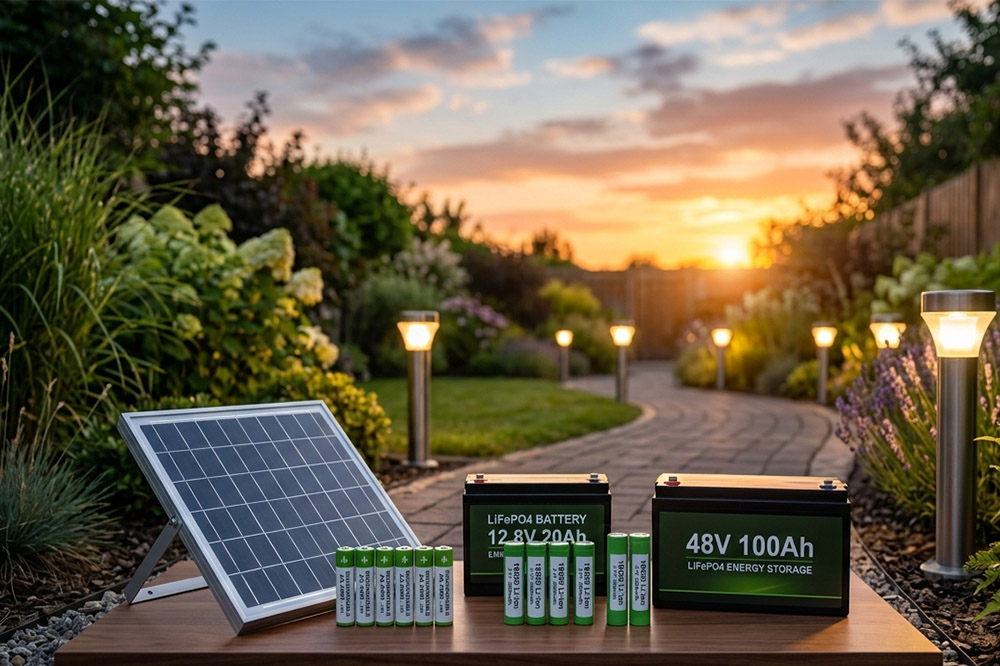
Best Rechargeable Batteries for Solar Lights
If you’ve been sourcing solar lights for a while, you’ve probably noticed something interesting.
Many buyers spend weeks comparing the brightness of LEDs or the efficiency of solar panels, but they pay surprisingly little attention to the battery inside. Yet, after several months outdoors, it’s usually the battery—not the LED—that determines whether the customer is happy or asking for replacements.
I’ve seen wholesale buyers replace entire suppliers simply because battery quality caused too many warranty claims. The solar light itself wasn’t poorly designed. The battery just couldn’t survive enough charging cycles.
So if you’re buying rechargeable batteries for solar lights in bulk, it’s worth understanding what actually matters before placing an order.
Why Battery Quality Matters More Than Many Buyers Expect
A solar light works in a simple cycle.
It collects energy during the day, stores it, and powers the LED after sunset.
That sounds straightforward, but the battery repeats this cycle almost every single day of the year. Depending on the climate, that’s more than 300 charging cycles annually.
Cheap batteries often begin losing capacity after only several months. The light still turns on, but instead of working throughout the night, it may last only two or three hours.
Customers usually don’t blame the battery.
They blame the solar light brand.
For wholesalers, that means more complaints, replacement costs, and damaged reputation.

Which Rechargeable Battery Is Best for Solar Lights?
There isn’t one perfect answer because different projects have different budgets.
Still, these are the battery types most commonly used today.
1. NiMH Batteries
Nickel Metal Hydride (NiMH) batteries remain the most popular option for residential garden lights.
They’re affordable, easy to replace, and work well in moderate climates.
Many AA and AAA solar lights still use capacities between 600mAh and 2500mAh.
For importers selling entry-level products, NiMH usually provides the best balance between cost and performance.
Typical applications include:
- Garden lights
- Pathway lights
- Decorative landscape lighting
- Fence lights
2. Lithium-ion Batteries
As solar lights become brighter, manufacturers increasingly move toward lithium-ion batteries.
Compared with NiMH, lithium batteries offer higher energy density and longer operating time.
They’re often found in:
- Solar street lights
- Solar flood lights
- Security lighting
- Commercial outdoor lighting
The trade-off is cost.
Lithium batteries require proper battery management and better charging protection, but the longer runtime often justifies the investment.
3. LiFePO4 Batteries
Over the past few years, I’ve noticed more commercial projects requesting LiFePO4 batteries instead of traditional lithium-ion cells.
The reason isn’t simply capacity.
LiFePO4 batteries tolerate high temperatures better, offer excellent cycle life, and have a strong reputation for safety.
If your products are shipped to regions such as the Middle East, Australia, or southern Europe, this chemistry is becoming increasingly common.
Although the initial purchase price is higher, replacement frequency is often much lower.
What Wholesale Buyers Usually Check
Battery specifications on paper don’t always reflect real-world performance.
Experienced buyers usually ask suppliers several additional questions.
For example:
- Are the battery cells grade A?
- Can cycle-life test reports be provided?
- Is capacity tested before shipment?
- Are UN38.3 and MSDS documents available?
- Can OEM labels or custom packaging be supplied?
- Is voltage consistency checked for every production batch?
These questions often reveal much more than a simple product datasheet.

Outdoor Conditions Make a Bigger Difference Than Many Think
One project I discussed involved decorative garden lights installed near the coast.
The customer assumed battery capacity was the issue because runtime gradually decreased.
After reviewing the application, the actual problem appeared to be the environment.
Salt air, high humidity, and continuous summer heat accelerated battery aging much faster than laboratory testing suggested.
That’s why experienced manufacturers often recommend selecting batteries based on local climate rather than simply choosing the highest advertised capacity.
Sometimes a slightly smaller but higher-quality battery performs noticeably better over several years.
Should You Replace Solar Light Batteries?
Yes—provided the battery compartment is accessible.
Many homeowners replace AA or AAA rechargeable batteries after two or three years instead of replacing the entire light.
Commercial installations are slightly different.
Facility managers usually prefer purchasing replacement batteries in bulk to reduce maintenance costs across hundreds or thousands of fixtures.
For wholesalers, offering compatible replacement batteries can become an additional revenue stream alongside complete solar lighting products.
Choosing a Reliable Battery Supplier
Price naturally matters.
But experienced importers rarely choose a supplier based only on the lowest quotation.
Instead, they look for manufacturers that can provide:
- Stable production capacity
- OEM and private-label services
- Consistent cell quality
- International certifications
- Flexible MOQ options
- Technical support before and after delivery
These factors tend to reduce long-term costs more effectively than saving a few cents per battery.
Final Thoughts
The “best” rechargeable battery for solar lights depends on where the lights will be installed, how they’re used, and how long customers expect them to last.
For basic residential lighting, NiMH batteries remain a dependable choice.
For higher-power outdoor lighting, lithium-ion batteries deliver longer runtime.
And for demanding commercial environments where durability matters more than initial cost, LiFePO4 batteries are increasingly becoming the preferred solution.
If you’re sourcing rechargeable batteries for solar lights in wholesale quantities, it’s worth discussing your application with the manufacturer first. A battery that performs well in one market may not be the ideal choice in another. Small differences in chemistry, testing standards, and quality control often become much more noticeable after thousands of units are installed.
Why Choose Our OEM Battery Manufacturing Service?
We specialize in supplying rechargeable batteries for solar lighting manufacturers, distributors, and OEM brands worldwide.
We provide:
- Bulk wholesale pricing
- OEM & private label production
- Custom battery pack design
- Strict capacity and cycle-life testing
- UN38.3, MSDS, CE and transportation documentation
- Fast sampling and global shipping support
Whether you need AA NiMH batteries for garden lights or custom LiFePO4 battery packs for commercial solar systems, our engineering team can help you build a reliable solution while keeping your supply chain stable.
Contact us today for bulk pricing, free technical consultation, and customized battery solutions.
-

12.8V 8Ah LiFePO4 Power Wall Battery
-

12V 100Ah LiFePO4 Solar Battery
-

18650 2200Mah 10S3P 36V 6.6Ah Electric Scooter Lithium Battery
-

18650 2600Mah 10S3P 36V 7.8ah Scooter Battery
-

18650 36V 5.2Ah Electric Bicyle Battery
-

1S2P 3.7V 1600mAh 14500 Lithium Battery
-

2000Mah 18650 Battery Cell 6Ah 36V Scooter Battery
-

21700 3.7V 4800mAh Rechargeable Lithium-Ion Battery
-

3.2V 280ah Lifepo4 Battery Cell
-

3.2V 320Ah LifePo4 Battery Cell
-

3.7V 21700 Rechargeable Lithium Battery Cells 5000mah
-

3.7V 5000mah 26650 Battery
-

32140 LiFePO4 Battery Cell 3.2V – 10000mAh / 15000mAh
-

32700 Lifepo4 3.2V 6000mah Lithium Battery
-

48V 15ah 720wh Ebike Battery
-

48V 200Ah LiFePO4 Battery Solar Power Wall
-

60V 21Ah 18650 16S7P E Bike Battery
-

Customized 48V-72V Triangle Ebike Lithium Battery Pack | 52V 30Ah
-

IP67 48V 100Ah Solid State LiFePO4 Battery
Leave a Reply