
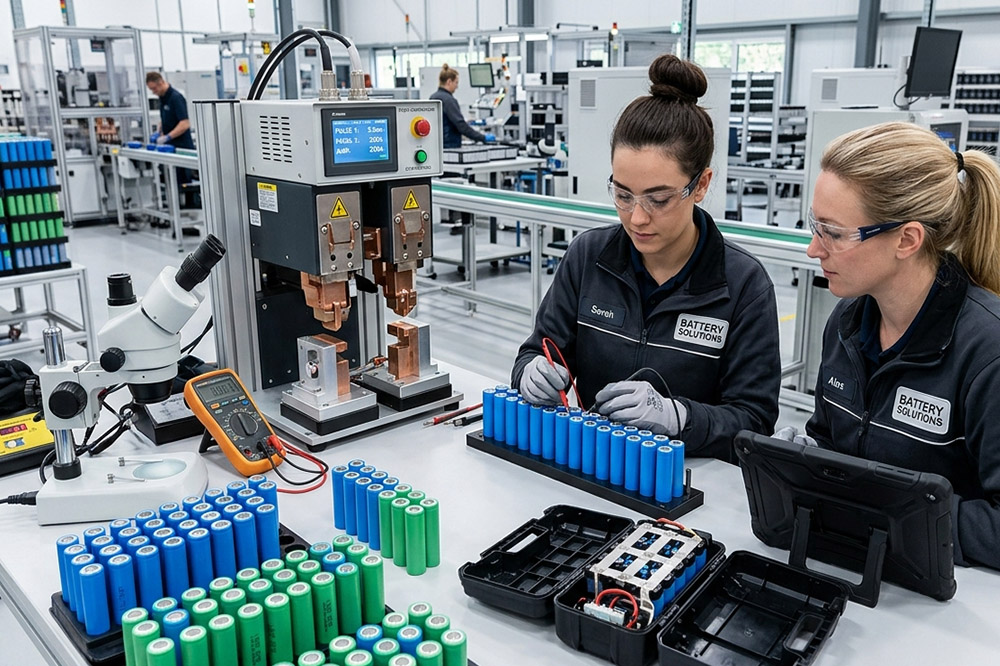
If you’ve ever opened an old power tool battery pack, you’ve probably noticed something interesting. Most of them don’t actually fail because every cell is dead. In many cases, just a few weak 18650 cells drag the whole pack down.
We see this quite often when talking with repair companies and battery pack assemblers. A customer says, “The drill only runs for five minutes now.” After testing the pack, maybe only two or three cells have developed high internal resistance while the others are still usable. It sounds simple—replace the bad cells and the battery comes back to life. But in reality, it’s rarely that straightforward.
That’s exactly why choosing replacement 18650 batteries deserves more attention than many buyers give it.
Not Every 18650 Cell Fits a Power Tool
One misunderstanding appears again and again.
A battery is labeled “18650,” so people assume any 18650 cell will work.
Not really.
Power tools create short bursts of very high current. An angle grinder starting under load or a hammer drill cutting through concrete can easily demand 20A, sometimes even higher from each cell.
A standard consumer-grade 18650 designed for flashlights or power banks simply isn’t built for this kind of stress.
We’ve seen replacement packs become hot after only a few minutes because low-drain cells were installed. The capacity looked attractive on paper, but the discharge rate wasn’t enough.
When selecting replacement cells, experienced buyers usually care about several things:
- Continuous discharge current
- Internal resistance consistency
- Cycle life
- Cell matching
- Safety certifications
- Production batch consistency
Oddly enough, capacity isn’t always the first priority.
Why Matching Cells Matters More Than People Think
Imagine replacing only one weak cell inside a 10-cell battery pack.
The new cell has lower resistance.
The remaining nine cells have already aged after hundreds of cycles.
Everything may appear normal during the first charge.
Then, after several weeks, balancing problems begin showing up. Some cells reach full voltage earlier while others lag behind. Eventually the Battery Management System cuts power even though the pack still contains usable energy.
This situation isn’t uncommon.
Professional battery repair shops often replace an entire matched group instead of only one individual cell. It costs slightly more, but the finished pack behaves much more consistently.
That’s also why OEM manufacturers supply matched cells from the same production lot rather than mixing inventory from different batches.

The Hidden Difference Between Cheap and Reliable Cells
Price comparisons online can be confusing.
Two suppliers both advertise “3000mAh 18650.”
One costs half the price.
Where’s the difference?
Usually it isn’t printed in the specification sheet.
The cheaper cells often show:
- Higher internal resistance
- Larger capacity variation
- Lower cycle consistency
- Faster voltage drop under load
These differences become obvious only after several months inside demanding applications like cordless drills, impact wrenches, hedge trimmers, or electric saws.
A purchasing manager once mentioned that switching to stable OEM cells reduced customer warranty claims noticeably. Nothing about the battery pack design changed. Only the cell supplier changed.
That says quite a lot.
Should You Replace Individual Cells or Build a New Pack?
The answer depends on the application.
For hobby projects or older tools, replacing several cells can make financial sense.
For commercial fleets—maintenance contractors, rental companies, construction firms—it often makes more sense to rebuild the entire battery pack using fresh matched cells.
Downtime usually costs much more than battery cells.
Imagine a construction team waiting because cordless tools stop halfway through the day. Saving a few dollars on replacement cells suddenly doesn’t seem like such a good decision.

Choosing an OEM 18650 Battery Supplier
Bulk buyers generally ask different questions than retail customers.
Instead of focusing only on capacity, they usually want to know:
- Can you provide OEM or private label production?
- Are UN38.3, IEC62133, CE and MSDS available?
- Can cells be matched before shipment?
- Is spot-welding or battery pack assembly supported?
- What is the production lead time?
- Can samples be tested before placing a volume order?
These questions often tell you more about a supplier than the product page itself.
Reliable manufacturers don’t simply sell battery cells. They help customers reduce production risk.
We Support OEM Battery Pack Manufacturers Worldwide
At our factory, we supply high-quality 18650 lithium-ion cells for power tool battery replacement, battery pack assembly, and OEM production.
Whether you’re repairing cordless drill batteries, developing a custom power tool pack, or sourcing batteries for wholesale distribution, we can provide:
- OEM & ODM battery solutions
- Matched 18650 cells
- Spot-welded battery packs
- Custom voltage and capacity
- Low MOQ for project testing
- Stable supply for long-term wholesale orders
- Global shipping with complete export documentation
If you’re comparing suppliers, requesting samples before committing to a larger order is usually a smart place to start. It gives your engineering team a chance to test real performance rather than relying only on specification sheets.
-

12V 4400 mah Lithium ion 3S2P 18650 Battery Pack
-

18650 2000mAh 3.7 volt Lithium-ion Battery
-

18650 20V 3.0Ah Cordless Drill battery
-

18650 22.2V 7.8Ah 2600Mah 6S3P Rechargeable Battery Pack
-

18650 2200Mah 10S3P 36V 6.6Ah Electric Scooter Lithium Battery
-

18650 2600Mah 10S3P 36V 7.8ah Scooter Battery
-

18650 2600mAh Rechargeable Lithium-Ion Battery 3.7V
-

18650 3.7V 10Ah Li-Ion Power Battery Pack
-

18650 3.7V 3300mah Rechargeable Lithium ion Battery
-

18650 36V 5.2Ah Electric Bicyle Battery
-

18650 7S7P 24V 14Ah Lithium ion Electric Scooter Battery Pack
-

18650 battery 3.7V 1500mAh Lithium-Ion Battery
-

18650 Battery 3500 mah Rechargeable Battery Cells
-

18650 Electric Scooter 48V 13000mAh Lithium Battery
-

1S2P 3.7V 1600mAh 14500 Lithium Battery
-

2000Mah 18650 Battery Cell 6Ah 36V Scooter Battery
-

21700 3.7V 4800mAh Rechargeable Lithium-Ion Battery
-

2600mAh 3S1P 11.1V 18650 Battery Packs
-

3.7V 21700 Rechargeable Lithium Battery Cells 5000mah
-

3.7V 5000mah 26650 Battery
-

3.7V Li ion Rechargeable 3000mah 18650 Battery Cell
-

32140 LiFePO4 Battery Cell 3.2V – 10000mAh / 15000mAh
-

32700 Lifepo4 3.2V 6000mah Lithium Battery
-

36V 5200mAh 10S2P 18650 Battery Pack
-

48V 15ah 720wh Ebike Battery
-

48v 4400mah 13S2P 18650 Rechargeable Battery Pack
-

60V 21Ah 18650 16S7P E Bike Battery
-

7S2P 24V 18650 Lithium Battery Pack
-

Customized 48V-72V Triangle Ebike Lithium Battery Pack | 52V 30Ah
-

Electric Scooter 36V 4400mAH 10S2P 18650 Battery Pack
-

ICR 18650 Battery 2200mah 3.7V
Leave a Reply