
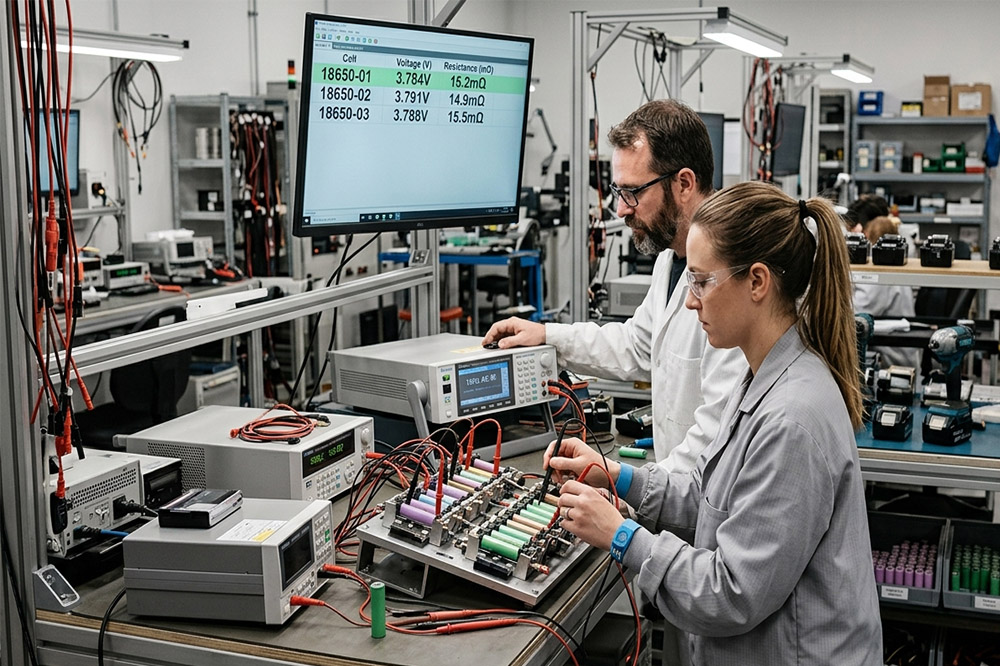
When people compare 18650 cells for power tools, they usually look at capacity first.
“How many mAh does it have?”
“How much runtime can it provide?”
Those questions are reasonable, but they do not tell the whole story.
In real power tool applications, especially with impact wrenches, angle grinders, and heavy-duty drills, another parameter quietly affects performance every day.
Internal resistance.
It is not something users can see from the outside, but they can feel the result.
A tool that suddenly loses power under load, a battery pack that becomes hotter than expected, or a runtime that drops faster after several months — these problems are often related to internal resistance.
What is internal resistance in 18650 cell?
Every battery has a certain amount of resistance inside.
When current flows through the cell, part of the energy is lost as heat because of this resistance.
A simple way to understand it:
Lower internal resistance means the battery can deliver current more efficiently.
Higher internal resistance means more energy is wasted and more heat is generated.
In a small electronic device, the difference may not be obvious.
But in power tools that demand high current, even small resistance differences can change the working experience.

Why power tools expose internal resistance problems quickly
A cordless drill used for light assembly may not put much stress on a battery.
But an impact wrench removing a tight bolt is a completely different situation.
During heavy operation:
- Current demand increases quickly
- Voltage starts dropping
- Heat builds inside the cells
- Battery protection systems may reduce output
This is why a battery can look fine during normal use but struggle when the tool is pushed harder.
The problem is not always the total capacity.
Sometimes the battery simply cannot deliver current efficiently.
Voltage drop: the performance issue users actually notice
Most users do not measure internal resistance.
They notice symptoms.
For example:
A worker uses an impact wrench on a vehicle repair job.
The first few bolts are removed easily.
Later, the tool feels weaker, even though the battery still shows remaining charge.
This can happen because higher internal resistance causes a larger voltage drop when current demand increases.
The battery still contains energy, but it cannot release that energy effectively under load.
Heat generation and battery aging
Another important effect is temperature.
When internal resistance is higher, more energy turns into heat during discharge.
In power tool applications, repeated heat cycles can accelerate battery aging.
Common results include:
- Reduced cycle life
- Faster capacity loss
- Lower discharge performance over time
This is especially important for professional users who operate tools every day.
A battery that works well for occasional DIY use may not perform the same way in an industrial environment.

Why cell matching matters in OEM battery packs
A power tool battery pack usually contains multiple 18650 cells connected together.
The challenge is not only selecting good cells.
The cells also need to work well as a group.
Imagine a battery pack with several cells:
- Most cells have similar resistance
- One cell has noticeably higher resistance
During charging and discharging, that weaker cell can affect the balance of the entire pack.
Over time, this may lead to:
- Uneven cell aging
- Reduced usable capacity
- Lower pack reliability
This is why professional battery manufacturers often test and match cells before assembly.
Internal resistance and different power tool applications
Different tools create different levels of stress.
Cordless drills
Usually require balanced performance.
A moderate internal resistance level may be acceptable depending on the application.
Impact wrenches
Need strong current delivery.
Low internal resistance becomes more important because torque peaks demand fast power output.
Angle grinders
Create continuous heavy loads.
Thermal control and resistance stability become critical because the battery works under stress for longer periods.
Industrial maintenance tools
Reliability matters more than maximum capacity.
A stable battery that performs consistently is often preferred over a higher-capacity option with unstable output.
What OEM buyers should ask battery suppliers
When sourcing 18650 battery packs, many buyers focus on:
- Cell capacity
- Price
- Production quantity
These are important, but experienced buyers usually ask deeper questions:
- What is the internal resistance range?
- Are cells tested before assembly?
- How are cells matched?
- How does the pack perform under continuous load?
- Is there cycle testing after assembly?
Because the final product is not just a collection of cells.
It is a complete power system.

A practical example from battery pack production
A manufacturer may receive two batches of cells with the same capacity rating.
On paper, they look identical.
But during testing, one batch shows lower resistance variation.
After assembly into power tool packs, the difference becomes clearer:
- More stable output
- Lower temperature rise
- Better consistency between packs
This is why experienced OEM factories pay attention to details that may not appear on a basic specification sheet.
Choosing the right 18650 cells is about balance
Internal resistance is not the only factor that defines a good battery cell.
Capacity, discharge capability, safety, and cost all matter.
However, for power tool applications, ignoring internal resistance can create problems later.
A battery pack needs to handle real working conditions, not just laboratory numbers.
For manufacturers, distributors, and OEM customers, understanding this small technical detail can make a big difference in the final product experience.
-

12V 4400 mah Lithium ion 3S2P 18650 Battery Pack
-

18650 2000mAh 3.7 volt Lithium-ion Battery
-

18650 20V 3.0Ah Cordless Drill battery
-

18650 22.2V 7.8Ah 2600Mah 6S3P Rechargeable Battery Pack
-

18650 2600mAh Rechargeable Lithium-Ion Battery 3.7V
-

18650 3.7V 10Ah Li-Ion Power Battery Pack
-

18650 3.7V 3300mah Rechargeable Lithium ion Battery
-

18650 7S7P 24V 14Ah Lithium ion Electric Scooter Battery Pack
-

18650 battery 3.7V 1500mAh Lithium-Ion Battery
-

18650 Battery 3500 mah Rechargeable Battery Cells
-

18650 Electric Scooter 48V 13000mAh Lithium Battery
-

2600mAh 3S1P 11.1V 18650 Battery Packs
-

3.7V Li ion Rechargeable 3000mah 18650 Battery Cell
-

36V 5200mAh 10S2P 18650 Battery Pack
-

48v 4400mah 13S2P 18650 Rechargeable Battery Pack
-

7S2P 24V 18650 Lithium Battery Pack
-

Electric Scooter 36V 4400mAH 10S2P 18650 Battery Pack
-

ICR 18650 Battery 2200mah 3.7V
Leave a Reply