
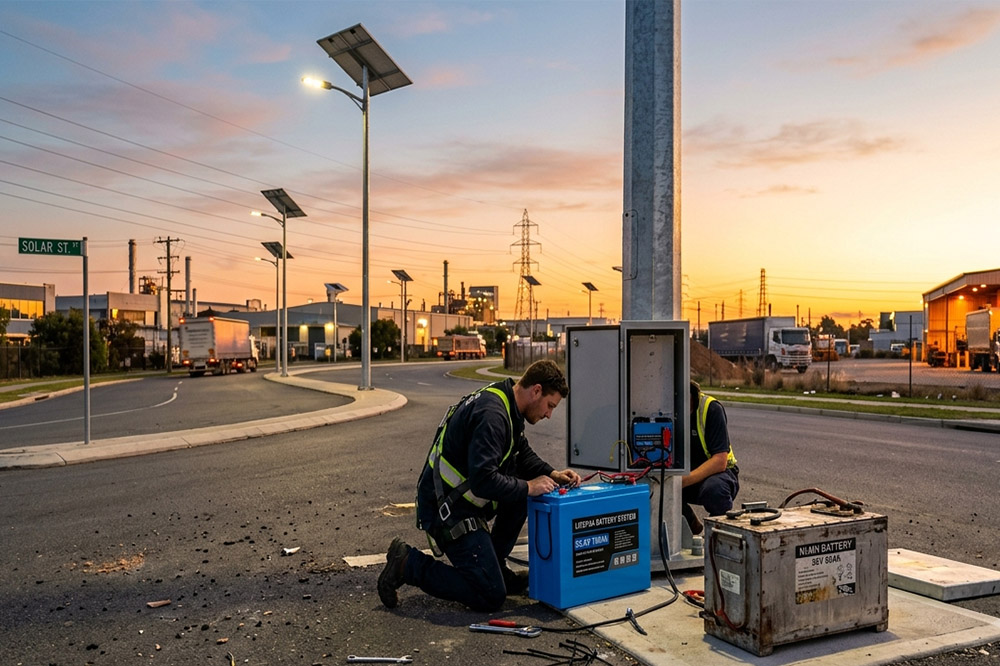
A few years ago, if someone asked what battery should go inside a solar garden light, the answer was almost always NiMH.
Walk into today’s commercial lighting projects, however, and the conversation has changed.
Whether it’s a municipal street lighting project, a logistics park, a factory perimeter, or a large residential development, LiFePO4 batteries are showing up far more often than NiMH packs. It didn’t happen overnight, but the shift is becoming difficult to ignore.
We’ve spoken with buyers who originally specified NiMH because it was familiar. Six months later, they came back asking if the same fixture could be redesigned with LiFePO4 instead. Their maintenance teams had already noticed the difference.
That trend says quite a lot.
Commercial Solar Lighting Has Different Priorities
Small decorative solar lights and commercial solar lighting don’t really solve the same problem.
A decorative light outside a home might illuminate a pathway for four or five hours.
A commercial solar street light may be expected to operate all night, every night, through winter, rain, and cloudy weeks.
If one light stops working, someone has to send a technician.
If fifty lights stop working, it becomes an expensive maintenance project.
That’s why battery performance suddenly matters much more than purchase price.
Longer Service Life Changes the Economics
This is probably the biggest reason LiFePO4 has become so popular.
A quality NiMH battery generally lasts several hundred charging cycles before noticeable capacity loss.
A LiFePO4 battery often reaches 2,000–4,000 cycles under normal operating conditions.
On paper, those numbers are impressive.
In reality, the benefit is even easier to understand.
Imagine installing 500 solar lights around an industrial park.
Replacing hundreds of battery packs every few years isn’t just buying batteries. It also means labor costs, equipment rental, traffic control, and downtime.
Many project managers eventually realize the battery itself is only part of the total expense.
Better Performance During Long Nights
One installer shared something interesting after upgrading several parking lot lights.
The brightness stayed more consistent until sunrise.
That isn’t surprising.
LiFePO4 batteries typically provide a flatter discharge curve, allowing LED drivers to maintain stable output for a longer period.
NiMH batteries often begin losing voltage gradually during discharge, so brightness may decrease earlier in the night.
Drivers may not notice the technical reason, but they definitely notice when half the parking lot looks dim at 4 a.m.
Fast Charging Makes a Bigger Difference Than Expected
Commercial solar systems don’t always enjoy perfect sunshine.
Several cloudy days can quickly expose weaknesses in a battery system.
LiFePO4 batteries generally accept charging more efficiently than NiMH batteries, allowing them to recover faster when sunlight returns.
This becomes especially valuable in regions with long rainy seasons or unpredictable weather.
We’ve seen municipal lighting projects in Southeast Asia and Northern Europe place increasing emphasis on this characteristic because weather patterns rarely cooperate with engineering plans.

Weight and Installation Matter More Than People Think
This isn’t usually the first specification buyers compare.
Yet installers mention it surprisingly often.
LiFePO4 battery packs typically offer higher usable energy while keeping the overall battery compartment relatively compact.
That makes pole installation easier, particularly for integrated solar street lights where every kilogram matters.
When crews install hundreds of poles in a single project, even small reductions in installation time become noticeable.
Safety Has Become a Purchasing Requirement
Commercial projects today face stricter safety expectations than they did several years ago.
Schools.
Airports.
Industrial facilities.
Public roads.
These customers don’t simply ask about battery capacity anymore.
They ask about battery chemistry.
LiFePO4 has earned a strong reputation for thermal stability and low fire risk compared with many other lithium chemistries.
For engineering companies preparing project documentation, that simplifies conversations with clients and regulators.
Lower Maintenance Is Quietly Becoming the Biggest Selling Point
Something interesting has changed in procurement meetings.
People spend less time asking:
“How much does the battery cost?”
Instead, they’re asking:
“How often will we need to replace it?”
Those are very different questions.
Maintenance budgets continue long after installation is complete.
The battery that saves a few dollars initially can become the expensive option five years later.
Several lighting contractors we’ve worked with now calculate total ownership cost rather than component price alone.
That wasn’t nearly as common a few years ago.

Is NiMH Completely Outdated?
Not really.
NiMH still works well for many low-power products.
Garden lights.
Decorative landscape lighting.
Seasonal lighting.
Consumer products with lower operating demands.
If the budget is extremely limited, NiMH may still make sense.
But once lighting projects become larger, brighter, or expected to last many years without frequent servicing, LiFePO4 usually becomes the more practical choice.
That seems to be where the market is heading.
What Wholesale Buyers Are Looking for Today
When commercial lighting manufacturers contact battery suppliers, the conversation usually goes beyond voltage and capacity.
Common questions include:
- Can you customize the battery pack dimensions?
- Do you support OEM and private labeling?
- Are UN38.3, MSDS, CE and IEC certifications available?
- Can the Battery Management System be customized?
- What’s the production lead time for bulk orders?
- Can different capacities fit the same lighting enclosure?
These discussions reflect a broader shift.
Battery suppliers are no longer simply selling cells—they’re helping lighting manufacturers build complete products that can stay in the field for years.
For OEM brands, EPC contractors, and solar lighting manufacturers, choosing the right battery partner often has as much impact as choosing the right LED or solar panel.
If your next commercial lighting project is moving toward LiFePO4 technology, working with an experienced wholesale battery manufacturer can reduce development time, simplify certification, and provide battery packs designed specifically for your application instead of relying on generic off-the-shelf solutions.


Leave a Reply