
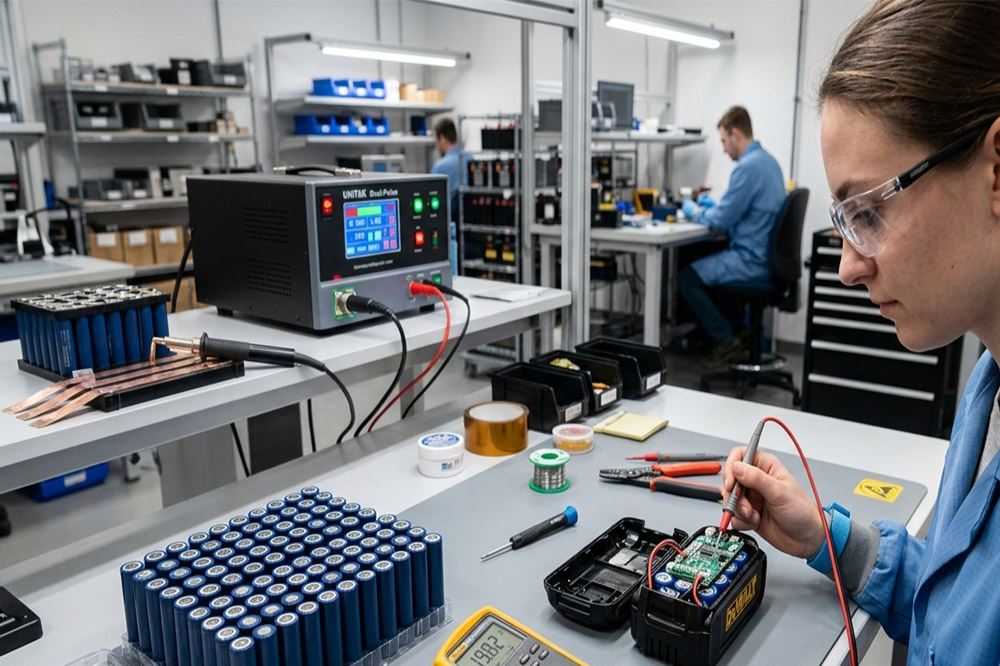
Can You Replace Power Tool Battery Packs with 18650 Cells?
The short answer is yes.
The longer answer is…it depends on what you’re trying to achieve.
I’ve noticed that many people search this question after pulling apart an old cordless drill battery. They see a row of 18650 cells inside and immediately think, “Great, I’ll just buy the same number of new batteries.”
Sometimes that works surprisingly well.
Sometimes the rebuilt battery lasts for years.
And sometimes it refuses to charge after the first cycle.
The difference usually isn’t the battery holder or even the BMS. More often than not, it comes down to the cells themselves.
Why So Many Power Tool Batteries Use 18650 Cells
There’s a reason manufacturers have relied on 18650 lithium-ion cells for years.
They’re compact, offer a good balance between capacity and discharge current, and are available from several well-known manufacturers. Even now, although 21700 cells are becoming more common in premium tools, millions of cordless drills, impact drivers, hedge trimmers, and garden tools still use 18650 battery packs.
Walk into almost any repair shop that services power tools, and you’ll probably see shelves filled with old battery packs waiting to be rebuilt.
Most of them don’t look badly damaged from the outside.
Inside tells a different story.
Replacing the Cells Isn’t the Difficult Part
Taking a battery pack apart is relatively easy if you have the right tools.
The real challenge begins after that.
We’ve talked with customers who ordered replacement cells from different online marketplaces because they all claimed to be “3000mAh High Capacity.”
On paper, everything matched.
In reality, the battery pack became weaker than before.
One repair company even sent us photos showing three different brands mixed into the same pack. It worked…for about two weeks.
Eventually the BMS stopped charging because the cell voltages drifted too far apart.
That wasn’t really a surprise.
Not Every 18650 Cell Can Handle Power Tools
This is probably the biggest misunderstanding.
People often compare battery capacity first.
Personally, I think discharge capability deserves much more attention.
A cordless drill pulling heavy torque may require each cell to deliver 15A, 20A, or even higher current for short periods.
Cells designed for laptops or power banks simply aren’t built for that workload.
The result usually looks like this:
- The battery becomes hot quickly.
- Runtime drops much faster than expected.
- Voltage sags under heavy load.
- The protection board shuts the pack down.
The battery isn’t necessarily defective.
It’s just being asked to do a job it wasn’t designed for.

Cell Matching Is More Important Than Most Buyers Expect
Here’s something interesting we’ve observed from OEM battery production.
Manufacturers don’t randomly grab cells from warehouse shelves.
Before assembly, cells are usually sorted according to:
- Voltage
- Internal resistance
- Capacity
- Production batch
That process takes time, but it also makes a noticeable difference.
Imagine replacing ten old cells with ten brand-new cells from five different factories.
Technically they’re all 18650 batteries.
Performance probably won’t be consistent.
Now imagine using ten matched cells produced during the same manufacturing batch.
Charging becomes more balanced.
Temperature stays more uniform.
The battery pack generally ages much more evenly.
It isn’t magic.
It’s simply better consistency.
Is It Worth Rebuilding an Old Battery Pack?
That depends on the application.
For a homeowner who uses a cordless drill twice a month, rebuilding can be a cost-effective solution.
For construction companies, rental businesses, or maintenance contractors, reliability often matters more than saving a few dollars.
One failed battery can stop an entire crew.
I’ve heard purchasing managers say the battery itself wasn’t the expensive part.
The downtime was.
That’s why many professional users rebuild battery packs before they completely fail instead of waiting until tools stop working on-site.

Choosing Replacement 18650 Cells for OEM Projects
Wholesale buyers usually ask different questions than DIY users.
Instead of asking, “What’s the highest capacity?”
They’re more interested in things like:
- Is the discharge current suitable for power tools?
- Are all cells matched before shipment?
- Can the supplier provide stable production batches?
- Are UN38.3, IEC62133, CE and MSDS available?
- Can battery packs be spot welded before delivery?
- Is OEM branding supported?
Interestingly, those questions tend to prevent far more problems than simply chasing higher mAh ratings.
What We Supply for Battery Pack Manufacturers
We manufacture OEM lithium-ion batteries for customers building and repairing power tool battery packs worldwide.
Whether you’re producing cordless drill batteries, supplying battery repair businesses, or assembling custom lithium battery packs, we can support your project with:
- Premium 18650 lithium-ion cells
- High-drain batteries for power tools
- Matched cell grading
- OEM & ODM battery pack manufacturing
- Spot welding and custom assembly
- Low MOQ for prototype projects
- Wholesale pricing for volume orders
- Stable long-term production capacity
- Global shipping with export certifications
Many of our customers begin with sample orders instead of jumping directly into bulk purchasing. After running their own discharge and cycle-life tests, they place larger orders with much more confidence. That approach usually saves both time and unexpected warranty costs later.
-

12V 4400 mah Lithium ion 3S2P 18650 Battery Pack
-

18650 2000mAh 3.7 volt Lithium-ion Battery
-

18650 20V 3.0Ah Cordless Drill battery
-

18650 22.2V 7.8Ah 2600Mah 6S3P Rechargeable Battery Pack
-

18650 2600mAh Rechargeable Lithium-Ion Battery 3.7V
-

18650 3.7V 10Ah Li-Ion Power Battery Pack
-

18650 3.7V 3300mah Rechargeable Lithium ion Battery
-

18650 7S7P 24V 14Ah Lithium ion Electric Scooter Battery Pack
-

18650 battery 3.7V 1500mAh Lithium-Ion Battery
-

18650 Battery 3500 mah Rechargeable Battery Cells
-

18650 Electric Scooter 48V 13000mAh Lithium Battery
-

2600mAh 3S1P 11.1V 18650 Battery Packs
-

3.7V Li ion Rechargeable 3000mah 18650 Battery Cell
-

36V 5200mAh 10S2P 18650 Battery Pack
-

48v 4400mah 13S2P 18650 Rechargeable Battery Pack
-

7S2P 24V 18650 Lithium Battery Pack
-

Electric Scooter 36V 4400mAH 10S2P 18650 Battery Pack
-

ICR 18650 Battery 2200mah 3.7V
Leave a Reply