
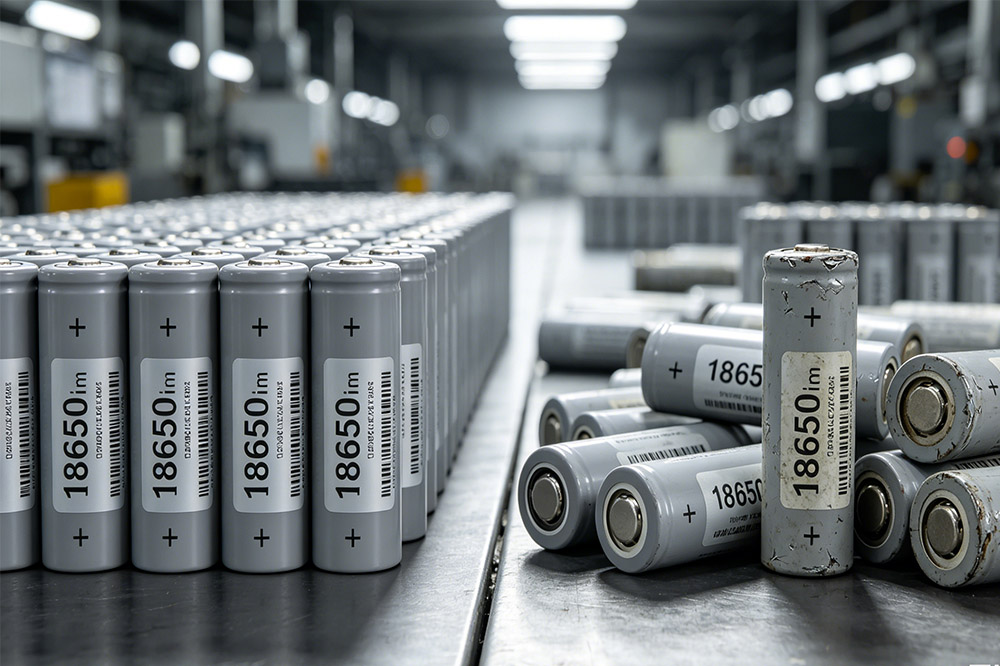
When sourcing 18650 3.7V 2200mAh batteries in bulk, price is usually the first thing buyers compare.
But experienced importers and pack assemblers know one thing:
The lowest price often leads to the highest long-term cost.
If you’ve ever received a batch that looked fine at first but failed during assembly or after a few cycles, you already understand the risk.
This guide breaks down how to avoid low-quality 18650 cells when buying wholesale — and what to really check before placing an order.
Why Cheap 18650 Batteries Become Expensive Later
On a quotation sheet, the difference might only be a few cents per cell.
But in real projects, that small gap can turn into a big loss.
Here’s where problems usually show up:
- High inconsistency in voltage and internal resistance
- Cells heating up faster under load
- Large capacity deviation within the same batch
- Early failure during cycling tests
If you’re building battery packs (especially 3S, 4S, or larger configurations), these issues multiply quickly.
One weak cell can affect the entire pack.
That means rework, replacements, and sometimes even customer complaints.

Key Things to Check Before You Place a Bulk Order
Most suppliers will send you a datasheet.
But datasheets don’t tell the full story.
Here’s what experienced buyers usually verify:
1. Real Capacity Testing
Don’t rely only on labeled “2200mAh”.
Ask for actual discharge test data.
A reliable supplier should provide:
- Tested capacity range (not just nominal value)
- Test conditions (current, cutoff voltage)
- Batch consistency report
If the real capacity drops significantly below 2200mAh, that’s already a red flag.
2. Internal Resistance Consistency
Internal resistance directly affects:
- Heat generation
- Power output
- Cycle life
Well-matched cells usually have very close resistance values.
If the spread is too wide, your battery pack will be unstable.
Ask suppliers:
- What is the typical IR range?
- How do they sort and match cells?
3. Cell Grading Standard
Not all “Grade A” claims are real.
In the market, you’ll typically see:
- True A-grade (new, consistent, tested)
- B-grade (slightly off-spec)
- Mixed or recycled cells (lowest cost, highest risk)
For wholesale buyers, clarity here matters more than price.
Always confirm:
- Are the cells newly produced?
- Are batches mixed?
- Is there a grading report?
4. Cycle Life Data (Not Just Claims)
Many listings say “500 cycles” or “800 cycles”.
But under what conditions?
Cycle life depends heavily on:
- Charge/discharge rate
- Temperature
- Cutoff voltage
Ask for real cycle test curves instead of just a number.

When Lower Price Might Still Make Sense
Not every project needs top-tier cells.
Lower-cost 18650 2200mAh batteries can still be suitable for:
- Low-drain devices
- Short lifecycle products
- Cost-sensitive consumer goods
But for applications like:
- Electric scooters
- Energy storage systems
- Medical or industrial devices
Choosing higher-quality cells is usually the safer decision.
A Practical Tip from Bulk Buyers
Many experienced buyers don’t start with a large order.
Instead, they:
- Order samples from 2–3 suppliers
- Test capacity and internal resistance
- Build small packs for real-world testing
- Compare performance after 20–50 cycles
Only then do they move to bulk purchasing.
This approach reduces risk significantly.
Final Thoughts
When it comes to 18650 3.7V 2200mAh batteries, price differences are not random.
They reflect real differences in:
- Cell quality
- Manufacturing control
- Performance consistency
For wholesale buyers, the goal isn’t just to find the cheapest option.
It’s to find the most reliable supplier for your specific application.
Related Products
-

12V 4400 mah Lithium ion 3S2P 18650 Battery Pack
-

18650 2000mAh 3.7 volt Lithium-ion Battery
-

18650 20V 3.0Ah Cordless Drill battery
-

18650 22.2V 7.8Ah 2600Mah 6S3P Rechargeable Battery Pack
-

18650 2600mAh Rechargeable Lithium-Ion Battery 3.7V
-

18650 3.7V 10Ah Li-Ion Power Battery Pack
-

18650 3.7V 3300mah Rechargeable Lithium ion Battery
-

18650 7S7P 24V 14Ah Lithium ion Electric Scooter Battery Pack
-

18650 battery 3.7V 1500mAh Lithium-Ion Battery
-

18650 Battery 3500 mah Rechargeable Battery Cells
-

18650 Electric Scooter 48V 13000mAh Lithium Battery
-

2600mAh 3S1P 11.1V 18650 Battery Packs
-

3.7V Li ion Rechargeable 3000mah 18650 Battery Cell
-

36V 5200mAh 10S2P 18650 Battery Pack
-

48v 4400mah 13S2P 18650 Rechargeable Battery Pack
-

7S2P 24V 18650 Lithium Battery Pack
-

Electric Scooter 36V 4400mAH 10S2P 18650 Battery Pack
-

ICR 18650 Battery 2200mah 3.7V
Leave a Reply