
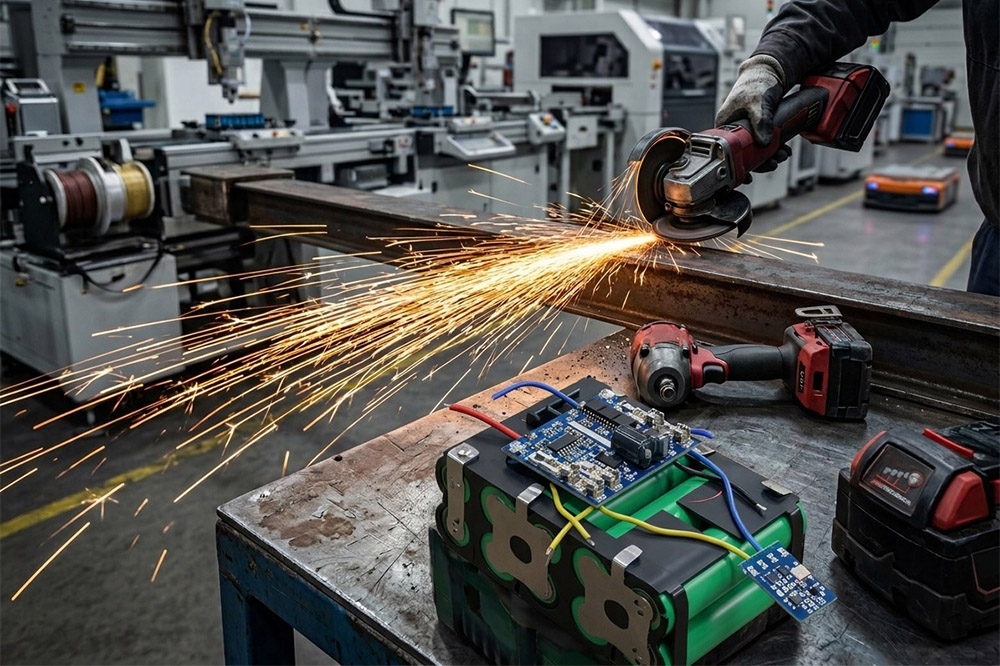
If you ask someone on a job site what makes a cordless grinder feel “strong,” they rarely talk about milliamp-hours.
They talk about power that doesn’t fade.
That feeling usually comes down to one thing hidden inside the pack — the discharge rate of the 18650 cells.
Not many users think about it directly, but in heavy-duty tools, discharge rate often matters more than total capacity.
And that’s where most misunderstandings start.
High discharge is not just a technical number
On paper, discharge rate looks simple.
10A, 15A, 20A… sometimes higher.
But in real use, it behaves less like a number and more like a limit that gets tested every time you pull the trigger.
A cordless impact wrench, for example, doesn’t draw power evenly. It pulls sudden bursts of current when the hammer mechanism engages. An angle grinder is different again — it holds a steady, heavy load for longer periods.
So when OEM engineers talk about “high drain cells,” they are not describing theoretical performance. They are talking about whether the battery can survive real jobsite stress without voltage collapse.

What actually happens when discharge capability is too low
This is where field experience becomes more useful than datasheets.
If the 18650 cell inside a battery pack cannot supply enough current:
- Voltage drops faster than expected
- Tools feel weaker under load
- Heat builds up inside the pack
- Runtime becomes inconsistent
Workers usually don’t describe it in technical terms. They just say, “the tool feels tired.”
That “tired feeling” is often the battery struggling, not the motor.
Why angle grinders and impact wrenches are special cases
Electric screwdrivers and small drills are relatively forgiving.
But angle grinders and impact wrenches behave differently.
A grinder may run continuously while cutting steel, meaning sustained current draw. There’s little rest for the battery to recover.
An impact wrench, on the other hand, creates repeated high-current pulses. Each impact demands instant energy delivery.
These two patterns — continuous load and pulse load — are exactly what expose weak 18650 cells.
That’s why OEM manufacturers usually test cells under dynamic discharge conditions, not just static load tests.
Capacity vs discharge rate — a trade-off OEMs think about quietly
On the surface, higher capacity looks attractive.
But in practice, something interesting happens in factory selection.
Cells with very high capacity sometimes struggle under high current.
Cells with slightly lower capacity often perform better in heavy tools because they maintain voltage stability.
So OEM engineers often balance three things at the same time:
- Discharge rate
- Internal resistance
- Thermal behavior
Capacity is still important, but it is rarely the first decision factor in industrial tools.
That might feel surprising if you only look at marketing specifications.
Inside an OEM battery pack, cells don’t work alone
A common misunderstanding is assuming battery performance comes from a single “good cell.”
In reality, a battery pack is a system.
Even high-quality 18650 cells can underperform if:
- They are not properly matched
- Welding resistance is inconsistent
- BMS protection is poorly tuned
- Heat is not evenly distributed
I’ve seen cases where two packs use almost identical cells, but one performs noticeably better just because the internal resistance matching was tighter during assembly.
For industrial buyers, this is where supplier capability becomes more important than cell branding.

Real-world usage tells a different story than lab testing
In controlled testing, everything looks stable.
But on a construction site or factory floor, conditions change constantly.
Temperature shifts.
Load spikes.
Tool usage is irregular.
Sometimes a tool runs continuously for minutes, sometimes it sits idle and suddenly demands full power again.
This unpredictability is exactly where high discharge 18650 cells matter most.
They don’t just need to perform once. They need to perform consistently across uneven workloads.
Why OEM and wholesale buyers still prefer 18650 platforms
Even with newer lithium formats entering the market, 18650 cells are still widely used in power tools for practical reasons:
- Mature global supply chain
- Stable production quality control
- Flexible pack design (series/parallel)
- Proven performance in industrial tools
- Easy replacement and service support
For distributors, this reduces risk.
For manufacturers, it reduces engineering complexity.
For end users, it improves serviceability.
That combination is hard to replace quickly.
A simple way factories evaluate “good” high discharge cells
Instead of focusing on one specification, many factories use a more practical approach:
They test how long the cell can maintain stable voltage under load.
Not peak performance.
Not short bursts.
But stability over time.
Because in real power tools, consistency often matters more than short-term output.
Final thought
High discharge 18650 cells are not just about power on paper.
They are about whether a tool can stay reliable when the workload becomes unpredictable.
For OEM manufacturers and wholesale buyers, the real challenge is not finding the highest-rated cell, but finding a stable combination of discharge performance, thermal control, and production consistency.
That’s usually what separates a battery that simply works from one that keeps working in real industrial environments.
-

12V 4400 mah Lithium ion 3S2P 18650 Battery Pack
-

18650 2000mAh 3.7 volt Lithium-ion Battery
-

18650 20V 3.0Ah Cordless Drill battery
-

18650 22.2V 7.8Ah 2600Mah 6S3P Rechargeable Battery Pack
-

18650 2600mAh Rechargeable Lithium-Ion Battery 3.7V
-

18650 3.7V 10Ah Li-Ion Power Battery Pack
-

18650 3.7V 3300mah Rechargeable Lithium ion Battery
-

18650 7S7P 24V 14Ah Lithium ion Electric Scooter Battery Pack
-

18650 battery 3.7V 1500mAh Lithium-Ion Battery
-

18650 Battery 3500 mah Rechargeable Battery Cells
-

18650 Electric Scooter 48V 13000mAh Lithium Battery
-

2600mAh 3S1P 11.1V 18650 Battery Packs
-

3.7V Li ion Rechargeable 3000mah 18650 Battery Cell
-

36V 5200mAh 10S2P 18650 Battery Pack
-

48v 4400mah 13S2P 18650 Rechargeable Battery Pack
-

7S2P 24V 18650 Lithium Battery Pack
-

Electric Scooter 36V 4400mAH 10S2P 18650 Battery Pack
-

ICR 18650 Battery 2200mah 3.7V
Leave a Reply