
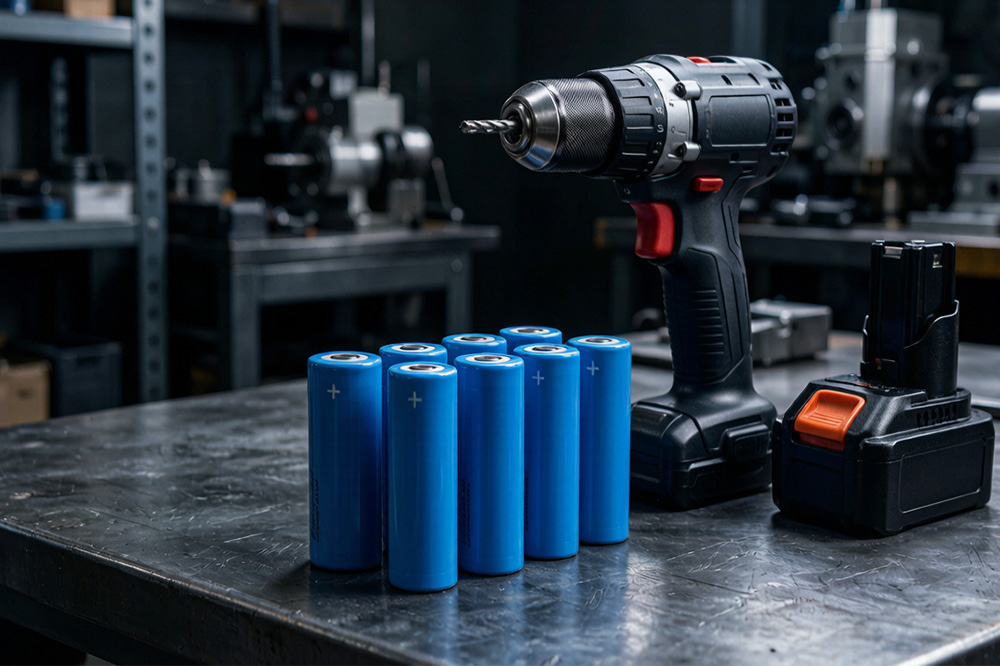
When people first start sourcing batteries for cordless drills or impact wrenches, the conversation almost always goes the same way.
“What’s your highest capacity cell?”
Interestingly, that’s usually the wrong question.
For power tools, capacity is only part of the story. What actually determines whether a drill feels strong under load isn’t just how many milliamp-hours are printed on the label. In many cases, it’s the battery’s high discharge capability that makes the real difference.
We’ve worked with buyers who switched from one supplier to another simply because their battery packs looked identical on paper but delivered completely different performance once installed inside a tool.
That’s where discharge rate starts to matter.
Why Power Tools Need High Discharge Batteries
Imagine using an impact wrench to remove rusted bolts from heavy equipment.
For a few seconds, the motor demands an enormous amount of current. The battery has to respond instantly.
If the cell cannot provide enough current:
- torque drops
- rotation slows
- voltage sags
- the battery heats up quickly
- protection circuits may shut everything down
This isn’t necessarily because the battery is defective. Sometimes it’s simply the wrong cell for the application.
A battery designed for flashlights or energy storage behaves very differently from one built specifically for power tools.

Capacity Isn’t Everything
One thing we’ve noticed in OEM projects is that many buyers compare batteries only by capacity.
For example:
| Cell | Capacity | Continuous Discharge |
|---|---|---|
| Cell A | 3500mAh | 10A |
| Cell B | 2500mAh | 30A |
On paper, Cell A looks more attractive.
Inside a cordless grinder, however, Cell B will usually outperform it.
Why?
Because the motor doesn’t ask for extra capacity during acceleration. It asks for current.
That’s an important distinction that isn’t always obvious until products reach end users.
What Does “High Discharge Rate” Actually Mean?
High discharge rate simply refers to how much current a battery can continuously deliver without overheating or damaging its internal chemistry.
For power tools, you’ll often see cells rated for:
- 15A continuous
- 20A continuous
- 25A continuous
- 30A continuous
- even higher for specialized industrial applications
There’s also something called pulse discharge, which can briefly exceed the continuous rating.
One mistake buyers sometimes make is designing a battery pack based only on the pulse specification. It might work during laboratory testing, but after months of real-world use, performance becomes inconsistent.
Continuous discharge rating is usually the safer number to design around.

A Real Manufacturing Scenario
A customer developing cordless hedge trimmers contacted us after experiencing excessive battery heating.
Initially, they believed the BMS needed redesigning.
After reviewing the system, the issue turned out to be much simpler.
The cells they selected were optimized for energy density instead of current output.
Replacing them with higher discharge 18650 cells reduced operating temperature noticeably without changing the pack dimensions.
Not every project ends this neatly, of course. Ambient temperature, motor efficiency and PCB layout all influence the final result. Still, choosing the correct cell often solves more problems than expected.
High Discharge Doesn’t Mean Short Battery Life
This is another common misunderstanding.
A high-drain 18650 battery doesn’t automatically have a shorter lifespan.
What usually shortens battery life is running a low-discharge cell beyond its intended operating range.
When a battery repeatedly experiences excessive heat, internal resistance increases faster, accelerating capacity loss.
In other words, using the right high-discharge cell can actually improve long-term durability.
Factors Buyers Should Compare
Rather than looking only at capacity, experienced battery pack manufacturers typically evaluate several specifications together.
Continuous discharge current
Probably the most important parameter for cordless tools.
Internal resistance
Lower resistance generally means lower heat generation under heavy load.
Cycle life
Especially important for professional tools used every day.
Temperature performance
Construction sites aren’t climate-controlled. Cells should remain stable in both hot summers and cold winters.
Consistency between cells
Matching cells inside one battery pack often matters more than having the highest specification on a single datasheet.

Which Applications Need High Drain 18650 Batteries?
High discharge cells are commonly used in:
- Cordless drills
- Impact drivers
- Rotary hammers
- Angle grinders
- Circular saws
- Garden power equipment
- Electric pruning shears
- Industrial fastening tools
- Portable vacuum cleaners
- Robotics
These applications draw current very differently from LED lighting or backup power systems.
Why Wholesale Buyers Should Pay Attention
If you’re importing batteries for OEM production, the cheapest cell isn’t always the lowest-cost option.
We’ve seen projects where replacing low-cost cells with slightly higher-quality high-discharge models reduced warranty claims, improved customer satisfaction, and simplified after-sales support.
For distributors, that often matters more than saving a few cents per cell.
It also helps avoid one awkward conversation nobody enjoys—explaining to a customer why their “new” power tool suddenly loses power halfway through a job.
Looking for a Reliable 18650 Battery Supplier?
At Apsenx, we supply high-discharge 18650 lithium batteries for power tools, industrial equipment, robotics, and custom battery pack manufacturing.
We support:
- OEM & ODM battery packs
- Bulk wholesale orders
- Cell matching and grading
- Custom voltage and capacity
- Fast global shipping
- Technical engineering support
Whether you’re building a new cordless tool platform or sourcing replacement battery cells, selecting the correct discharge rate at the beginning usually saves both time and warranty costs later.
Sometimes the best battery isn’t the one with the biggest number on the label—it’s the one that keeps delivering stable power every time the trigger is pulled.
FAQ
What discharge rate is suitable for power tool 18650 batteries?
Most cordless power tools require cells with continuous discharge ratings between 15A and 30A, depending on motor power and battery pack design.
Can high-discharge 18650 batteries be used in low-power devices?
Yes. They can power low-current devices safely, although their higher current capability may not provide additional benefits in those applications.
Does a higher discharge rate reduce battery capacity?
Not necessarily. High-discharge cells often prioritize power output over maximum capacity, but modern cell technology can balance both depending on the design.
Why do power tool batteries get hot during use?
Heat usually comes from high current demand, internal resistance, poor ventilation, or using cells that aren’t designed for heavy-load applications. Choosing the right high-drain cell can significantly reduce operating temperatures.
-

12V 4400 mah Lithium ion 3S2P 18650 Battery Pack
-

18650 2000mAh 3.7 volt Lithium-ion Battery
-

18650 20V 3.0Ah Cordless Drill battery
-

18650 22.2V 7.8Ah 2600Mah 6S3P Rechargeable Battery Pack
-

18650 2600mAh Rechargeable Lithium-Ion Battery 3.7V
-

18650 3.7V 10Ah Li-Ion Power Battery Pack
-

18650 3.7V 3300mah Rechargeable Lithium ion Battery
-

18650 7S7P 24V 14Ah Lithium ion Electric Scooter Battery Pack
-

18650 battery 3.7V 1500mAh Lithium-Ion Battery
-

18650 Battery 3500 mah Rechargeable Battery Cells
-

18650 Electric Scooter 48V 13000mAh Lithium Battery
-

2600mAh 3S1P 11.1V 18650 Battery Packs
-

3.7V Li ion Rechargeable 3000mah 18650 Battery Cell
-

36V 5200mAh 10S2P 18650 Battery Pack
-

48v 4400mah 13S2P 18650 Rechargeable Battery Pack
-

7S2P 24V 18650 Lithium Battery Pack
-

Electric Scooter 36V 4400mAH 10S2P 18650 Battery Pack
-

ICR 18650 Battery 2200mah 3.7V
Leave a Reply