
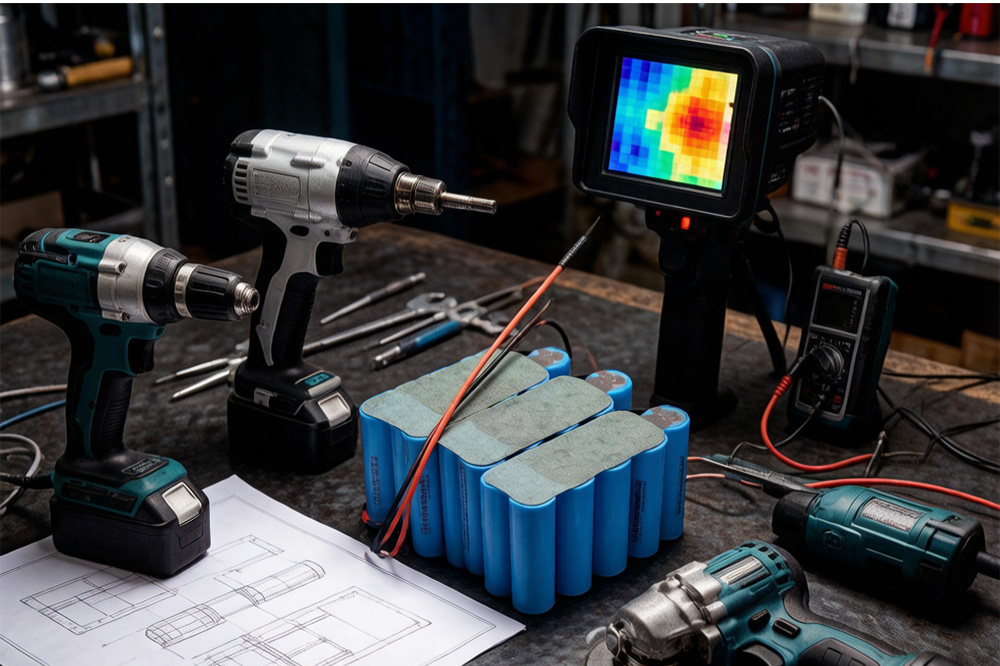
Not long ago, a customer sent us a short video from his production line.
Several cordless impact drivers were being tested one after another. Everything looked normal until the operator picked up the fourth tool. The motor still worked, but it didn’t sound quite right. The hammering felt weaker, almost as if the battery had already been half used.
The strange part was that all the battery packs had just come off the charger.
After a closer inspection, the reason became clear. The batteries had similar capacity ratings, but they weren’t built with the same type of cells.
That situation comes up more often than people might expect.
Many buyers compare voltage and capacity first because those are the easiest numbers to understand. High discharge rate doesn’t usually receive the same attention, even though it’s one of the biggest factors affecting real-world performance.
Capacity Gets the Attention. Discharge Rate Does the Work.
If you’re buying batteries for flashlights or portable speakers, capacity is probably the right place to start.
Power tools are different.
A cordless drill doesn’t draw a steady amount of energy. Neither does an impact wrench or an angle grinder. The current demand changes constantly. Sometimes it jumps within a fraction of a second when the tool encounters resistance.
That’s exactly where high-discharge cells show their value.
Instead of struggling to deliver current, they respond quickly and maintain a more stable voltage. From the user’s perspective, the difference feels surprisingly simple.
The tool keeps pulling.
It doesn’t hesitate when drilling hardwood or cutting thick steel.
We’ve watched side-by-side tests where two battery packs carried nearly identical specifications. On paper, they looked interchangeable. During continuous operation, however, one pack maintained torque while the other gradually lost power as the temperature increased.
You probably wouldn’t notice that difference by reading the product label.

More Current Also Means More Heat
There’s another side to high-performance batteries that sometimes gets overlooked.
Delivering large amounts of current creates heat.
Actually, it creates more heat than many first-time designers expect.
Heat isn’t automatically a problem, but it becomes one if the battery pack isn’t prepared for it.
We’ve opened battery packs that used perfectly good cells but failed because the internal connections weren’t designed for heavy current. In one case, the nickel strips were simply too thin. The cells survived. The connections didn’t.
That experience changed how the customer approached future projects.
Instead of asking which battery had the highest capacity, they started asking how the entire battery pack handled continuous discharge.
It’s a better question.
High-Drain Cells Aren’t Just for Industrial Equipment
People often associate high-discharge batteries with professional construction tools, but that’s only part of the picture.
We’ve supplied battery packs for agricultural equipment, warehouse scanners, rescue tools, industrial cleaning machines, and even portable hydraulic devices.
Each application has its own operating pattern.
Some demand high current for only a few seconds.
Others keep drawing heavy loads for much longer.
That’s why there isn’t a single “best” 18650 cell.
Choosing the right battery is usually about understanding how the equipment is actually used rather than chasing the highest specification available.
A Battery Pack Is More Than a Collection of Cells
This is something we often explain during OEM discussions.
Customers sometimes spend weeks comparing battery cells from different manufacturers while paying very little attention to everything surrounding those cells.
Ironically, those surrounding components often determine whether the battery performs well.
The BMS, welding quality, nickel strip design, insulation materials, fuse protection, connector resistance, and housing ventilation all influence discharge performance.
Think about it this way.
A high-performance engine won’t reach its potential if it’s installed in a poorly designed vehicle.
Battery packs work in much the same way.
A premium cell inside a poorly designed pack won’t magically solve engineering problems.
Not Every Tool Needs the Highest Discharge Rate
This might sound unexpected coming from a battery manufacturer.
Sometimes, the highest-discharge cell isn’t the right choice.
If a cordless screwdriver is mainly used for light assembly work, using an expensive ultra-high-drain cell may not provide any meaningful benefit. It simply increases the overall battery cost.
On the other hand, a demolition hammer, rescue saw, or industrial grinder places completely different demands on the battery.
Those applications justify higher-discharge cells because the tool regularly operates near its performance limits.
Finding the balance between power, runtime, weight, and cost is usually where battery pack design becomes interesting.
And honestly, that’s where engineering experience matters far more than marketing specifications.

Looking Beyond the Cell: Why the Battery Pack Matters Just as Much
A few years ago, we worked with a customer developing a cordless concrete vibrator. The prototype already used reputable high-drain 18650 cells, so everyone expected the battery to perform well.
It didn’t.
The output became unstable after several minutes of continuous operation. At first, the customer assumed the cells were defective.
After testing, we found something else entirely.
The BMS was limiting the discharge current much earlier than necessary, and the internal layout trapped heat around the center cells. The cells weren’t the weak point—the battery pack design was.
Once the BMS parameters were adjusted and the internal structure was improved, the same cells delivered noticeably better performance.
That’s why we often tell customers not to judge a battery pack by its cell model alone.
Questions Worth Asking Before Placing a Bulk Order
We’ve noticed that experienced buyers rarely start with, “What’s your lowest price?”
Instead, their questions sound more like this:
- What is the continuous discharge current?
- How does the battery perform after 500 charge cycles?
- Has the battery pack been tested under continuous heavy load?
- How many temperature sensors are used?
- Can the BMS be customized for our equipment?
Those questions usually lead to better purchasing decisions because they focus on how the battery behaves in real working conditions, not just in a specification sheet.
High Discharge Doesn’t Mean Sacrificing Reliability
There’s a common assumption that higher power automatically means a shorter battery life.
Sometimes that’s true.
Sometimes it isn’t.
A properly matched high-drain 18650 cell operating within its design limits can actually last longer than a standard consumer cell that’s constantly pushed beyond its comfort zone.
We’ve seen battery packs fail not because they were powerful, but because they were asked to deliver more current than they were designed for every single day.
Choosing the right cell from the beginning is often less expensive than replacing batteries after deployment.
Building Battery Packs Around the Tool
Every cordless tool behaves a little differently.
An impact wrench creates short, repeated bursts of current.
A grinder may draw a heavy load almost continuously.
A pruning shear cycles on and off hundreds of times throughout the day.
These differences influence much more than battery capacity.
They affect cell selection, pack layout, BMS strategy, fuse design, connector choice, and thermal management.
That’s one reason OEM manufacturers increasingly choose custom battery packs instead of off-the-shelf solutions. The goal isn’t simply to build a battery—it’s to build one that matches the way the tool is actually used.

Working With an OEM Battery Manufacturer
For companies developing new cordless tools, battery selection shouldn’t be the final step of the project.
It works better when it’s one of the first.
Discussing discharge current, operating temperature, charging methods, available installation space, and expected duty cycles early in development often avoids expensive redesigns later.
At Apsenx, we’ve supported customers in industries ranging from construction and landscaping to industrial automation and cleaning equipment. Every project starts with the same question:
“How will this tool really be used?”
The answer usually tells us much more than a capacity rating ever could.
Frequently Asked Questions
What is a high-discharge 18650 battery?
A high-discharge 18650 battery is designed to deliver large amounts of current safely and consistently. These cells are commonly used in cordless drills, impact wrenches, grinders, and other professional power tools that require strong bursts of power.
Is a higher mAh rating always better?
Not necessarily. Higher capacity increases runtime, but it doesn’t automatically improve performance under heavy load. For demanding tools, discharge capability is often more important.
How can I tell if my tool needs a high-drain battery?
If the equipment frequently experiences heavy loads, rapid acceleration, or continuous operation, a high-drain battery is usually the better choice. The exact requirement depends on the motor and the application’s duty cycle.
Can the BMS affect power output?
Yes. The Battery Management System controls current limits, temperature protection, balancing, and safety functions. An improperly configured BMS can reduce performance even when premium cells are used.
Does Apsenx offer custom 18650 battery packs?
Yes. We provide OEM and ODM battery pack solutions based on your voltage, capacity, discharge current, enclosure size, and application. Our engineering team can help optimize both performance and reliability for your product.
Ready to Develop a Better Battery Pack?
Whether you’re designing a new cordless tool or upgrading an existing product, choosing the right 18650 battery pack involves much more than selecting a cell with the highest capacity.
At Apsenx, we manufacture custom 18650 lithium battery packs for power tools, industrial equipment, garden machinery, robotics, medical devices, and other professional applications.
If you have technical drawings, performance requirements, or an existing battery pack that needs improvement, our engineering team can help evaluate the design and recommend a solution tailored to your project.
-

12V 4400 mah Lithium ion 3S2P 18650 Battery Pack
-

18650 2000mAh 3.7 volt Lithium-ion Battery
-

18650 20V 3.0Ah Cordless Drill battery
-

18650 22.2V 7.8Ah 2600Mah 6S3P Rechargeable Battery Pack
-

18650 2600mAh Rechargeable Lithium-Ion Battery 3.7V
-

18650 3.7V 10Ah Li-Ion Power Battery Pack
-

18650 3.7V 3300mah Rechargeable Lithium ion Battery
-

18650 7S7P 24V 14Ah Lithium ion Electric Scooter Battery Pack
-

18650 battery 3.7V 1500mAh Lithium-Ion Battery
-

18650 Battery 3500 mah Rechargeable Battery Cells
-

18650 Electric Scooter 48V 13000mAh Lithium Battery
-

2600mAh 3S1P 11.1V 18650 Battery Packs
-

3.7V Li ion Rechargeable 3000mah 18650 Battery Cell
-

36V 5200mAh 10S2P 18650 Battery Pack
-

48v 4400mah 13S2P 18650 Rechargeable Battery Pack
-

7S2P 24V 18650 Lithium Battery Pack
-

Electric Scooter 36V 4400mAH 10S2P 18650 Battery Pack
-

ICR 18650 Battery 2200mah 3.7V
Leave a Reply