
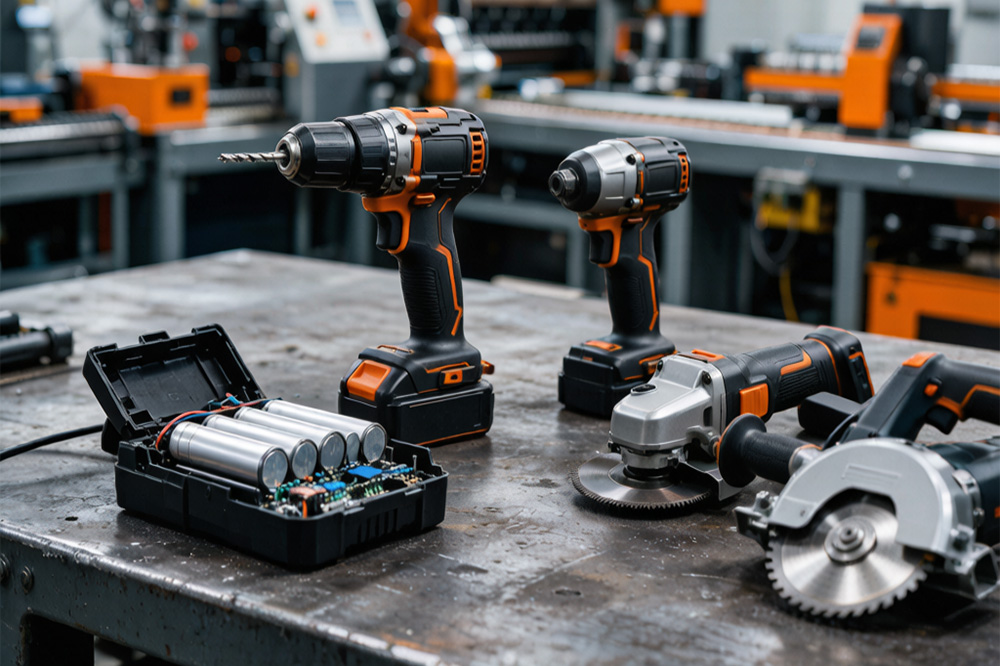
Most people notice the tool.
Few people notice the battery.
Pick up a cordless drill, an impact wrench, or an oscillating multi-tool, and the first thing you pay attention to is usually the grip, the trigger, or maybe how much torque it delivers. The battery sits quietly underneath, almost becoming invisible.
Until it doesn’t.
The moment a battery struggles to keep up, the entire tool feels different. Torque fades. Cutting slows. Charging becomes more frequent. Productivity slips little by little.
That’s probably why conversations about cordless tools eventually become conversations about batteries.
And more often than not, those conversations still come back to one familiar format — the 18650 lithium-ion cell.
Behind every cordless tool is a battery pack, not a single cell
There’s a common misunderstanding among first-time buyers.
Some imagine that one 18650 battery powers an entire cordless drill.
In reality, modern cordless tools rely on battery packs made from multiple cells working together.
A typical pack may connect cells in both series and parallel to create the voltage, capacity, and current output required by the tool.
That modular design gives engineers considerable flexibility.
A compact electric screwdriver needs something very different from a demolition-grade impact wrench. Yet both can be built around the same cylindrical cell format simply by changing the battery pack configuration.
For OEM manufacturers, that flexibility reduces development costs while simplifying large-scale production.

Different tools ask very different questions
One thing I’ve learned from watching production lines is that tools don’t “use batteries.”
They challenge them in completely different ways.
Take a cordless drill.
It spends much of its day drilling, pausing, drilling again.
Now compare that with an angle grinder.
Once the trigger is pulled, the battery faces continuous heavy current until the cut is complete.
An impact wrench behaves differently again.
Current demand rises sharply with every impact.
Portable circular saws often combine both sustained load and frequent acceleration.
The battery pack has to adapt to all of these situations.
That’s why battery engineers spend so much time studying discharge behavior instead of looking only at capacity.
Stable power usually beats impressive specifications
If you’ve browsed battery catalogs before, you’ve probably noticed that capacity numbers dominate product pages.
3000mAh.
3200mAh.
3500mAh.
Those numbers certainly matter.
But they rarely tell the whole story.
Imagine two battery packs.
One advertises slightly higher capacity but loses voltage quickly under heavy load.
The other maintains stable output throughout the job.
Most professionals will choose the second one every time.
Consistency doesn’t always look exciting on a specification sheet.
On a construction site, however, it’s immediately noticeable.

Heat is often the hidden enemy
Battery performance isn’t only about electricity.
It’s also about temperature.
Every time a cordless grinder cuts steel or an impact wrench loosens seized bolts, heat begins building inside the battery pack.
If that heat isn’t managed properly, several things can happen:
- Voltage drops earlier than expected
- Runtime decreases
- Cell aging accelerates
- Long-term cycle life shortens
This is one reason OEM battery manufacturers pay close attention to cell matching, pack structure, thermal spacing, and Battery Management System (BMS) design.
The user may never see those engineering details.
They’ll certainly notice the results.
The factory process matters more than many buyers realize
A battery pack is much more than a collection of cells.
Inside an OEM production facility, the manufacturing process usually includes:
- Cell grading
- Capacity matching
- Internal resistance testing
- Automated spot welding
- BMS installation
- Charge and discharge verification
- Aging tests
- Final quality inspection
Skip one of those steps, and the battery may still work.
It simply may not work consistently after hundreds of charging cycles.
That’s why experienced wholesale buyers often ask about factory processes before asking about pricing.

One battery technology, countless industries
Cordless tools have expanded far beyond construction sites.
Today, 18650 battery packs support equipment used in:
- Construction and renovation
- Furniture manufacturing
- Automotive assembly
- Warehouse maintenance
- Solar energy installation
- Industrial production lines
- Agricultural equipment servicing
- Home appliance assembly
Each application creates its own battery demands.
A production-line screwdriver may complete thousands of fastening cycles each shift.
A field technician might use an impact wrench only occasionally but expect maximum torque every time.
Different work patterns require different battery pack designs, even when the same cell format is used.
Why distributors continue buying 18650 battery packs
Battery technology continues evolving.
New cylindrical formats appear every few years.
Some offer higher energy density.
Others promise faster charging.
Yet wholesale distributors continue purchasing large quantities of 18650 battery packs.
Part of the reason is familiarity.
But there’s more to it than that.
The supply chain is mature.
Production equipment already exists.
Replacement demand remains steady.
OEM engineering experience is extensive.
International logistics are well established.
Taken together, these factors reduce uncertainty, and uncertainty is expensive in wholesale purchasing.
A conversation with an equipment manager
Not long ago, I spoke with a maintenance supervisor responsible for several hundred cordless tools.
I expected him to talk about battery capacity.
Instead, he said something much simpler.
“If my team finishes the shift without changing batteries halfway through a repair, I’m happy.”
That comment stayed with me.
It reminded me that end users rarely judge batteries by laboratory data.
They judge them by whether work gets finished on time.
Sometimes practical performance says more than any technical brochure ever could.
Looking beyond today’s battery trends
Will newer battery formats continue growing?
Almost certainly.
Technology rarely stands still.
Even so, 18650 battery packs remain one of the most practical solutions for cordless tools because they combine proven reliability, mature manufacturing, flexible pack design, and global availability.
For OEM manufacturers, distributors, and wholesale buyers, those qualities matter every day.
After all, cordless tools are built to keep people working.
Reliable batteries are what quietly make that possible.
-

12V 4400 mah Lithium ion 3S2P 18650 Battery Pack
-

18650 2000mAh 3.7 volt Lithium-ion Battery
-

18650 20V 3.0Ah Cordless Drill battery
-

18650 22.2V 7.8Ah 2600Mah 6S3P Rechargeable Battery Pack
-

18650 2600mAh Rechargeable Lithium-Ion Battery 3.7V
-

18650 3.7V 10Ah Li-Ion Power Battery Pack
-

18650 3.7V 3300mah Rechargeable Lithium ion Battery
-

18650 7S7P 24V 14Ah Lithium ion Electric Scooter Battery Pack
-

18650 battery 3.7V 1500mAh Lithium-Ion Battery
-

18650 Battery 3500 mah Rechargeable Battery Cells
-

18650 Electric Scooter 48V 13000mAh Lithium Battery
-

2600mAh 3S1P 11.1V 18650 Battery Packs
-

3.7V Li ion Rechargeable 3000mah 18650 Battery Cell
-

36V 5200mAh 10S2P 18650 Battery Pack
-

48v 4400mah 13S2P 18650 Rechargeable Battery Pack
-

7S2P 24V 18650 Lithium Battery Pack
-

Electric Scooter 36V 4400mAH 10S2P 18650 Battery Pack
-

ICR 18650 Battery 2200mah 3.7V
Leave a Reply