
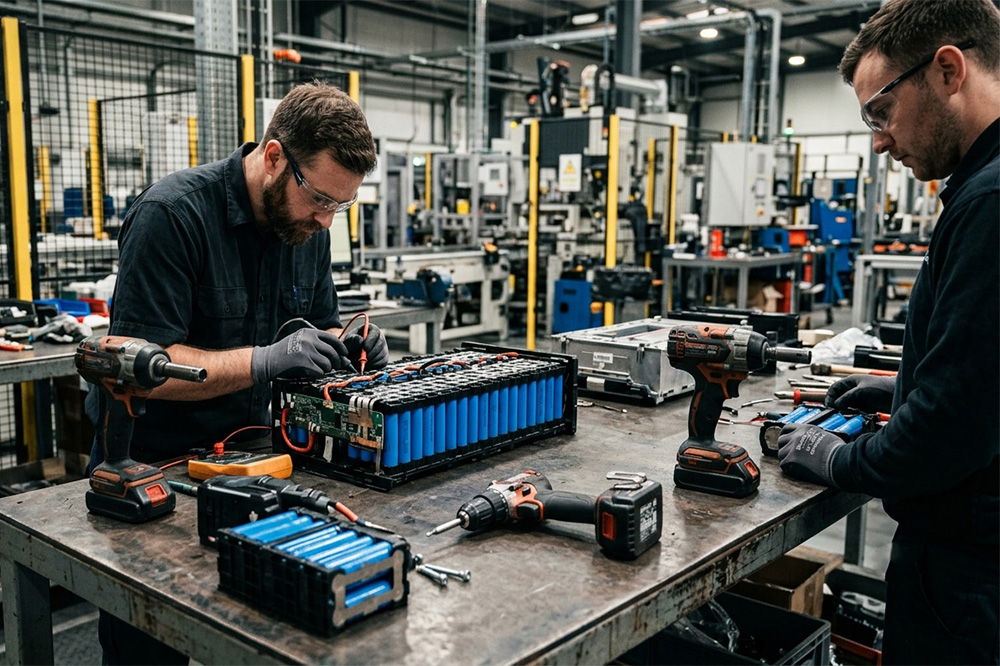
Walk into almost any repair workshop and you’ll hear the same sound all day long—the sharp clicks of electric screwdrivers and the deep bursts of impact wrenches.
People usually pay attention to motor power, maximum torque, or brushless technology. Strangely enough, the battery pack is often treated as an afterthought.
From what we’ve seen working with OEM customers, that’s usually where problems begin.
A powerful motor doesn’t mean much if the battery can’t keep up. We’ve talked with tool manufacturers who upgraded their motors only to discover the finished product actually felt weaker during continuous use. The reason wasn’t mechanical—it was hidden inside the battery pack.
The choice of cells, pack design, and battery management system all influence how a tool performs after the trigger is pulled.
A Small Tool Can Demand a Surprisingly Powerful Battery
Electric screwdrivers don’t look demanding.
Most people assume they only tighten a few screws and consume very little power.
That may be true for household models.
Industrial screwdrivers used on production lines are another story.
Imagine an assembly operator fastening hundreds or even thousands of screws during a shift. The tool starts and stops every few seconds. Each trigger pull creates a short but significant current demand.
Impact wrenches push the battery even harder.
Removing rusted wheel bolts or tightening heavy structural fasteners requires repeated bursts of very high current. During those moments, the battery has only one job—deliver stable power immediately.
If voltage drops too much, users notice it right away.
The tool feels slower.
Torque becomes inconsistent.
The battery warms up faster than expected.
Sometimes workers simply assume the motor isn’t powerful enough, when the real limitation is the battery pack.

Why 18650 Cells Continue to Dominate Many Power Tools
With larger formats like 21700 becoming more common, some buyers wonder whether 18650 cells are becoming obsolete.
Not really.
Many professional tool manufacturers continue using 18650 cells because the format has matured over many years.
That brings several practical advantages.
The supply chain is stable.
Pack configurations are flexible.
Replacement parts are widely available.
Manufacturing costs remain competitive.
For compact electric screwdrivers, the smaller diameter also allows designers to create slimmer handles that feel more comfortable during extended use.
Sometimes the best engineering solution isn’t the newest one.
It’s Not About the Highest Capacity
One purchasing manager once told us,
“Just give us the highest mAh battery you have.”
It’s a reasonable request—until you look at how impact tools actually work.
Higher capacity usually comes with a compromise.
Cells designed for maximum energy storage often aren’t optimized for sustained high-current discharge.
That’s why experienced battery engineers rarely start by asking,
“How many milliamp-hours do you need?”
Instead, they ask questions like:
- What’s the peak current of the motor?
- How long does each working cycle last?
- Is this tool used occasionally or all day?
- What’s the operating temperature?
Those answers determine whether a slightly lower-capacity, high-drain cell may actually outperform a larger-capacity alternative.
For power tools, stable output usually matters more than impressive numbers printed on a specification sheet.
Battery Configuration Changes Everything
The individual cell is only part of the story.
Battery pack configuration affects voltage, runtime, and overall performance.
Common examples include:
3S1P
Compact screwdrivers for light-duty assembly.
5S2P
Professional cordless drills and heavy-duty electric screwdrivers.
5S3P
Industrial impact wrenches requiring longer runtime.
10S2P
High-voltage professional equipment with greater power demand.
Choosing the wrong configuration often leads to oversized packs, unnecessary weight, or disappointing runtime.
Good battery pack design starts with understanding how the tool is actually used, not simply fitting in as many cells as possible.
Inside a Reliable Power Tool Battery Pack
From the outside, most battery packs look nearly identical.
Inside, the differences can be significant.
Reliable OEM battery packs typically include:
- Matched high-drain 18650 cells
- Precision spot welding
- Thick nickel strips for lower resistance
- Battery Management System (BMS)
- Temperature protection
- Short-circuit protection
- Overcharge and over-discharge protection
- Strong impact-resistant housing
One detail that’s often overlooked is cell matching.
Even high-quality cells won’t perform well if their internal resistance varies too much. Over time, mismatched cells create uneven charging and discharging, reducing the lifespan of the entire pack.
What Industrial Buyers Usually Care About
When discussing new projects with equipment manufacturers, the conversation rarely starts with battery chemistry.
Instead, questions sound more like this:
“Can this pack survive daily charging for two years?”
“Can you customize the connector to fit our existing housing?”
“Can the BMS communicate with our controller?”
“Can you match the dimensions of our current battery pack?”
These are practical concerns.
And they often matter more than adding another 100mAh to the specification.
18650 vs 26650 for Power Tools
Some buyers also compare 18650 and 26650 cells.
On paper, 26650 cells offer larger capacity and higher current capability because of their bigger physical size.
But bigger isn’t always better.
Larger cells increase battery weight.
They require a bulkier housing.
Existing power tool molds may need to be redesigned.
For compact electric screwdrivers, this extra size can affect ergonomics more than expected.
That’s one reason many OEM manufacturers still prefer 18650 packs, especially when compatibility with existing products is important.
Unless extremely long runtime is the primary goal, 18650 remains the more practical choice for many cordless power tools.

Custom Battery Packs Make More Sense Than Standard Packs
One thing we’ve noticed is that very few industrial customers buy completely standard battery packs anymore.
Most projects require some level of customization.
That could include:
- Different connectors
- Plastic housing design
- Communication protocol
- Battery indicator
- Waterproof sealing
- Charging interface
- Cell brand preference
- Private labeling
Building the battery around the tool usually produces a better result than forcing the tool to fit an off-the-shelf battery.
Choosing OEM Battery Pack Supplier
Price is always part of the conversation.
But experienced buyers usually look further.
Questions worth asking include:
- Can production remain consistent across large orders?
- Are incoming cells tested before assembly?
- Does the supplier perform aging tests?
- Can battery packs pass UN38.3 transportation requirements?
- Is technical support available during development?
- Can prototypes be delivered quickly?
Reliable suppliers don’t simply manufacture battery packs—they help reduce problems before mass production begins.

Wholesale 18650 Battery Packs for Electric Screwdrivers and Impact Wrenches
Whether you’re developing cordless electric screwdrivers, impact wrenches, assembly tools, automotive repair equipment, or industrial fastening systems, choosing the right battery pack directly affects product reliability and customer satisfaction.
Our OEM team supports custom 18650 lithium battery pack development based on your voltage, capacity, discharge current, housing dimensions, and communication requirements.
From prototype development to mass production, we provide wholesale battery solutions designed for professional power tools worldwide.
Contact us today to discuss your OEM battery project and receive a customized quotation.
FAQ
Why are 18650 batteries still widely used in power tools?
They offer an excellent balance of size, weight, discharge capability, mature manufacturing, and cost, making them ideal for many cordless power tools.
What is more important, capacity or discharge rate?
For electric screwdrivers and impact wrenches, discharge capability is often more important. A battery that maintains stable voltage under load delivers more consistent torque.
Can you customize battery packs for our existing tool?
Yes. OEM battery packs can be customized for voltage, capacity, connectors, housing, BMS, communication protocols, and branding.
How long should a professional battery pack last?
Service life depends on usage patterns, charging conditions, and cell quality. Properly designed industrial battery packs generally provide hundreds of charge cycles while maintaining stable performance.
-

12V 4400 mah Lithium ion 3S2P 18650 Battery Pack
-

18650 2000mAh 3.7 volt Lithium-ion Battery
-

18650 20V 3.0Ah Cordless Drill battery
-

18650 22.2V 7.8Ah 2600Mah 6S3P Rechargeable Battery Pack
-

18650 2600mAh Rechargeable Lithium-Ion Battery 3.7V
-

18650 3.7V 10Ah Li-Ion Power Battery Pack
-

18650 3.7V 3300mah Rechargeable Lithium ion Battery
-

18650 7S7P 24V 14Ah Lithium ion Electric Scooter Battery Pack
-

18650 battery 3.7V 1500mAh Lithium-Ion Battery
-

18650 Battery 3500 mah Rechargeable Battery Cells
-

18650 Electric Scooter 48V 13000mAh Lithium Battery
-

2600mAh 3S1P 11.1V 18650 Battery Packs
-

3.7V Li ion Rechargeable 3000mah 18650 Battery Cell
-

36V 5200mAh 10S2P 18650 Battery Pack
-

48v 4400mah 13S2P 18650 Rechargeable Battery Pack
-

7S2P 24V 18650 Lithium Battery Pack
-

Electric Scooter 36V 4400mAH 10S2P 18650 Battery Pack
-

ICR 18650 Battery 2200mah 3.7V
Leave a Reply