
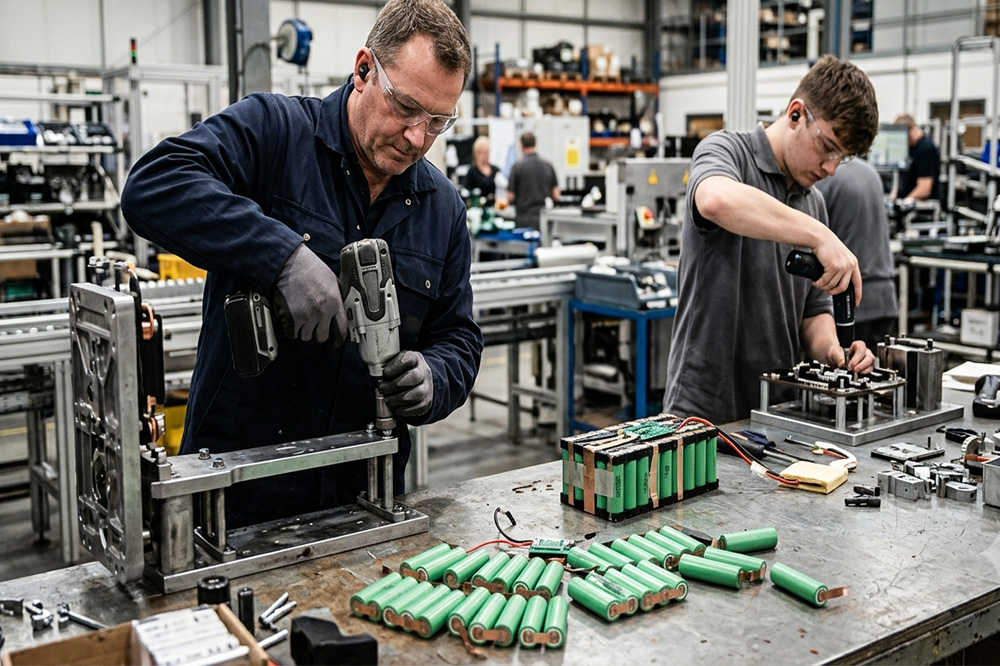
There are some cordless tools that quietly reveal whether a battery pack is well designed.
Electric screwdrivers are one of them.
Impact wrenches are another.
Neither tool gives the battery much time to prepare. The moment the trigger is pulled, current demand rises almost instantly. If the battery can’t respond quickly enough, users feel it before they ever read a specification sheet. The tool slows down, torque feels inconsistent, and jobs that should take minutes begin taking much longer.
That’s why 18650 lithium battery packs continue to be widely used in professional power tools. Not because they’re the newest battery format, but because years of OEM production and field use have shown that, when properly assembled, they deliver a balance of power, flexibility, and dependable performance.
Small tools, surprisingly demanding batteries
An electric screwdriver doesn’t look intimidating.
It’s compact, lightweight, and often used for repetitive assembly work. Yet this type of tool places a unique demand on lithium batteries.
Imagine an assembly worker tightening hundreds of screws during a single shift. The tool stops and starts constantly, asking the battery to deliver repeated bursts of current. There’s little time for the cells to recover between cycles.
An impact wrench pushes the battery even harder.
Breaking loose rusted bolts or tightening structural fasteners requires sudden, high-current output. Every impact creates another demand on the battery pack. The process repeats dozens or even hundreds of times each day.
From the outside, both tools seem simple.
Inside the battery pack, however, the workload is anything but.

Capacity catches attention. Stable output keeps the job moving.
One thing I’ve noticed after talking with battery pack buyers is that the conversation usually changes after the first production run.
At the beginning, many buyers ask about capacity.
3000mAh?
3200mAh?
3500mAh?
A few months later, the questions become different.
Can the battery maintain torque after several hours of work?
Does voltage stay stable when the tool is under repeated load?
How much heat builds up inside the battery pack?
Those questions usually matter more in real production.
A slightly smaller capacity cell that maintains consistent output often delivers a better user experience than a higher-capacity cell that struggles under heavy current demand.
That’s why experienced OEM manufacturers rarely judge a battery by one number alone.

The battery pack matters as much as the cells
It’s easy to assume that choosing premium cells automatically creates a premium battery pack.
Reality is a little more complicated.
The finished performance depends on several factors working together:
- Cell matching before assembly
- Nickel strip welding quality
- Battery Management System (BMS)
- Internal resistance consistency
- Thermal management
- Pack structure and vibration resistance
I’ve seen battery packs with nearly identical specifications behave very differently after months of use.
The difference often comes down to manufacturing discipline rather than advertised specifications.
For wholesale buyers, that’s an important distinction.

OEM factories focus on repeatability, not just performance
Factories building thousands of battery packs every month don’t evaluate products the same way end users do.
Their biggest concern isn’t whether one battery performs well.
It’s whether ten thousand batteries perform the same way.
That changes the entire production philosophy.
Most manufacturers spend significant time on:
- Automated cell grading
- Capacity matching
- Internal resistance sorting
- Charge and discharge testing
- Aging tests before shipment
- Finished pack inspection
These steps don’t make marketing headlines, but they greatly reduce field failures.
And for distributors supplying industrial customers, fewer failures usually mean stronger long-term business relationships.
Where these battery packs are working every day
Electric screwdrivers and impact wrenches are no longer limited to repair shops.
They’re now common in:
- Furniture manufacturing lines
- Automotive assembly plants
- Metal fabrication workshops
- Solar panel installation
- Warehouse equipment maintenance
- Industrial production facilities
- Home appliance assembly
- Construction projects
Each environment creates a different load profile.
A screwdriver on an electronics assembly line may operate thousands of times with relatively low torque.
An impact wrench at a truck maintenance center may spend the entire day removing seized wheel bolts.
The same battery format supports both, but the internal battery pack design is often very different.
That’s one reason custom OEM battery packs remain in high demand.
Choosing the right supplier becomes part of the product
One purchasing manager once told me something that stayed in my mind:
“We don’t really buy batteries. We buy consistency.”
That sentence explains why supplier selection matters so much.
Reliable factories typically offer more than finished battery packs.
They also provide:
- OEM and ODM customization
- Stable production capacity
- Batch consistency
- Engineering support
- Flexible pack configurations
- International certification support
- Long-term supply planning
For wholesalers, these services reduce uncertainty as much as they improve the product itself.
A real example from industrial maintenance
Consider a maintenance team working in a manufacturing plant.
During a routine shift, technicians might tighten electrical terminals with an electric screwdriver, install machine guards, and then switch to an impact wrench to remove worn mechanical components.
The tools are used intermittently rather than continuously.
Sometimes they sit idle for thirty minutes.
Then they operate at full load for the next ten.
These changing work patterns are surprisingly difficult for a battery pack.
A well-designed 18650 lithium battery pack handles these transitions smoothly, maintaining stable voltage and consistent torque without noticeable performance drops.
That’s exactly the type of reliability industrial users expect, even if they never think about the battery itself.
Wholesale demand continues to grow for one simple reason
Battery technology will continue to evolve.
New cell formats will enter the market.
Some applications will eventually move in different directions.
Yet for electric screwdrivers and impact wrenches, 18650 lithium battery packs remain one of the most practical solutions available today.
They offer mature manufacturing processes, flexible pack configurations, dependable high-current performance, and an established global supply chain.
For OEM manufacturers, distributors, and wholesale buyers, those advantages often outweigh the appeal of chasing the newest battery format.
In large-scale production, consistency is rarely the most exciting feature.
It’s simply the one customers come back for.
按类别列出产品
-

12V 4400 mah Lithium ion 3S2P 18650 Battery Pack
-

18650 2000mAh 3.7 volt Lithium-ion Battery
-

18650 20V 3.0Ah Cordless Drill battery
-

18650 22.2V 7.8Ah 2600Mah 6S3P Rechargeable Battery Pack
-

18650 2600mAh Rechargeable Lithium-Ion Battery 3.7V
-

18650 3.7V 10Ah Li-Ion Power Battery Pack
-

18650 3.7V 3300mah Rechargeable Lithium ion Battery
-

18650 7S7P 24V 14Ah Lithium ion Electric Scooter Battery Pack
-

18650 battery 3.7V 1500mAh Lithium-Ion Battery
-

18650 Battery 3500 mah Rechargeable Battery Cells
-

18650 Electric Scooter 48V 13000mAh Lithium Battery
-

2600mAh 3S1P 11.1V 18650 Battery Packs
-

3.7V Li ion Rechargeable 3000mah 18650 Battery Cell
-

36V 5200mAh 10S2P 18650 Battery Pack
-

48v 4400mah 13S2P 18650 Rechargeable Battery Pack
-

7S2P 24V 18650 Lithium Battery Pack
-

Electric Scooter 36V 4400mAH 10S2P 18650 Battery Pack
-

ICR 18650 Battery 2200mah 3.7V
Leave a Reply