
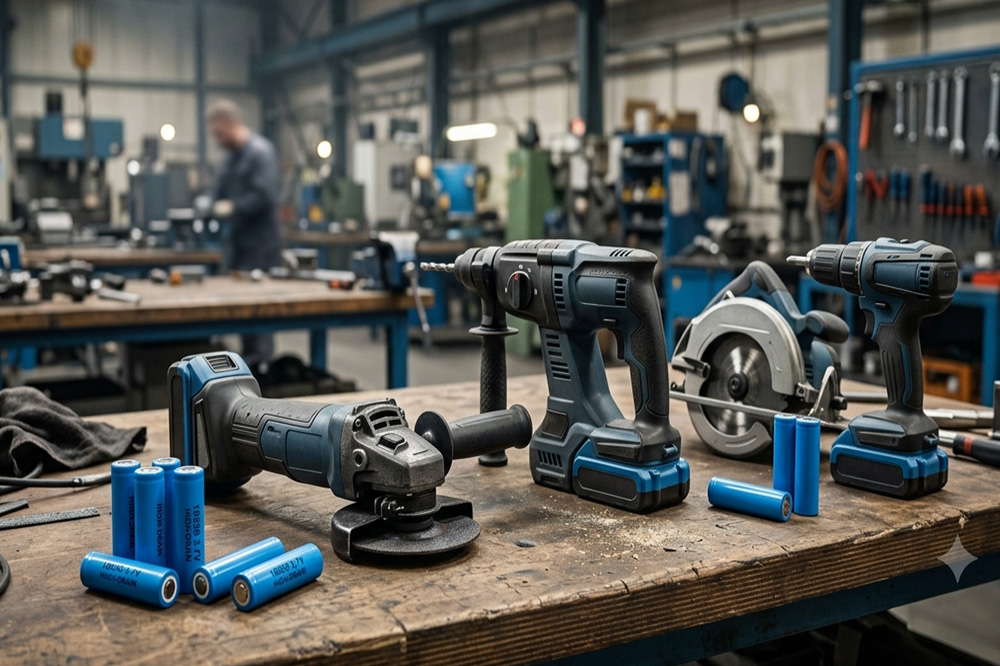
If you’ve ever opened a cordless drill battery pack, an angle grinder, or a demolition hammer battery, you’ve probably noticed something interesting.
Most of them still rely on 18650 cells.
That surprises some buyers because newer formats like 21700 receive much of the attention today. Yet many industrial manufacturers continue building professional battery packs around high-drain 18650 cells—not because they’re outdated, but because they offer a balance that’s difficult to replace.
We’ve spoken with OEM customers who originally requested “the highest mAh available.” After discussing how their tools were actually used, nearly all of them ended up choosing a different cell.
Capacity is only one piece of the puzzle.
When an industrial tool pulls 20A, 30A, or even more during startup, the battery experiences a completely different kind of stress than a flashlight or power bank. Selecting the wrong cell may not cause immediate failure, but it often leads to overheating, reduced runtime under load, voltage sag, and a noticeably shorter service life.
This article explores what really defines a high-drain 18650 battery and why industrial buyers should evaluate more than just the capacity printed on the label.
Why Industrial Power Tools Demand High-Drain Cells
Imagine using a cordless angle grinder to cut steel beams throughout the day.
The motor doesn’t consume current evenly. Every time the trigger is pulled, current spikes sharply before settling into continuous operation. Hammer drills, reciprocating saws, impact wrenches, and chainsaws behave similarly.
These repeated current bursts place significant stress on the battery.
A consumer-grade cell designed mainly for long runtime often struggles in this environment. Internal resistance causes voltage to drop quickly, the tool may lose torque, and excessive heat builds inside the battery pack.
Industrial applications typically require batteries that can:
- Deliver high continuous current
- Handle repeated surge loads
- Recover voltage quickly
- Maintain stable output under heavy load
- Resist heat accumulation during long working cycles
That is exactly where high-drain 18650 cells make a difference.

Capacity Isn’t Everything
One of the biggest misconceptions among first-time buyers is that higher capacity automatically means better performance.
In reality, battery design is always a compromise.
Higher capacity usually requires thinner electrodes and more active material packed inside the cell. While this increases energy storage, it often limits how much current the cell can safely deliver.
Conversely, cells engineered for very high discharge rates tend to sacrifice some capacity in exchange for stronger current output and lower internal resistance.
A practical example helps illustrate this.
A maintenance team replacing batteries for cordless grinders once selected the highest-capacity cells available because they expected longer operating time.
On paper, that seemed reasonable.
However, workers soon noticed the grinders slowed noticeably during heavy cutting, especially after several minutes of continuous use. Heat also built up more quickly than before.
Switching to genuine high-drain cells with slightly lower capacity restored cutting performance and actually improved productivity. Although the nominal runtime per charge was a bit shorter, jobs finished faster because the tools maintained full power.
For industrial users, consistent performance often matters more than squeezing every last milliamp-hour from a battery.
What Defines a High-Drain 18650 Cell?
There isn’t one universal specification that labels a battery as “high-drain.”
Instead, manufacturers evaluate several technical characteristics together.
Continuous Discharge Current
Continuous discharge rating indicates how much current a cell can safely provide without overheating.
Industrial tools commonly require cells capable of sustained high-current output rather than short marketing bursts.
Ignoring continuous ratings while focusing only on pulse current can lead to unreliable battery packs.
Low Internal Resistance
Internal resistance directly affects voltage drop.
Lower resistance means:
- Higher efficiency
- Better acceleration for power tools
- Less heat generation
- Improved cycle life
This specification often receives less attention than capacity, but experienced battery engineers usually treat it as one of the first numbers worth checking.
Thermal Stability
Heavy-duty applications naturally generate heat.
Cells intended for industrial tools are designed to maintain stable electrochemical performance even after repeated high-current cycles.
Heat management becomes especially important inside compact battery packs where multiple cells sit closely together.
Cycle Life Under High Load
Many battery datasheets quote impressive cycle life figures under ideal laboratory conditions.
Industrial environments are rarely ideal.
Construction equipment, warehouse tools, mining equipment, and outdoor maintenance all expose batteries to vibration, dust, temperature swings, and repeated high-current demand.
A cell that survives 800 laboratory cycles may perform very differently after months of real-world industrial use.
Matching Cell Performance to Different Power Tools
Not every cordless tool stresses a battery the same way.
| Tool | Typical Requirement |
|---|---|
| Cordless Drill | Balanced capacity and discharge |
| Impact Driver | Fast current response |
| Angle Grinder | Very high continuous discharge |
| Rotary Hammer | Stable high-load output |
| Circular Saw | High peak current |
| Reciprocating Saw | Continuous heavy current |
| Garden Tools | Long runtime with moderate discharge |
Selecting cells according to actual tool behavior usually delivers better long-term results than choosing a single specification for every battery pack.
OEM Battery Packs Need More Than Good Cells
This is something many purchasing managers discover only after production begins.
A battery pack is never just a collection of cells.
Even excellent cells can perform poorly if the pack design isn’t optimized.
Factors including:
- Cell matching
- Nickel strip thickness
- Welding quality
- BMS programming
- Thermal layout
- Wire gauge
- Connector quality
all influence overall performance.
We’ve seen situations where replacing the cells solved only half of the problem because excessive voltage loss actually originated from undersized nickel strips or poor welding consistency.
Reliable OEM battery pack manufacturing treats the entire electrical system as one integrated product rather than focusing only on the cells.
Industrial Buyers Are Asking Different Questions Today
Five years ago, buyers often compared only price and capacity.
Today, purchasing conversations have changed.
Many OEM customers now ask:
“How much current can the pack continuously deliver?”
“What happens at 45°C ambient temperature?”
“Can the cells remain consistent after hundreds of charge cycles?”
“Can you customize the BMS for our equipment?”
Those questions usually lead to better battery packs than simply requesting the highest-capacity cell available.
Choosing the Right High-Drain 18650 Battery Supplier
Not every battery supplier specializes in industrial applications.
Before placing a large wholesale order, buyers usually evaluate several practical areas:
- Consistent cell grading between production batches
- Stable long-term supply capability
- Support for custom battery pack assembly
- Comprehensive safety testing
- OEM and private-label manufacturing
- Engineering assistance during battery pack development
- Certifications required for international shipping
Working with a manufacturer familiar with industrial battery packs often reduces redesign work later in the project.

Wholesale OEM Solutions for Industrial Power Tool Batteries
Whether you’re producing cordless drills, construction equipment, outdoor power tools, cleaning machines, or industrial automation devices, selecting the right high-drain 18650 cell is only the starting point.
A professional OEM partner can help optimize:
- Cell selection
- Battery configuration
- BMS design
- Mechanical housing
- Connector compatibility
- Safety protection
- Global transportation compliance
For wholesale buyers, these engineering details usually matter far more than chasing the highest advertised battery capacity.
If you’re developing a new industrial power tool or replacing an existing battery platform, our engineering team can recommend the most suitable high-discharge 18650 solution based on your current requirements, runtime expectations, and production budget.
Frequently Asked Questions
Is a higher mAh rating always better for industrial power tools?
Not necessarily. Higher-capacity cells generally store more energy, but they may deliver lower continuous current. For tools with heavy startup loads, a high-drain cell often provides better real-world performance.
How many amps should a high-drain 18650 battery support?
The required discharge current depends on the application. Heavy-duty industrial tools typically demand cells capable of delivering stable high continuous current rather than relying on short pulse ratings.
Can 18650 batteries still compete with 21700 cells?
Yes. Although 21700 cells offer higher energy density, many industrial battery packs continue using 18650 cells because of mature manufacturing, flexible pack design, and broad compatibility with existing equipment.
What affects battery life besides the cell itself?
Battery management systems, charging methods, welding quality, thermal design, operating temperature, and user habits all influence service life.
CTA
Looking for High-Drain 18650 Battery Packs for OEM Projects?
Whether you need individual high-discharge 18650 cells or fully customized lithium battery packs for industrial power tools, our engineering team can help you select the right solution based on discharge current, runtime, and application requirements.
Contact us today for wholesale pricing, OEM customization, and technical consultation.
-

12V 4400 mah Lithium ion 3S2P 18650 Battery Pack
-

18650 2000mAh 3.7 volt Lithium-ion Battery
-

18650 20V 3.0Ah Cordless Drill battery
-

18650 22.2V 7.8Ah 2600Mah 6S3P Rechargeable Battery Pack
-

18650 2600mAh Rechargeable Lithium-Ion Battery 3.7V
-

18650 3.7V 10Ah Li-Ion Power Battery Pack
-

18650 3.7V 3300mah Rechargeable Lithium ion Battery
-

18650 7S7P 24V 14Ah Lithium ion Electric Scooter Battery Pack
-

18650 battery 3.7V 1500mAh Lithium-Ion Battery
-

18650 Battery 3500 mah Rechargeable Battery Cells
-

18650 Electric Scooter 48V 13000mAh Lithium Battery
-

2600mAh 3S1P 11.1V 18650 Battery Packs
-

3.7V Li ion Rechargeable 3000mah 18650 Battery Cell
-

36V 5200mAh 10S2P 18650 Battery Pack
-

48v 4400mah 13S2P 18650 Rechargeable Battery Pack
-

7S2P 24V 18650 Lithium Battery Pack
-

Electric Scooter 36V 4400mAH 10S2P 18650 Battery Pack
-

ICR 18650 Battery 2200mah 3.7V
Leave a Reply