
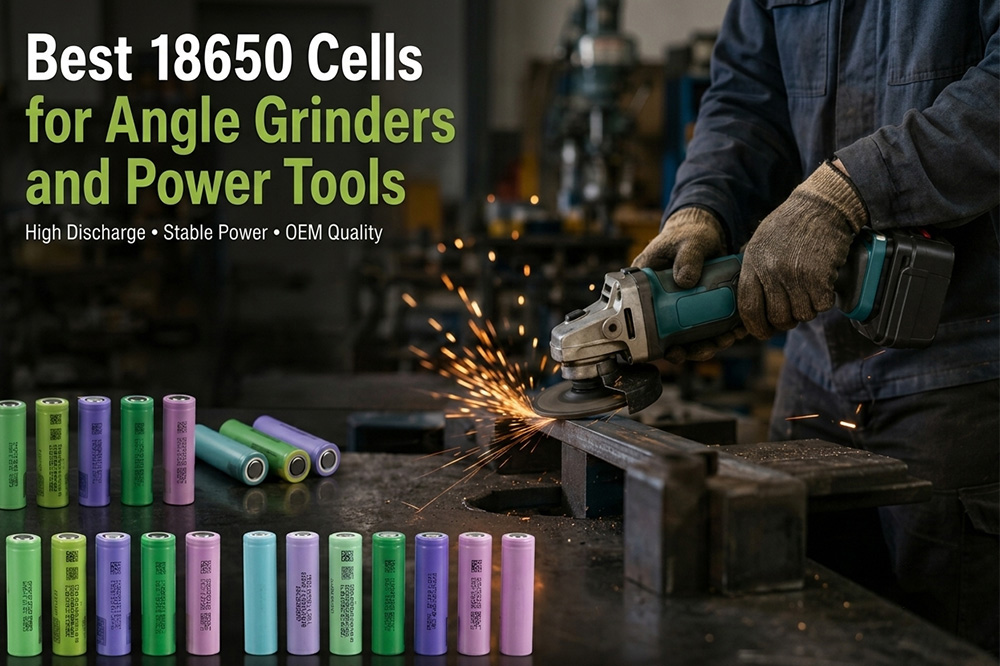
If you’ve ever used a cordless angle grinder, you’ve probably noticed something that doesn’t happen with a flashlight or a portable fan.
The battery works hard from the very first second.
There’s no gentle start.
The motor asks for a large amount of current almost immediately, and it keeps doing that until the cut is finished.
That single difference explains why choosing an 18650 cell for power tools is very different from choosing one for consumer electronics.
Capacity matters, of course.
But once heavy loads enter the picture, capacity stops being the first priority.
Angle grinders expose weak batteries very quickly
Construction workers usually don’t need battery analyzers.
They can tell within a few minutes whether a battery pack is built well.
If the grinder slows noticeably while cutting steel, they notice.
If the battery becomes unusually hot after several cuts, they notice.
If charging finishes quickly but runtime keeps getting shorter every week, they notice that too.
In many ways, angle grinders are one of the hardest cordless tools for lithium batteries.
Unlike drills, which often work in short bursts, grinders may stay under heavy load continuously.
That changes how manufacturers evaluate battery cells.

High discharge capability usually matters more than maximum capacity
It’s tempting to compare batteries only by milliamp-hours.
3000mAh looks better than 2500mAh.
3500mAh sounds even better.
But real production rarely works like that.
Many OEM battery manufacturers are willing to sacrifice a little capacity if it means obtaining:
- lower internal resistance
- better heat control
- stronger continuous discharge
- more stable voltage under load
That’s because power tools don’t reward the highest capacity.
They reward stable power delivery.
A grinder that keeps cutting smoothly is usually more valuable than one that simply runs a few extra minutes under light testing conditions.

Not every “high-performance” cell performs the same inside a battery pack
One interesting thing becomes obvious after visiting battery pack factories.
Engineers rarely evaluate a single cell by itself.
Instead, they evaluate how groups of cells behave together.
A battery pack is a complete system.
Cell matching.
Nickel strip welding.
Battery management.
Heat distribution.
Assembly accuracy.
Each part influences the final result.
Two battery packs using similar 18650 specifications can feel surprisingly different once installed inside an angle grinder.
That’s one reason experienced OEM manufacturers spend so much time matching cells before production begins.

Why distributors continue choosing 18650 cells
Battery technology keeps evolving.
Larger cylindrical cells receive plenty of attention.
Even so, distributors continue ordering large volumes of 18650 cells.
There are practical reasons behind that decision.
The manufacturing ecosystem is already mature.
Production equipment is widely available.
Replacement demand remains strong.
Supply chains are stable.
And perhaps most importantly, battery pack designs have already been optimized around this format.
Changing cell formats doesn’t only change the battery.
Sometimes it changes tooling, production processes, enclosures, and inventory planning as well.
For wholesale buyers, that’s a significant investment.
One battery rarely fits every power tool
This is something many first-time buyers overlook.
A battery pack designed for a cordless screwdriver isn’t automatically suitable for an angle grinder.
Different tools place completely different demands on lithium cells.
Cordless drills
Usually experience repeated bursts of moderate-to-high current.
Angle grinders
Often maintain heavy continuous loads while generating significant heat.
Impact wrenches
Require extremely high current for short periods.
Portable saws
Need consistent voltage output throughout long cutting sessions.
Industrial maintenance equipment introduces yet another usage pattern.
Sometimes tools remain idle for hours.
Then suddenly operate at maximum load.
Those unpredictable conditions are exactly why OEM battery pack manufacturers focus heavily on discharge stability instead of capacity alone.

The replacement market tells an interesting story
Repair shops often see batteries long before manufacturers do.
Their observations are surprisingly practical.
Many failed battery packs don’t contain completely dead cells.
Instead, they contain cells that have drifted apart over time.
One weak cell forces the entire battery pack to perform below its potential.
That’s why replacement battery packs built with carefully matched 18650 cells often restore tool performance much more effectively than replacing individual cells without proper balancing.
For distributors, this creates continuous aftermarket demand.
Construction companies.
Equipment rental businesses.
Maintenance contractors.
Battery rebuilding services.
All continue purchasing replacement packs years after the original tool entered service.
What wholesale buyers usually ask before placing orders
Interestingly, professional buyers rarely begin with capacity questions anymore.
Instead, conversations often start with topics like:
- Can production remain consistent across future batches?
- What discharge rate is recommended for heavy-duty grinders?
- Are OEM and ODM battery pack services available?
- Can battery packs be customized for different voltage platforms?
- What quality control process is used before shipment?
- How are cells matched during production?
Those questions reveal something important.
Wholesale purchasing isn’t just about buying batteries.
It’s about reducing production risk.
Choosing a factory partner is often more important than choosing a specification
Two suppliers can advertise similar technical data.
The finished battery packs may still perform very differently.
That’s why experienced manufacturers usually evaluate more than product specifications.
They also consider:
Factory production capacity.
Cell grading procedures.
Automated testing equipment.
Pack assembly consistency.
OEM engineering support.
Long-term supply stability.
Those factors don’t always appear in product catalogs, but they often determine whether a battery pack performs reliably after hundreds of charging cycles.
Looking beyond the specification sheet
If there’s one lesson the power tool industry keeps repeating, it’s probably this:
The best 18650 cell isn’t always the one with the biggest number printed on the label.
For angle grinders and other demanding cordless tools, reliable power delivery, stable discharge behavior, and consistent manufacturing quality usually matter much more.
That’s why OEM manufacturers, distributors, and wholesale buyers continue choosing factory-tested 18650 cells backed by dependable production processes instead of chasing specifications alone.
When thousands of battery packs are headed to construction sites, workshops, and industrial maintenance teams, consistency is what keeps both tools and businesses running.
-

12V 4400 mah Lithium ion 3S2P 18650 Battery Pack
-

18650 2000mAh 3.7 volt Lithium-ion Battery
-

18650 20V 3.0Ah Cordless Drill battery
-

18650 22.2V 7.8Ah 2600Mah 6S3P Rechargeable Battery Pack
-

18650 2600mAh Rechargeable Lithium-Ion Battery 3.7V
-

18650 3.7V 10Ah Li-Ion Power Battery Pack
-

18650 3.7V 3300mah Rechargeable Lithium ion Battery
-

18650 7S7P 24V 14Ah Lithium ion Electric Scooter Battery Pack
-

18650 battery 3.7V 1500mAh Lithium-Ion Battery
-

18650 Battery 3500 mah Rechargeable Battery Cells
-

18650 Electric Scooter 48V 13000mAh Lithium Battery
-

2600mAh 3S1P 11.1V 18650 Battery Packs
-

3.7V Li ion Rechargeable 3000mah 18650 Battery Cell
-

36V 5200mAh 10S2P 18650 Battery Pack
-

48v 4400mah 13S2P 18650 Rechargeable Battery Pack
-

7S2P 24V 18650 Lithium Battery Pack
-

Electric Scooter 36V 4400mAH 10S2P 18650 Battery Pack
-

ICR 18650 Battery 2200mah 3.7V
Leave a Reply