
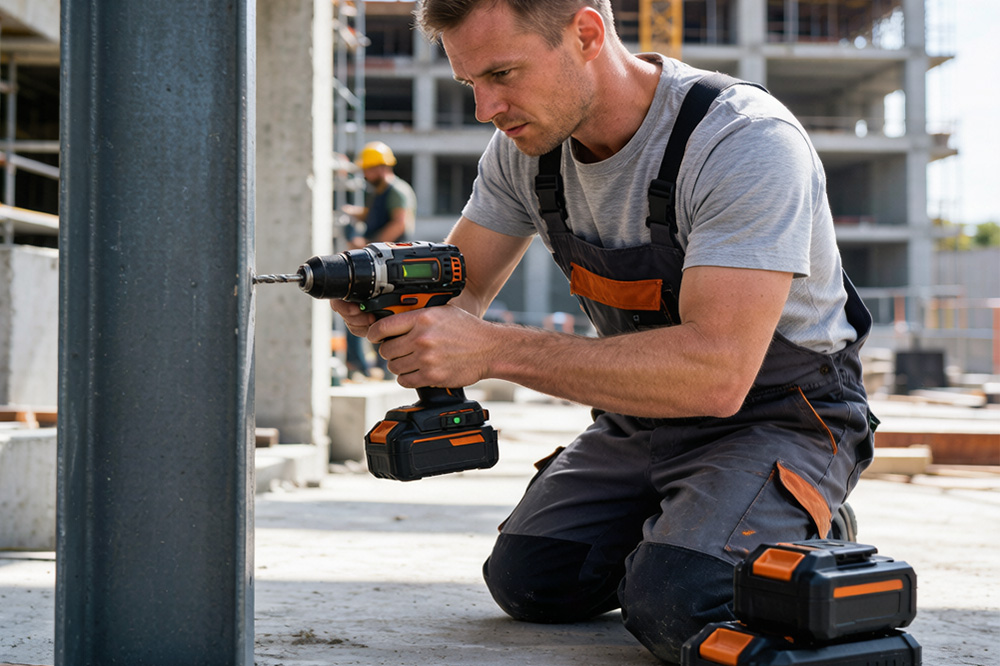
Walk onto almost any construction site and you’ll hear it sooner or later.
Someone complaining that a drill battery doesn’t last like it used to.
The drill itself is usually fine.
The motor still works.
The gearbox isn’t damaged.
But the battery pack starts showing its age long before the tool does.
That’s one reason 18650 batteries became so important in the cordless power tool industry. They’re small enough to fit compact battery packs, powerful enough to handle demanding jobs, and perhaps most importantly, flexible enough for manufacturers to build around.
Years later, they’re still everywhere.
Not because they’re perfect.
They simply solve a lot of practical problems.
Why cordless drills still rely on 18650 cells
Most people never see what’s inside a drill battery pack.
They just slide the battery into the handle and get to work.
Inside, however, things are more interesting.
A typical cordless drill battery pack contains multiple 18650 lithium-ion cells connected together in series and parallel arrangements. These cells work as a team rather than individually.
One cell alone can’t power a drill.
A properly designed battery pack can.
Manufacturers like this approach because it gives them flexibility.
Need higher voltage?
Add more cells in series.
Need longer runtime?
Increase parallel groups.
The same cell format can support several different tool platforms.
For OEM factories producing thousands of battery packs every month, that flexibility is hard to ignore.

Drill batteries don’t fail all at once
A common misconception is that drill batteries suddenly die.
Usually they don’t.
Performance fades gradually.
At first the changes are easy to miss.
Maybe the battery doesn’t finish quite as many holes as it used to.
Maybe charging takes longer.
Maybe torque feels slightly weaker under heavy load.
Then one day someone notices they’re swapping batteries twice as often.
That’s typically when users begin looking for replacements.
The interesting part is that battery capacity loss is only one piece of the puzzle.
Internal resistance often increases as batteries age.
When that happens, voltage drops become more noticeable during demanding drilling tasks.
To the user, it feels like the drill has lost power.
In reality, the cells simply can’t deliver current as efficiently anymore.
A battery with higher capacity isn’t always better
This surprises many buyers.
People naturally assume higher mAh means better performance.
Sometimes that’s true.
Sometimes it isn’t.
Imagine a contractor drilling hundreds of holes into hardwood framing.
The drill needs short bursts of high current repeatedly throughout the day.
In that situation, discharge performance can be more important than maximum capacity.
A cell with moderate capacity but strong current delivery may outperform a higher-capacity alternative during real work.
This is one reason professional battery pack manufacturers spend considerable time balancing capacity, discharge rate, and thermal behavior rather than focusing on a single specification.
What OEM manufacturers actually evaluate
Marketing brochures often focus on runtime.
Factories usually focus on consistency.
Those are different conversations.
When manufacturers evaluate 18650 cells for cordless drill battery packs, they commonly test:
- Voltage stability under load
- Internal resistance consistency
- Temperature rise during operation
- Cycle life performance
- Cell matching quality
- Pack balance over time
A battery pack that behaves consistently across thousands of units often becomes more valuable than one with slightly better laboratory numbers.
For wholesale buyers, consistency reduces warranty issues.
For manufacturers, it simplifies production.
For end users, it means fewer surprises on the jobsite.
The replacement market is larger than many people realize
A funny thing happens in construction and maintenance industries.
Tools often outlive batteries.
A professional drill may remain in service for years.
Battery packs don’t always enjoy the same lifespan.
This creates a steady replacement market.
Contractors.
Repair centers.
Equipment rental companies.
Maintenance departments.
Many of them purchase replacement battery packs long after the original tool was sold.
That’s one reason distributors continue sourcing large quantities of 18650 cells.
The demand doesn’t disappear after the first sale.
It keeps returning.

When should a cordless drill battery be replaced?
There isn’t a perfect answer.
Some batteries last several years.
Others wear out sooner depending on usage patterns.
However, several signs appear repeatedly:
- Runtime drops significantly
- Charging becomes inconsistent
- Battery heats excessively during use
- Drill loses power under moderate load
- Charging cycles become shorter and shorter
When multiple symptoms appear together, replacement often becomes more practical than continued use.
Many repair technicians notice that users wait too long before replacing aging battery packs.
By then productivity has already suffered.
Not every replacement battery performs the same
This is where wholesale buyers and OEM manufacturers become cautious.
Two battery packs may advertise similar specifications.
Yet real-world performance can differ noticeably.
The reasons vary:
Cell quality.
Cell matching.
Battery management systems.
Pack assembly standards.
Thermal design.
Welding quality.
In some cases, the difference isn’t visible from the outside at all.
That’s why experienced buyers often focus on supplier reliability as much as battery specifications.
A dependable manufacturing process usually produces more predictable results.
Real-world drill applications tell a different story
Battery testing laboratories are useful.
Construction sites are more honest.
A contractor installing drywall all day uses batteries differently from an electrician working overhead.
A maintenance technician repairing machinery creates another usage pattern entirely.
These differences matter.
The best battery pack isn’t necessarily the one with the largest number printed on the label.
It’s the one that continues delivering stable performance when work conditions become unpredictable.
And job sites are almost always unpredictable.
Why wholesale buyers continue choosing 18650-based drill batteries
New battery formats enter the market regularly.
Some offer higher energy density.
Some promise better performance.
Yet 18650 cells continue appearing inside countless cordless drill battery packs.
Part of the reason is familiarity.
Part is manufacturing efficiency.
But a large part comes from proven field performance.
The format has been tested across millions of tools in workshops, factories, warehouses, construction sites, and maintenance operations.
That history creates confidence.
And confidence matters when purchasing thousands of battery packs instead of one.
Looking beyond the specification sheet
It’s easy to compare voltage.
Capacity.
Charging time.
Cycle life.
Those numbers matter.
But when cordless drills are used every day in demanding environments, battery behavior becomes more important than battery marketing.
That’s usually where experienced OEM manufacturers and wholesale distributors focus their attention.
Not on the most impressive number.
On the most predictable result.
And that’s one reason 18650 battery packs continue to remain a practical choice for cordless drill applications worldwide.
-

12V 4400 mah Lithium ion 3S2P 18650 Battery Pack
-

18650 2000mAh 3.7 volt Lithium-ion Battery
-

18650 20V 3.0Ah Cordless Drill battery
-

18650 22.2V 7.8Ah 2600Mah 6S3P Rechargeable Battery Pack
-

18650 2600mAh Rechargeable Lithium-Ion Battery 3.7V
-

18650 3.7V 10Ah Li-Ion Power Battery Pack
-

18650 3.7V 3300mah Rechargeable Lithium ion Battery
-

18650 7S7P 24V 14Ah Lithium ion Electric Scooter Battery Pack
-

18650 battery 3.7V 1500mAh Lithium-Ion Battery
-

18650 Battery 3500 mah Rechargeable Battery Cells
-

18650 Electric Scooter 48V 13000mAh Lithium Battery
-

2600mAh 3S1P 11.1V 18650 Battery Packs
-

3.7V Li ion Rechargeable 3000mah 18650 Battery Cell
-

36V 5200mAh 10S2P 18650 Battery Pack
-

48v 4400mah 13S2P 18650 Rechargeable Battery Pack
-

7S2P 24V 18650 Lithium Battery Pack
-

Electric Scooter 36V 4400mAH 10S2P 18650 Battery Pack
-

ICR 18650 Battery 2200mah 3.7V
Leave a Reply