
A few years ago, many people in the battery industry thought the 18650 format would gradually disappear from power tools.
Larger cells were entering the market. New battery technologies were getting attention. On paper, some alternatives looked more advanced.
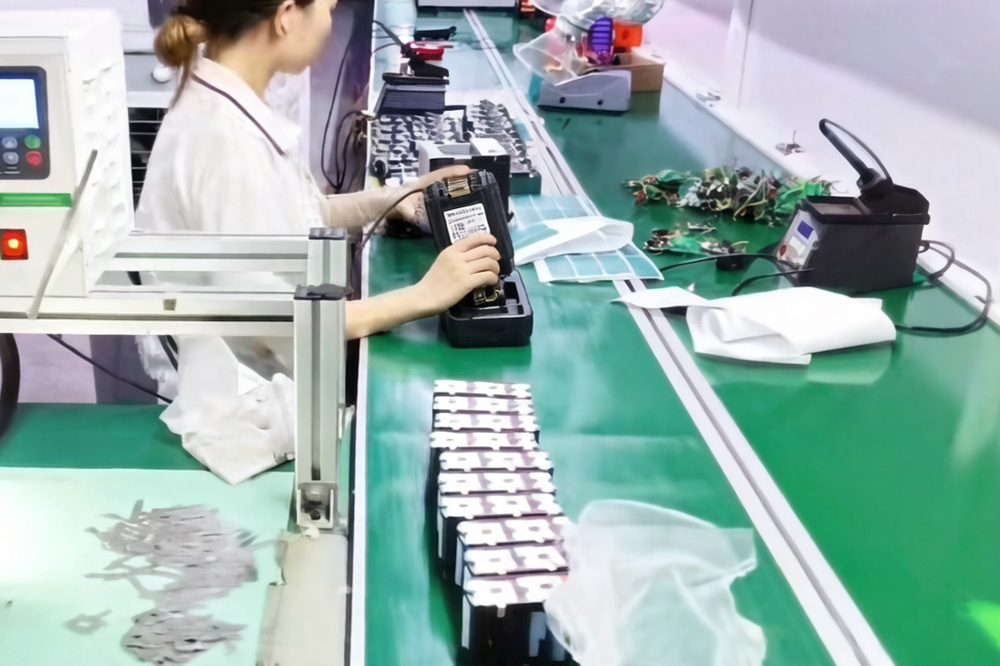
Yet when you walk through battery pack factories today, you’ll still see trays filled with 18650 cells moving across production lines.
Not because manufacturers are stuck in old habits.
Actually, the opposite.
Most distributors continue buying 18650 cells because they have already survived years of real-world testing in drills, grinders, impact tools, and industrial equipment.
And in business, proven products usually win over exciting products.
The reason isn’t capacity. It’s predictability.
When new buyers enter the power tool battery market, they often compare capacity first.
2500mAh.
3000mAh.
3500mAh.
Those numbers matter, of course.
But distributors purchasing tens of thousands of cells every month tend to focus somewhere else.
They want to know:
Will the next shipment behave the same as the previous one?
Can production continue without redesigning battery packs?
Will warranty claims remain under control?
That sounds less exciting than talking about energy density, but it affects profitability much more.
One purchasing manager once described it like this:
“Customers remember battery failures much longer than battery specifications.”
That statement is probably more accurate than most technical white papers.

Manufacturing ecosystems don’t get built overnight
Something many people overlook is how deeply the 18650 format has become integrated into battery manufacturing.
Factories already have:
- Automated welding systems
- Cell sorting equipment
- Pack assembly lines
- Battery management system designs
- Existing molds and enclosures
Changing battery formats often means changing much more than the cell itself.
For OEM manufacturers producing cordless drills or power tool batteries, redesigning an entire production process can be expensive.
That’s one reason distributors often stay with 18650-based packs even when alternatives are available.
The infrastructure already exists.
The supply chain already works.
And customers already trust the product.
Power tools are rough on batteries
A flashlight and an angle grinder may both use lithium batteries.
The similarities end there.
Power tools demand sudden bursts of current.
A cordless drill hitting dense hardwood.
An impact wrench removing rusted bolts.
A grinder cutting steel.
Those situations create stress that many batteries simply don’t handle well.
What distributors have learned over time is that capacity alone doesn’t guarantee performance.
A cell with impressive capacity can still struggle if its discharge characteristics are not suitable for heavy-duty tools.
That’s why professional battery pack manufacturers often prioritize:
- High discharge capability
- Low internal resistance
- Thermal stability
- Consistent voltage output
The specification sheet tells part of the story.
Actual field performance tells the rest.

Repair markets quietly drive huge demand
Something interesting happens after power tools are sold.
Batteries wear out.
Tools don’t.
A contractor may replace several battery packs before replacing a drill.
This creates an aftermarket that many distributors pay close attention to.
Repair shops.
Battery rebuilding businesses.
Industrial maintenance teams.
Equipment service companies.
Many of them continue requesting 18650-based packs because replacements are widely available and easy to integrate into existing designs.
From a wholesale perspective, replacement demand often becomes more predictable than original equipment demand.
And predictable demand is valuable.
The flexibility factor
One of the reasons manufacturers like 18650 cells is simple.
They can be arranged in countless configurations.
5S2P.
5S3P.
10S2P.
10S4P.
And many others.
That flexibility allows OEM battery pack manufacturers to build products for different voltage platforms without starting from scratch every time.
A compact cordless screwdriver requires something very different from an industrial-grade saw.
Yet both may be built using the same cell format.
That simplifies sourcing and inventory management for distributors.
Factory conversations sound different from marketing brochures
Marketing materials often focus on runtime.
Factory engineers usually focus on consistency.
These are not the same thing.
In production environments, engineers frequently test:
- Voltage sag under load
- Temperature rise during operation
- Cell matching consistency
- Cycle life stability
- Batch-to-batch variation
Sometimes a cell with slightly lower capacity is selected because it performs more consistently over hundreds of cycles.
To an end user, that difference may not be obvious on day one.
To a distributor dealing with warranty returns, it becomes obvious very quickly.

Industrial maintenance tools changed the conversation
The rise of cordless industrial tools has increased demand for reliable battery packs.
Maintenance teams working in factories, warehouses, energy facilities, and infrastructure projects often depend on battery-powered equipment throughout the day.
Their usage patterns are unpredictable.
A tool may sit idle for two hours.
Then suddenly operate at maximum load.
Then return to standby.
Then repeat.
This kind of mixed-duty cycle exposes weaknesses that laboratory testing doesn’t always reveal.
Many distributors serving industrial customers have learned that long-term stability matters more than impressive marketing specifications.
Why wholesale buyers still ask for 18650 cells
By now, the answer is probably becoming clear.
Distributors don’t choose 18650 cells simply because they’re popular.
They choose them because the entire ecosystem surrounding them is mature.
Reliable supply.
Established manufacturing processes.
Strong aftermarket demand.
Flexible pack design.
Proven field performance.
When all those factors are combined, the result is something every wholesale buyer appreciates:
Lower uncertainty.
And in large-scale procurement, reducing uncertainty is often more valuable than chasing the newest technology available.
Looking ahead
Will 18650 cells dominate forever?
Probably not.
Battery technology keeps evolving.
New formats will continue entering the market.
Some applications will eventually move toward different solutions.
But for power tool battery packs, especially in OEM manufacturing and wholesale distribution, 18650 cells remain one of the most practical choices available today.
Not because they are the newest.
Not because they generate the most headlines.
Mostly because they continue doing what distributors need them to do:
Deliver dependable performance, year after year, shipment after shipment.
按类别列出产品
-

12V 4400 mah Lithium ion 3S2P 18650 Battery Pack
-

18650 2000mAh 3.7 volt Lithium-ion Battery
-

18650 20V 3.0Ah Cordless Drill battery
-

18650 22.2V 7.8Ah 2600Mah 6S3P Rechargeable Battery Pack
-

18650 2600mAh Rechargeable Lithium-Ion Battery 3.7V
-

18650 3.7V 10Ah Li-Ion Power Battery Pack
-

18650 3.7V 3300mah Rechargeable Lithium ion Battery
-

18650 7S7P 24V 14Ah Lithium ion Electric Scooter Battery Pack
-

18650 battery 3.7V 1500mAh Lithium-Ion Battery
-

18650 Battery 3500 mah Rechargeable Battery Cells
-

18650 Electric Scooter 48V 13000mAh Lithium Battery
-

2600mAh 3S1P 11.1V 18650 Battery Packs
-

3.7V Li ion Rechargeable 3000mah 18650 Battery Cell
-

36V 5200mAh 10S2P 18650 Battery Pack
-

48v 4400mah 13S2P 18650 Rechargeable Battery Pack
-

7S2P 24V 18650 Lithium Battery Pack
-

Electric Scooter 36V 4400mAH 10S2P 18650 Battery Pack
-

ICR 18650 Battery 2200mah 3.7V
Leave a Reply