
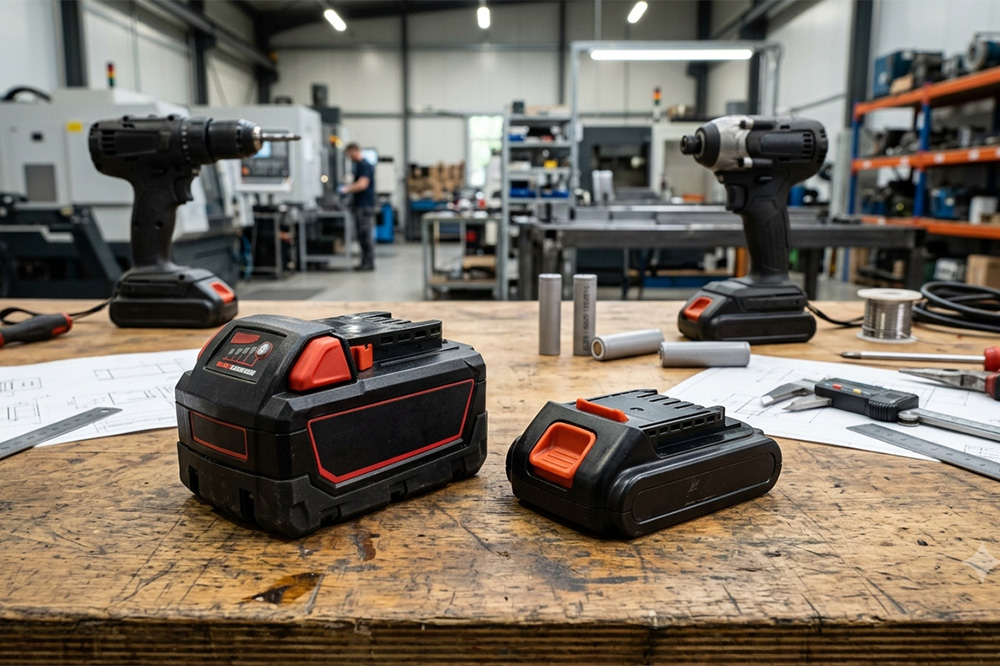
A few months ago, one of our customers shipped two cordless drill batteries to our factory. Both were rated at 20V. Both claimed similar capacity. Even the plastic housings looked almost identical.
His question was simple: “Why does one battery still perform well after a year while the other started losing power within a few months?”
It’s a question we hear more often than you might expect.
From the outside, battery packs don’t reveal much. The label tells you the voltage, the capacity, maybe a few safety certifications. What it doesn’t show is everything happening inside the case—and that’s usually where the real difference begins.
If you’re sourcing battery packs for power tools, especially for OEM or wholesale projects, it’s worth looking beyond the specifications printed on the label.
They Aren’t Designed for the Same Kind of Work
It’s easy to assume that a battery is just a battery.
In reality, manufacturers start with a completely different target user.
A DIY drill sitting in someone’s garage might only be used a few times each month. It drills a few holes, drives a handful of screws, and then spends the next week on a shelf.
Now picture a cordless grinder on a construction site. It may run continuously for hours in high temperatures, surrounded by dust and vibration.
Those two tools don’t ask the same things from their batteries.
That’s why industrial battery packs are usually engineered around durability and stable power delivery, while DIY batteries tend to focus more on cost, lightweight design, and reasonable runtime for occasional use.
Neither approach is wrong. They’re simply solving different problems.

The Battery Cells Tell Most of the Story
Whenever customers visit our production line, they almost always ask the same question first.
“Which battery cell has the highest capacity?”
It’s understandable. Capacity is easy to compare.
But engineers usually ask something different.
“What’s the continuous discharge current?”
That question often matters more.
A cordless impact wrench pulling high current every few seconds doesn’t really benefit from the highest-capacity cell if that cell struggles under heavy load.
We’ve actually seen projects where switching from a high-capacity consumer cell to a slightly lower-capacity high-drain cell made the entire tool feel more powerful. The runtime changed very little, but voltage stayed much more stable during demanding work.
That’s something you rarely notice from reading a specification sheet.
The Battery Management System Does More Than Protect the Battery
Many people think the Battery Management System, or BMS, is simply there to prevent overcharging.
Technically that’s true.
But for industrial tools, that’s only the beginning.
Depending on the application, a professional battery pack may also monitor temperature at multiple points, balance individual cells more accurately, limit excessive current during startup, and communicate with the tool itself.
Some systems even record fault history for later diagnostics.
A homeowner might never notice these functions.
A fleet manager responsible for hundreds of cordless tools probably will.
Heat Usually Causes Problems Before Capacity Does
Interestingly, battery capacity isn’t always the first thing that declines.
Heat often gets there first.
One customer producing cordless polishing machines contacted us after receiving complaints from end users. The batteries weren’t failing completely—they were simply shutting down during long polishing sessions.
After testing, we found the cells themselves were acceptable.
The real issue was inside the battery pack.
Current paths generated unnecessary heat, and the internal airflow wasn’t ideal. Once those details were redesigned, the overheating problem became much less frequent without changing the battery capacity at all.
Small engineering decisions sometimes have surprisingly large effects.
Price Isn’t the Only Number Worth Comparing
When buyers request quotations, price naturally becomes part of the conversation.
There’s nothing unusual about that.
Still, focusing only on the lowest unit price can become expensive later.
Warranty replacements, shipping defective batteries back from overseas, service labor, and damaged customer confidence all cost money—often much more than the initial savings.
We’ve seen companies reduce after-sales claims simply by upgrading the battery design rather than increasing battery capacity.
That wasn’t the cheapest solution on day one.
Looking back, it was probably the most economical one over the following two years.

Custom Battery Packs Make More Sense Than Many Buyers Expect
Off-the-shelf battery packs work well for many products.
But they’re not always the best fit.
Different power tools demand different discharge currents, operating temperatures, charging methods, and installation spaces.
That’s one reason many equipment manufacturers eventually move toward custom battery packs.
Instead of adapting the tool to match a standard battery, they build the battery around the tool.
It usually results in better performance, better safety, and fewer compromises.
So, Which Battery Pack Should You Choose?
There’s no universal answer.
If you’re building cordless tools for home users who occasionally handle small projects, a well-designed DIY battery pack will often do the job perfectly.
If your products are expected to survive warehouses, construction sites, factories, farms, or industrial maintenance work, the battery pack needs to withstand a completely different level of stress.
In many cases, the differences aren’t obvious until months after the products reach the market.
That’s why battery pack selection is something we always encourage customers to discuss early in product development rather than after problems appear.
It usually saves both time and money.
Looking for an OEM Power Tool Battery Manufacturer?
At ANPS Global, we design and manufacture custom lithium battery packs for professional power tools, industrial equipment, robotics, cleaning machines, garden tools, and other high-demand applications.
Whether you’re looking for 18650 battery packs, 21700 battery packs, high-discharge solutions, or a fully customized OEM battery design, our engineering team works with customers to match battery performance to real operating conditions—not just laboratory specifications.
If you’re planning a new project or sourcing battery packs in volume, we’d be happy to discuss your requirements and recommend a solution that fits your equipment.
Frequently Asked Questions
What’s the biggest difference between industrial and DIY battery packs?
Industrial battery packs are designed for continuous heavy-duty operation. They usually feature higher discharge capability, stronger thermal management, and more advanced battery protection systems.
Are 21700 cells always better than 18650 cells?
Not always. 21700 cells generally provide higher energy and power density, but the right choice depends on your tool’s design, available space, current demand, and overall battery pack configuration.
Why do some battery packs overheat?
Overheating can result from high current, poor thermal design, inadequate cell selection, or insufficient cooling inside the battery pack—not simply from battery capacity.
Is a custom battery pack worth the investment?
For OEM manufacturers, custom battery packs often improve product reliability, extend service life, and reduce warranty costs by matching the battery to the actual application instead of relying on a generic solution.
How do I choose the right battery supplier?
Look beyond price. Consider engineering support, cell quality, BMS design, production consistency, certifications, and the supplier’s ability to customize battery packs for your application.
-

12V 4400 mah Lithium ion 3S2P 18650 Battery Pack
-

18650 2000mAh 3.7 volt Lithium-ion Battery
-

18650 20V 3.0Ah Cordless Drill battery
-

18650 22.2V 7.8Ah 2600Mah 6S3P Rechargeable Battery Pack
-

18650 2600mAh Rechargeable Lithium-Ion Battery 3.7V
-

18650 3.7V 10Ah Li-Ion Power Battery Pack
-

18650 3.7V 3300mah Rechargeable Lithium ion Battery
-

18650 7S7P 24V 14Ah Lithium ion Electric Scooter Battery Pack
-

18650 battery 3.7V 1500mAh Lithium-Ion Battery
-

18650 Battery 3500 mah Rechargeable Battery Cells
-

18650 Electric Scooter 48V 13000mAh Lithium Battery
-

2600mAh 3S1P 11.1V 18650 Battery Packs
-

3.7V Li ion Rechargeable 3000mah 18650 Battery Cell
-

36V 5200mAh 10S2P 18650 Battery Pack
-

48v 4400mah 13S2P 18650 Rechargeable Battery Pack
-

7S2P 24V 18650 Lithium Battery Pack
-

Electric Scooter 36V 4400mAH 10S2P 18650 Battery Pack
-

ICR 18650 Battery 2200mah 3.7V
Leave a Reply