
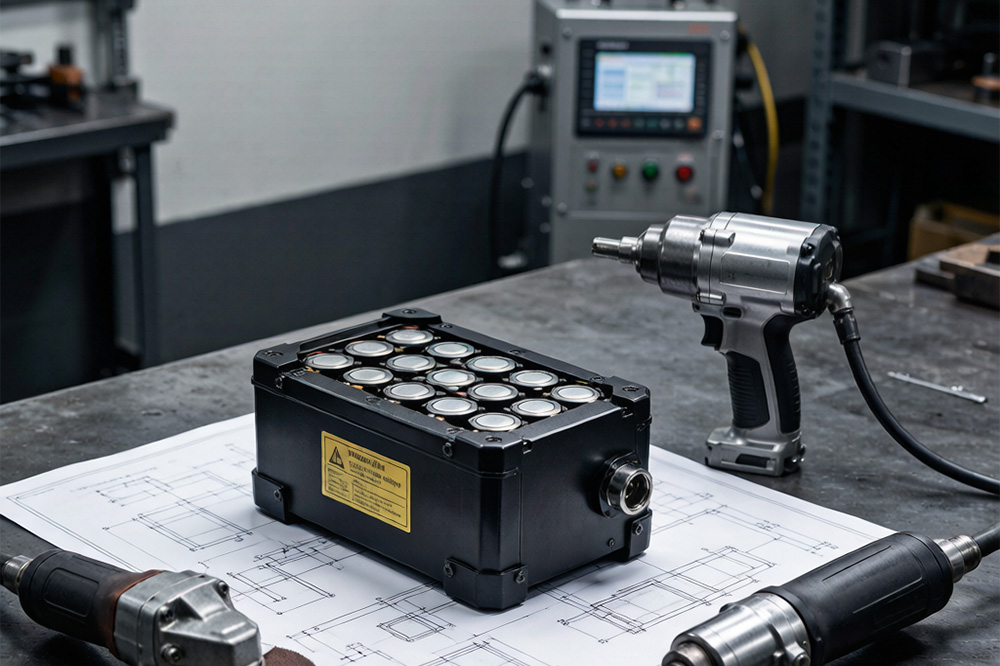
A few years ago, a customer developing cordless demolition hammers contacted us with what sounded like a familiar problem.
“The battery looks fine on paper,” he said. “Same voltage. Same capacity. But after ten or fifteen minutes of continuous work, performance drops noticeably.”
At first, everyone suspected the motor. Then they checked the charger. Nothing seemed wrong.
Eventually, the battery pack was opened. That was where the real answer was hiding.
Stories like this aren’t unusual. In fact, they remind us of something that many buyers discover only after their products reach the market: a battery specification sheet rarely tells the whole story.
Bigger Numbers Don’t Always Mean Better Performance
When purchasing managers compare batteries, capacity is often the first number they notice.
Three thousand milliamp-hours looks more attractive than twenty-five hundred. That’s understandable.
But heavy-duty power tools don’t spend much time reading specification sheets.
They demand current.
An impact wrench tightening large structural bolts, or a cordless angle grinder cutting thick steel, asks for a sudden burst of energy. If the cells inside the battery pack can’t deliver that current efficiently, the voltage begins to sag. Users usually describe it in simpler terms.
“The tool feels weak.”
What’s interesting is that the battery may still have plenty of energy left. It simply can’t release that energy fast enough under load.
We’ve seen customers replace an ultra-high-capacity consumer cell with a high-drain industrial cell and immediately notice smoother operation. Runtime changed very little, but the tool stopped struggling during demanding jobs.
That surprised them more than us.

Heat Builds Up Faster Than Most People Expect
One thing that’s easy to overlook is temperature.
Heavy-duty tools create heat everywhere. The motor gets warm. Electronics generate heat. The battery itself works hard every second the trigger is held.
If the pack can’t move that heat away efficiently, performance gradually drops.
It’s not always dramatic. Sometimes users only notice that the battery doesn’t seem as consistent after several months of daily use.
During one factory evaluation, thermal imaging revealed something unexpected. The hottest point wasn’t actually the battery cell.
It was a nickel connection carrying more current than originally planned.
Changing the connection layout solved the issue without changing the battery chemistry at all.
That’s a good reminder that battery performance depends on the entire pack, not only the cells inside.
Not Every 18650 Cell Is Built for Industrial Tools
This is probably one of the biggest misconceptions in the market.
Two 18650 cells can have identical dimensions and similar capacities, yet behave completely differently once installed in a high-power tool.
Some cells are optimized for longer runtime in consumer electronics.
Others are designed to deliver high continuous discharge with lower internal resistance.
Neither is “better” in every situation.
It simply depends on what the equipment is expected to do.
For professional construction tools, cleaning machines, rescue equipment, or agricultural devices, stable power delivery usually matters more than squeezing every last milliamp-hour into the battery.
That trade-off isn’t obvious until you test the tool in real working conditions rather than in a laboratory.

Battery Pack Design Is Often the Hidden Difference
Customers sometimes ask us which battery cell we recommend.
The answer is usually another question.
“What kind of tool are you building?”
Because even an excellent cell can perform poorly if the battery pack isn’t designed properly.
Cell arrangement, nickel strip thickness, spot welding quality, insulation materials, BMS programming, connector selection, and cooling space all influence the final result.
Think of it like building a racing car. A powerful engine helps, but it won’t perform well if the transmission, cooling system, and tires aren’t designed to work together.
Battery packs are surprisingly similar.
Sometimes the improvements that matter most aren’t visible from the outside at all.
Why More OEM Manufacturers Are Still Choosing 18650 Battery Packs
Every year, someone asks whether 18650 batteries are becoming outdated because 21700 cells are more common in newer products.
The honest answer is: it depends.
We’ve worked with customers who switched to 21700 cells and achieved exactly what they wanted—longer runtime with fewer cells. We’ve also worked with companies that tested 21700 prototypes and eventually returned to 18650 designs.
Why?
Because the battery pack wasn’t the only part of the product.
Changing the cell size meant redesigning the housing, updating the charger, modifying the BMS, and even adjusting the balance of the tool. Those changes added cost and delayed production.
For manufacturers already producing thousands of cordless tools every month, staying with a well-designed 18650 battery pack often made more business sense than starting over.
Sometimes the “newer” option isn’t automatically the better one.

What Buyers Usually Ask… and What They Probably Should Ask
When a quotation request arrives, the first questions are usually predictable.
- What’s the price?
- What’s the capacity?
- What’s the lead time?
They’re all important.
But after a few years in battery manufacturing, we’ve noticed that experienced buyers ask different questions.
They want to know how the pack performs after hundreds of charge cycles.
They ask about voltage drop during continuous discharge.
They ask how the battery behaves inside a tool that’s used every day on a construction site rather than on a laboratory bench.
Those conversations tend to lead to better products because they focus on long-term performance instead of just the initial specification.
Small Details Can Become Expensive Later
One project still stands out.
A customer wanted to reduce production costs on a cordless cutting tool. The changes looked minor—slightly thinner nickel strips and a less expensive BMS.
On paper, everything still met the specification.
Six months later, warranty claims started appearing.
Nothing catastrophic happened. The batteries still worked, but users noticed shorter operating time under heavy load and occasional overheating after repeated use.
Fixing the problem afterwards cost far more than the original savings.
That’s probably one of the biggest lessons in battery pack design. The parts that customers never see are often the ones that determine whether the product earns a good reputation.
Choosing the Right Battery Partner
Selecting a battery supplier isn’t only about finding someone who can assemble cells.
A reliable manufacturing partner should understand how the battery will actually be used.
For example, a battery pack designed for a cordless lawn mower faces different challenges than one used in an industrial impact wrench or a warehouse cleaning machine.
Those differences affect cell selection, BMS programming, thermal protection, enclosure design, and even connector choice.
That’s why engineering support often becomes just as valuable as manufacturing capacity.
Final Thoughts
Heavy-duty power tools place demands on a battery that aren’t always obvious from a product label.
Capacity matters, of course, but it’s only one piece of the puzzle.
Cell chemistry, discharge capability, pack structure, thermal management, and protection design all work together. Ignore one of them, and the rest may not perform as expected.
From what we’ve seen, companies that involve battery engineers early in product development usually spend less time solving problems after launch.
It’s not because the batteries are more complicated.
It’s because the right questions were asked before production began.
Looking for OEM 18650 Battery Pack Manufacturer?
At Apsenx, we design and manufacture custom 18650 lithium battery packs for professional power tools, garden equipment, industrial cleaning machines, robotics, medical devices, and other demanding applications.
Whether your project requires high-discharge cells, a compact battery pack, or a fully customized OEM solution, our engineering team can help optimize the design around your equipment instead of forcing your equipment to fit a standard battery.
If you’re planning a new cordless tool or sourcing battery packs in volume, we’d be glad to discuss your technical requirements and provide a solution tailored to your project.
FAQ
Are 18650 batteries still suitable for heavy-duty power tools?
Yes. High-quality 18650 cells are still widely used in professional power tools. When paired with the right battery pack design and BMS, they provide reliable performance for many industrial applications.
Does higher capacity always mean better performance?
Not necessarily. In heavy-load tools, discharge capability and voltage stability are often more important than maximum capacity.
Why do some battery packs become hot during operation?
Heat can come from several sources, including high current, internal resistance, poor thermal design, or insufficient cooling. It’s usually the result of the entire battery pack design rather than the battery cell alone.
Should I choose 18650 or 21700 cells?
It depends on your product goals. If you’re developing a new platform, 21700 may offer advantages in some cases. If you’re optimizing an existing design, a well-engineered 18650 pack may be the more practical and cost-effective choice.
Can Apsenx customize battery packs for OEM projects?
Yes. We provide custom lithium battery pack design, BMS development, cell selection, and OEM/ODM manufacturing based on your voltage, capacity, discharge current, and application requirements.
-

12V 4400 mah Lithium ion 3S2P 18650 Battery Pack
-

18650 2000mAh 3.7 volt Lithium-ion Battery
-

18650 20V 3.0Ah Cordless Drill battery
-

18650 22.2V 7.8Ah 2600Mah 6S3P Rechargeable Battery Pack
-

18650 2600mAh Rechargeable Lithium-Ion Battery 3.7V
-

18650 3.7V 10Ah Li-Ion Power Battery Pack
-

18650 3.7V 3300mah Rechargeable Lithium ion Battery
-

18650 7S7P 24V 14Ah Lithium ion Electric Scooter Battery Pack
-

18650 battery 3.7V 1500mAh Lithium-Ion Battery
-

18650 Battery 3500 mah Rechargeable Battery Cells
-

18650 Electric Scooter 48V 13000mAh Lithium Battery
-

2600mAh 3S1P 11.1V 18650 Battery Packs
-

3.7V Li ion Rechargeable 3000mah 18650 Battery Cell
-

36V 5200mAh 10S2P 18650 Battery Pack
-

48v 4400mah 13S2P 18650 Rechargeable Battery Pack
-

7S2P 24V 18650 Lithium Battery Pack
-

Electric Scooter 36V 4400mAH 10S2P 18650 Battery Pack
-

ICR 18650 Battery 2200mah 3.7V
Leave a Reply