
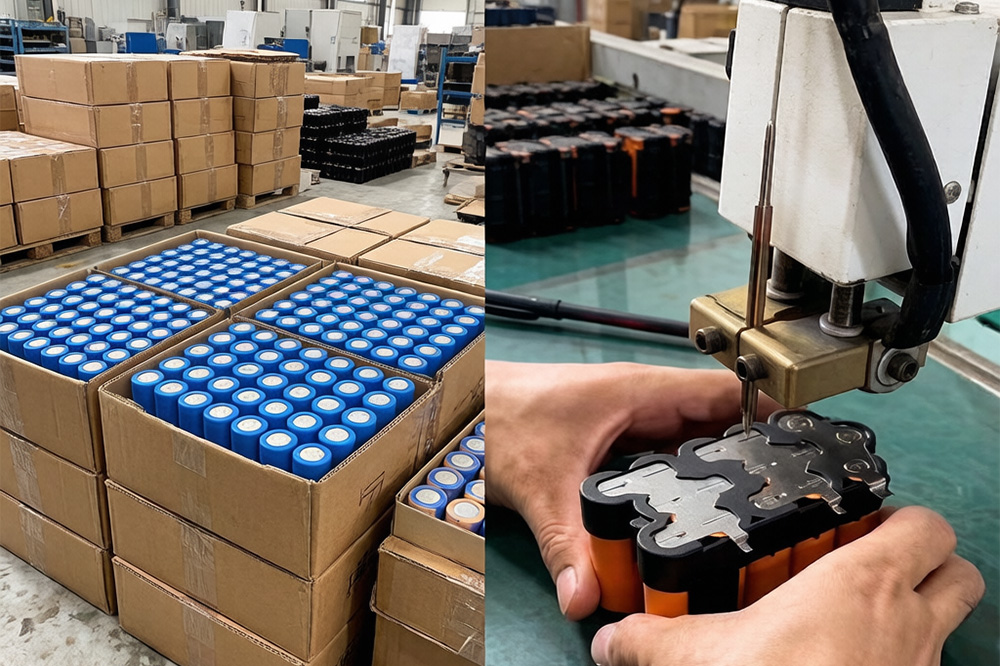
At some point, almost every buyer doing 18650 sourcing runs into the same confusion:
Why does a battery that looks identical online behave completely differently once it’s inside a power tool?
And interestingly, this question usually appears after they’ve already checked multiple channels—retail listings, OEM pages, even bulk suppliers.
The expectation is simple at the start:
same model → same performance.
But in reality, it rarely works that way.
Retail channels vs. bulk suppliers
If you look at retail-style listings (the kind you see in flashlight or hobby battery stores), the focus is usually on:
- capacity labeling
- discharge rating highlights
- “compatible with many devices” positioning
- individually packaged cells
It feels clean and standardized.
But when you move toward industrial sourcing or China OEM suppliers, the logic shifts quietly.
Here, the focus becomes:
- batch consistency
- internal resistance grouping
- pack-level performance (not single cell behavior)
- stability under repeated load cycles
This difference is not always obvious at first glance.
But it becomes very clear when cells are assembled into tool packs.
A single good cell doesn’t guarantee a good pack.
That’s where many first-time buyers get surprised.
The strange gap between “spec sheet truth” and “tool behavior”
Many guides explain 18650 batteries from a specification angle:
- mAh capacity
- discharge current
- chemistry type (Li-ion variations)
- cycle life estimate
These numbers are useful, but in power tools, they don’t tell the full story.
In real use scenarios—drills, grinders, saws—the battery behaves more like a system under stress.
What actually matters more:
- how quickly voltage drops under sudden torque
- how cells share load inside a pack
- whether heat spreads evenly or concentrates
- how stable performance stays after repeated short bursts
This is why two “same spec” batteries can feel completely different in hand.
And users usually don’t describe it technically.
They just say: “this one feels stronger.”

Why China suppliers are often misunderstood by overseas buyers
One thing that appears repeatedly in sourcing discussions (forums, buyer groups, technical threads) is this idea:
“China batteries are inconsistent.”
That statement is half true, but also incomplete.
The more accurate version might be:
consistency depends heavily on supplier type and grading process, not geography.
Some suppliers focus on high-volume generic output.
Others invest more in cell sorting, matching, and pack-level engineering.
And this is where things become less predictable for buyers who only compare listings.
Because two suppliers may both offer “18650 power tool cells,” but their internal control systems can be very different.
The part most buyers only learn after first shipment
There’s a pattern that shows up quite often:
Phase 1 — pre-order thinking
- focus on price per cell
- focus on capacity range
- focus on discharge rating claims
Phase 2 — sample testing
- everything looks fine
- short tests pass
- confidence increases
Phase 3 — real usage feedback
- uneven runtime between packs
- slightly different heat levels
- inconsistent torque under load
This is usually where sourcing decisions change direction.
Not because the product is “bad,” but because scale reveals variation.
Power tool batteries are not forgiving — this changes everything
Compared to consumer electronics, power tools behave aggressively:
- sudden high current draw
- frequent stop-start cycles
- partial discharge usage
- heat accumulation inside compact casing
Retail-grade expectations don’t always survive this environment.
That’s why industrial buyers start focusing less on “maximum capacity” and more on:
- discharge stability curve
- internal resistance matching
- thermal behavior under continuous load
One interesting observation from field feedback:
performance complaints rarely mention “capacity loss,” but often mention “power drop after some time.”
That subtle difference points directly to discharge behavior, not nominal specs.

OEM battery pack sourcing changes how suppliers are evaluated
When buyers move from single cells to power tool battery packs, evaluation becomes more layered.
Instead of asking:
- “What’s the mAh?”
They start asking:
- “How do you match cells inside the pack?”
- “What is your sorting tolerance?”
- “Do you test under load or only at rest?”
- “Can you guarantee batch repeatability?”
This shift is important.
Because at pack level, variation becomes more visible than individual performance.
Even small inconsistencies can create uneven load distribution.
A real-world scenario that explains most sourcing problems
Imagine this situation:
A buyer sources 18650 cells for power tool packs.
Samples look stable. Initial testing passes.
First production batch arrives:
- packs assemble normally
- tools run fine initially
- after repeated use, performance starts diverging slightly
Nothing fails completely. But users notice inconsistency.
After checking, the issue is not chemistry or capacity—it’s variation inside cell groups that weren’t tightly matched during bulk shipment.
This kind of issue is subtle.
It doesn’t appear in single-cell testing.
But it becomes visible in real tool usage.
Why experienced buyers don’t rely on “best battery lists” anymore
Many retail-oriented guides and comparison lists focus on:
- top-rated cells
- maximum capacity models
- popular rechargeable options
- general performance rankings
Those lists are useful for reference, but industrial buyers gradually shift away from them.
Instead, they rely more on:
- supplier consistency history
- batch testing results
- long-term stability feedback
- repeat order performance
Because in real production, the second and third shipments matter more than the first sample.

Sourcing 18650 batteries for power tools from China is not just a product decision.
It’s a control decision.
Control over:
- variation
- grouping
- testing depth
- repeatability
And once buyers recognize that, their evaluation criteria usually change completely.
If you are currently sourcing 18650 power tool battery suppliers in China, it usually helps to shift focus from single-cell specs to batch consistency and pack-level behavior.
Typical inquiry details that help suppliers respond faster:
- tool application type
- discharge requirement under load
- pack configuration
- expected cycle life range
- tolerance for internal resistance variation
-

12V 4400 mah Lithium ion 3S2P 18650 Battery Pack
-

18650 2000mAh 3.7 volt Lithium-ion Battery
-

18650 20V 3.0Ah Cordless Drill battery
-

18650 22.2V 7.8Ah 2600Mah 6S3P Rechargeable Battery Pack
-

18650 2600mAh Rechargeable Lithium-Ion Battery 3.7V
-

18650 3.7V 10Ah Li-Ion Power Battery Pack
-

18650 3.7V 3300mah Rechargeable Lithium ion Battery
-

18650 7S7P 24V 14Ah Lithium ion Electric Scooter Battery Pack
-

18650 battery 3.7V 1500mAh Lithium-Ion Battery
-

18650 Battery 3500 mah Rechargeable Battery Cells
-

18650 Electric Scooter 48V 13000mAh Lithium Battery
-

2600mAh 3S1P 11.1V 18650 Battery Packs
-

3.7V Li ion Rechargeable 3000mah 18650 Battery Cell
-

36V 5200mAh 10S2P 18650 Battery Pack
-

48v 4400mah 13S2P 18650 Rechargeable Battery Pack
-

7S2P 24V 18650 Lithium Battery Pack
-

Electric Scooter 36V 4400mAH 10S2P 18650 Battery Pack
-

ICR 18650 Battery 2200mah 3.7V
Leave a Reply