
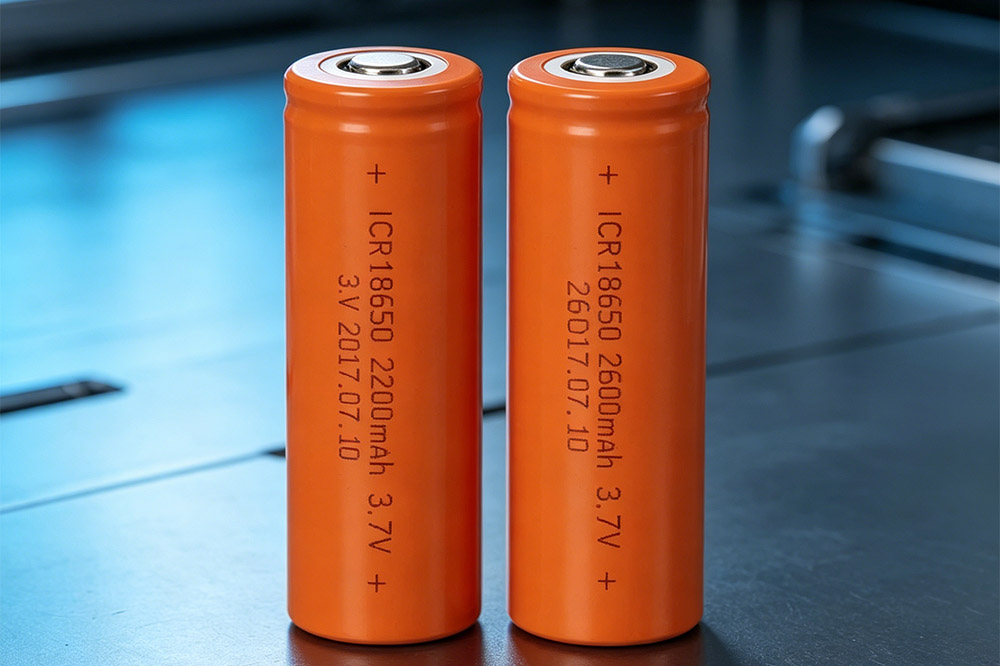
18650 2200mAh vs 2600mAh: Which One Makes More Sense for Bulk Orders?
If you’ve been sourcing 18650 batteries for a while, you’ve probably asked this question:
Should I go with 2200mAh or 2600mAh?
At first glance, it feels obvious — 2600mAh has higher capacity, so it should be better.
But once you actually start buying in bulk or building battery packs, the answer isn’t that simple.
The Difference Isn’t Just Capacity
Yes, 2600mAh stores more energy. That part is straightforward.
But in real use, especially in production, a few other things start to matter more:
- How stable the cells are across a batch
- How they behave under load
- How easy they are to match in packs
- And of course, the overall cost
That’s where the decision usually shifts.

Why Many Buyers Still Choose 2200mAh
Even today, a lot of bulk buyers stick with 2200mAh — not because it’s better on paper, but because it’s easier to work with.
It’s easier to control cost
If you’re ordering thousands of cells, even a small price difference adds up quickly.
For products where runtime isn’t the main selling point, 2200mAh is often enough.
The consistency is usually better
This is something you only notice after handling real batches.
2200mAh cells tend to be more stable from one batch to another.
Less variation, fewer surprises.
That makes a big difference when you’re assembling packs.
Fewer headaches during assembly
When cells are consistent, everything becomes easier:
- Voltage stays closer across the pack
- Heat is more manageable
- The pack behaves more predictably over time
For pack builders, this matters more than squeezing out a bit of extra capacity.
When 2600mAh Is the Better Call
That said, there are plenty of cases where 2600mAh makes more sense.
When runtime really matters
If your product is judged by how long it runs, then higher capacity helps — no way around that.
When you can’t add more cells
Sometimes space is fixed.
You can’t redesign the pack.
In that case, going from 2200mAh to 2600mAh is a simple way to extend runtime.
When you’re targeting higher-end products
For premium devices, users expect longer usage time.
That’s where 2600mAh fits better.
One Thing Buyers Often Overlook
A common mistake is assuming all 2600mAh cells are better than 2200mAh ones.
They’re not.
A well-made 2200mAh cell will often outperform a low-quality 2600mAh cell — especially after a few dozen cycles.
You’ll see it in:
- Faster capacity drop
- More imbalance in packs
- Less predictable performance
So capacity alone doesn’t tell the full story.

How Most Experienced Buyers Decide
Instead of choosing based on specs alone, they usually do something simple:
They test both.
A small sample order, basic checks on capacity and internal resistance, maybe build a small pack — that’s often enough to see the difference.
After that, the choice becomes much clearer.
Final Thought
Between 2200mAh and 2600mAh, there’s no universal “better” option.
It comes down to what you care about more:
- Cost and consistency → 2200mAh
- Runtime and positioning → 2600mAh
If you’re buying in bulk, the safer choice is usually the one that performs consistently — not just the one with the bigger number.
Related Products
-

12V 4400 mah Lithium ion 3S2P 18650 Battery Pack
-

18650 2000mAh 3.7 volt Lithium-ion Battery
-

18650 20V 3.0Ah Cordless Drill battery
-

18650 22.2V 7.8Ah 2600Mah 6S3P Rechargeable Battery Pack
-

18650 2600mAh Rechargeable Lithium-Ion Battery 3.7V
-

18650 3.7V 10Ah Li-Ion Power Battery Pack
-

18650 3.7V 3300mah Rechargeable Lithium ion Battery
-

18650 7S7P 24V 14Ah Lithium ion Electric Scooter Battery Pack
-

18650 battery 3.7V 1500mAh Lithium-Ion Battery
-

18650 Battery 3500 mah Rechargeable Battery Cells
-

18650 Electric Scooter 48V 13000mAh Lithium Battery
-

2600mAh 3S1P 11.1V 18650 Battery Packs
-

3.7V Li ion Rechargeable 3000mah 18650 Battery Cell
-

36V 5200mAh 10S2P 18650 Battery Pack
-

48v 4400mah 13S2P 18650 Rechargeable Battery Pack
-

7S2P 24V 18650 Lithium Battery Pack
-

Electric Scooter 36V 4400mAH 10S2P 18650 Battery Pack
-

ICR 18650 Battery 2200mah 3.7V
Leave a Reply