
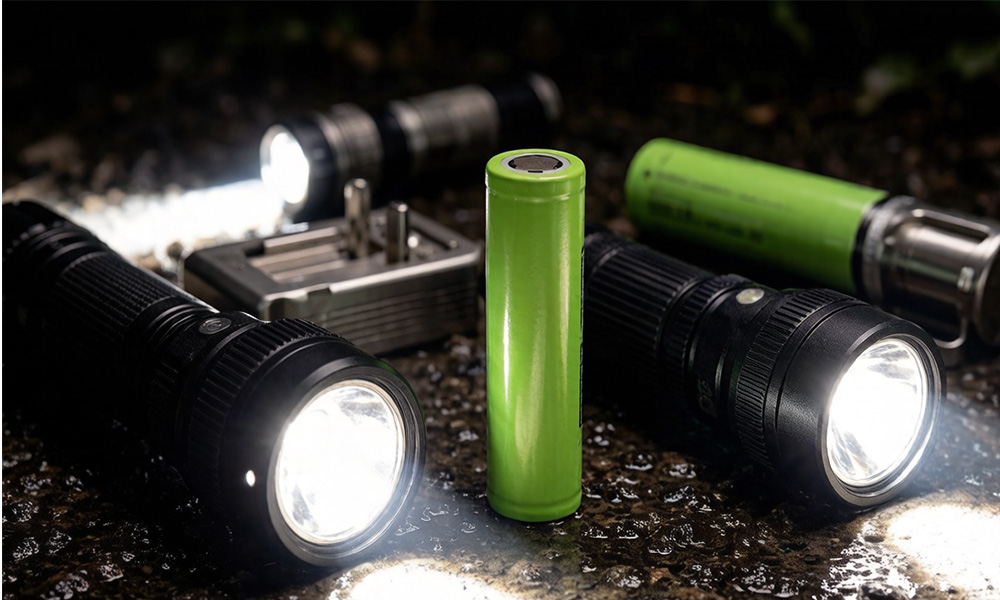
A few months ago, a customer contacted us after replacing all the batteries in a fleet of industrial inspection flashlights.
On paper, everything looked perfect.
The new batteries had a higher advertised capacity than the originals.
The expectation was simple:
Higher mAh should mean longer runtime.
Instead, operators started complaining within days.
The flashlights were stepping down from turbo mode faster than before. Some units even showed low-battery warnings while the batteries still had plenty of charge left.
The issue wasn’t capacity.
It was current delivery.
That situation comes up far more often than most people realize.
When people search for the best 18650 battery for a flashlight, they’re usually looking for one answer. In reality, there are several different answers depending on what the flashlight is expected to do.
A battery that works beautifully in a camping lantern may be a poor choice for a 3000-lumen tactical light.
Likewise, the cell preferred by flashlight enthusiasts isn’t always the one that makes sense for a distributor ordering ten thousand units at a time.
What Experienced Flashlight Users Tend to Look At First
Something interesting happens when you spend time reading flashlight communities.
Beginners usually focus on the biggest capacity number they can find.
Experienced users rarely do.
Instead, they start asking questions like:
- How much voltage sag occurs under load?
- What is the actual continuous discharge rating?
- Does the battery maintain output after several hundred cycles?
- Is the capacity rating independently tested?
Those questions sound less exciting than “Who makes the highest-capacity battery?”
But they have a much bigger impact on real-world flashlight performance.
Imagine two batteries.
One advertises 3600mAh.
The other advertises 3000mAh.
Most buyers instinctively choose the first one.
Yet if the flashlight demands high current, the lower-capacity cell may actually produce a brighter beam for a longer period before noticeable output reduction occurs.
That’s because LEDs don’t care about marketing numbers.
They care about available power.

The Outdoor Camper and the Search-and-Rescue Volunteer Are Shopping For Different Batteries
This is where many online buying guides become too generic.
They treat all flashlight users as if they have identical needs.
A camper sitting beside a tent often uses medium brightness levels for several hours at a time.
Current draw remains relatively low.
Capacity becomes valuable.
A search-and-rescue volunteer is dealing with a completely different situation.
The flashlight may spend repeated periods in turbo mode while scanning large areas.
Current demand spikes dramatically.
In that case, discharge performance often matters more than squeezing out another few hundred milliamp-hours.
The same battery can feel excellent in one flashlight and disappointing in another.
Not because the battery changed.
Because the application changed.
Why Some 3500mAh Batteries Feel Stronger Than Others
This confuses many buyers.
Two batteries can both claim 3500mAh.
One consistently delivers better flashlight performance.
How?
The answer usually comes down to cell design and internal resistance.
Lower internal resistance allows the battery to maintain voltage more effectively when current demand rises.
Think of it like water flowing through pipes.
A wider pipe delivers water more easily than a narrow one.
The amount of water stored in the tank may be identical, but delivery capability differs.
Flashlights react the same way.
This is why experienced flashlight reviewers often pay close attention to discharge curves rather than capacity ratings alone.
A battery that maintains stable voltage frequently feels more powerful even when capacity numbers appear similar.

The “5000mAh 18650” Problem Never Seems to Go Away
Every year new flashlight users discover batteries claiming impossible specifications.
5000mAh.
6000mAh.
Sometimes even 9900mAh.
The labels look impressive.
The physics does not.
Current lithium-ion technology places practical limits on what can fit inside a standard 18650 cell.
Whenever a specification seems dramatically higher than what reputable testing data suggests is possible, caution is warranted.
Interestingly, many of the batteries generating the most complaints in flashlight forums aren’t low-capacity cells.
They’re unrealistic-capacity cells.
People buy them expecting more runtime and end up getting less.
A Warehouse Test That Revealed More Than Any Spec Sheet
One industrial customer evaluated several 18650 batteries for inspection flashlights used during overnight maintenance shifts.
The test wasn’t particularly scientific.
Workers simply used the lights during normal operations over several weeks.
What stood out wasn’t runtime.
Most batteries delivered acceptable runtime.
What workers noticed was brightness consistency.
Some batteries seemed strong for the first few minutes before gradually feeling weaker.
Others maintained a more stable beam throughout the shift.
When employees were asked which batteries they preferred, very few mentioned capacity.
Most talked about visibility.
That’s a useful reminder.
Users experience flashlight performance, not battery specifications.

Why Wholesale Buyers Often Care About Different Things Than Flashlight Enthusiasts
Enthusiasts usually buy a few batteries.
Distributors buy thousands.
The priorities shift quickly.
For wholesale buyers, concerns often include:
- Batch consistency
- Shipping compliance
- Warranty rates
- Supply stability
- Production traceability
A cell that performs slightly better on a laboratory graph may not be the best business decision if supply becomes unpredictable six months later.
That’s particularly relevant for flashlight brands building long-term product lines.
Consistency tends to matter more than chasing the last few percentage points of performance.
The Better Question To Ask
After reading hundreds of flashlight discussions and battery reviews, one pattern keeps appearing.
People ask:
“What is the best 18650 battery for a flashlight?”
The more useful question is usually:
“What is the flashlight expected to do?”
A compact EDC light clipped into a pocket.
A weapon-mounted light.
A cave exploration flashlight.
An industrial inspection tool.
A searchlight mounted on emergency equipment.
They may all use the same battery size.
They rarely demand the same battery characteristics.
Once you start from the application rather than the specification sheet, battery selection becomes much easier.
-

18650 2000mAh 3.7 volt Lithium-ion Battery
-

18650 2600mAh Rechargeable Lithium-Ion Battery 3.7V
-

18650 3.7V 3300mah Rechargeable Lithium ion Battery
-

18650 battery 3.7V 1500mAh Lithium-Ion Battery
-

18650 Battery 3500 mah Rechargeable Battery Cells
-

3.7V Li ion Rechargeable 3000mah 18650 Battery Cell
-

ICR 18650 Battery 2200mah 3.7V
Leave a Reply