
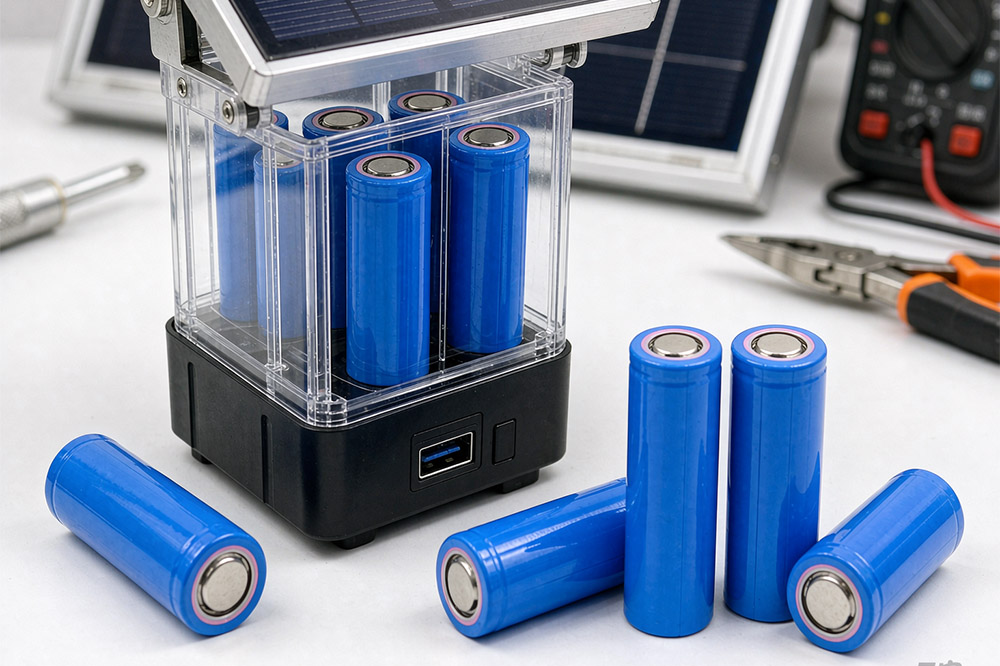
When people talk about solar lights, they usually focus on the solar panel, LED brightness, or waterproof housing. But after working with battery applications, we found that the battery is often the part that decides whether a solar light performs well after six months or becomes a customer complaint.
A solar light may look perfect when it leaves the factory. However, after repeated charging and discharging outdoors, battery quality starts to show the difference.
This is why many solar lighting manufacturers choose 18650 rechargeable batteries for solar lights. They offer a good balance between size, energy density, availability, and cost, making them a common choice for garden lights, solar security lights, and small outdoor lighting systems.
For wholesale buyers, choosing the right battery is not only about finding the cheapest option. The real question is whether the battery can keep stable performance in different weather conditions and long-term use.
Why 18650 Batteries Are Commonly Used in Solar Lights
The 18650 format has been used in many industries for years, including power tools, portable electronics, energy storage devices, and solar lighting.
One reason is the standard size.
An 18650 battery cell is compact, which allows designers to easily arrange batteries inside limited spaces. For solar light manufacturers, this is important because most lamps have strict internal size limitations.
A reliable 18650 battery cell can provide:
- Stable voltage output
- Good energy density
- Long service life
- Easy replacement options
- Flexible battery configuration
For example, a small garden light may only need one battery, while a higher-power outdoor lamp may require several cells connected together.
In actual projects, we often see customers choosing different capacities depending on the lighting time they need. A decorative garden lamp and a solar street light may both use lithium batteries, but the battery requirements are completely different.

Choosing the Right Capacity for Solar Lighting Applications
One common mistake is thinking that higher capacity always means a better battery.
It is not always true.
A larger capacity battery can provide longer working time, but it also requires:
- More charging power from the solar panel
- More installation space
- Higher cost
For example:
Small garden lights usually work with lower capacity cells because the LED power consumption is limited.
Outdoor security lights may require higher capacity because they need brighter lighting and longer operation time.
Commercial solar lighting projects often use customized battery solutions because the working environment is more demanding.
Before selecting a battery, manufacturers usually need to check:
- LED power consumption
- Daily working hours
- Solar panel charging capability
- Installation environment
- Expected battery lifespan
This information helps avoid choosing a battery that looks good on paper but does not match the actual application.
18650 Battery Cell or 18650 Battery Packs: Which One Is Better?
For solar light companies, there are usually two purchasing options.
They can buy individual cells and assemble batteries themselves, or they can order finished battery solutions.
A high-quality 18650 battery cell is suitable for companies that already have battery assembly capability. They can design their own battery structure and select different series or parallel combinations.
However, many solar lighting manufacturers prefer ready-made 18650 battery packs.
A customized battery pack can include:
- Battery management system (BMS)
- Protection circuit
- Connectors
- Wires
- Housing design
- Custom voltage configuration
This is especially useful for companies producing thousands of solar lights because consistent battery quality can reduce production problems.
From our experience, smaller lighting brands often save more time by purchasing finished battery packs instead of building their own battery assembly line.

When Should Solar Lights Use LiFePO4 Battery Cells?
Although 18650 lithium batteries are popular, they are not the only option.
For larger solar applications, many engineers consider LiFePO4 battery cell solutions.
LiFePO4 batteries are known for:
- Longer cycle life
- Better thermal stability
- Higher safety performance
- Strong outdoor durability
For example, solar street lights installed in remote areas may need batteries that can work for several years with minimal maintenance.
In these situations, LiFePO4 can be a better choice compared with standard lithium-ion batteries.
However, for small solar garden lights where size and cost are important, 18650 batteries may still be the more practical solution.
The right choice depends on the project, not simply the battery technology name.

What Should Wholesale Buyers Check Before Ordering?
When purchasing batteries in bulk, price is usually one of the first things buyers compare. But battery quality differences are often hidden.
Two batteries may have the same capacity label, but their real performance can be different.
Before placing an order, it is better to check:
Battery Testing
Ask suppliers about:
- Capacity testing
- Internal resistance testing
- Cycle life testing
- Aging testing
Safety Certifications
For international shipments, buyers usually need documents such as:
- UN38.3
- IEC62133
- CE
- RoHS
- MSDS
OEM Capability
A supplier with battery customization ability can provide more flexible solutions.
For example:
A solar lighting company may need a special battery size because the lamp housing has already been designed.
Instead of changing the whole product structure, a customized battery pack can solve the problem faster.
Common Problems With Solar Light Batteries
Some solar lights fail earlier than expected because of battery selection mistakes.
One common issue is using low-quality recycled cells. They may look cheaper at the beginning, but capacity drops quickly after repeated cycles.
Another problem is ignoring temperature conditions.
Solar lights installed outdoors can experience:
- Strong sunlight
- Cold winters
- High humidity
A battery that performs well indoors may not always work well outside.
This is why choosing a supplier with real testing experience is important.
Finding Reliable Supplier for 18650 Solar Light Batteries
For solar light manufacturers and distributors, battery supply stability is just as important as battery specifications.
A reliable supplier should be able to provide:
- Stable battery cells
- Custom battery pack design
- Quality inspection
- Technical support
- OEM production capability
Whether you need standard 18650 rechargeable batteries for solar lights, customized 18650 battery packs, or advanced LiFePO4 battery cell solutions, the battery partner you choose can directly affect your final product quality.
If you are sourcing lithium batteries for solar lighting projects, contact us for battery recommendations, samples, and wholesale solutions based on your application requirements.
-

12.8V 8Ah LiFePO4 Power Wall Battery
-

12V 100Ah LiFePO4 Solar Battery
-

12V 4400 mah Lithium ion 3S2P 18650 Battery Pack
-

18650 2000mAh 3.7 volt Lithium-ion Battery
-

18650 20V 3.0Ah Cordless Drill battery
-

18650 22.2V 7.8Ah 2600Mah 6S3P Rechargeable Battery Pack
-

18650 2600mAh Rechargeable Lithium-Ion Battery 3.7V
-

18650 3.7V 10Ah Li-Ion Power Battery Pack
-

18650 3.7V 3300mah Rechargeable Lithium ion Battery
-

18650 7S7P 24V 14Ah Lithium ion Electric Scooter Battery Pack
-

18650 battery 3.7V 1500mAh Lithium-Ion Battery
-

18650 Battery 3500 mah Rechargeable Battery Cells
-

18650 Electric Scooter 48V 13000mAh Lithium Battery
-

2600mAh 3S1P 11.1V 18650 Battery Packs
-

3.2V 280ah Lifepo4 Battery Cell
-

3.2V 320Ah LifePo4 Battery Cell
-

3.7V Li ion Rechargeable 3000mah 18650 Battery Cell
-

36V 5200mAh 10S2P 18650 Battery Pack
-

48V 200Ah LiFePO4 Battery Solar Power Wall
-

48v 4400mah 13S2P 18650 Rechargeable Battery Pack
-

7S2P 24V 18650 Lithium Battery Pack
-

Electric Scooter 36V 4400mAH 10S2P 18650 Battery Pack
-

ICR 18650 Battery 2200mah 3.7V
-

IP67 48V 100Ah Solid State LiFePO4 Battery
Leave a Reply