
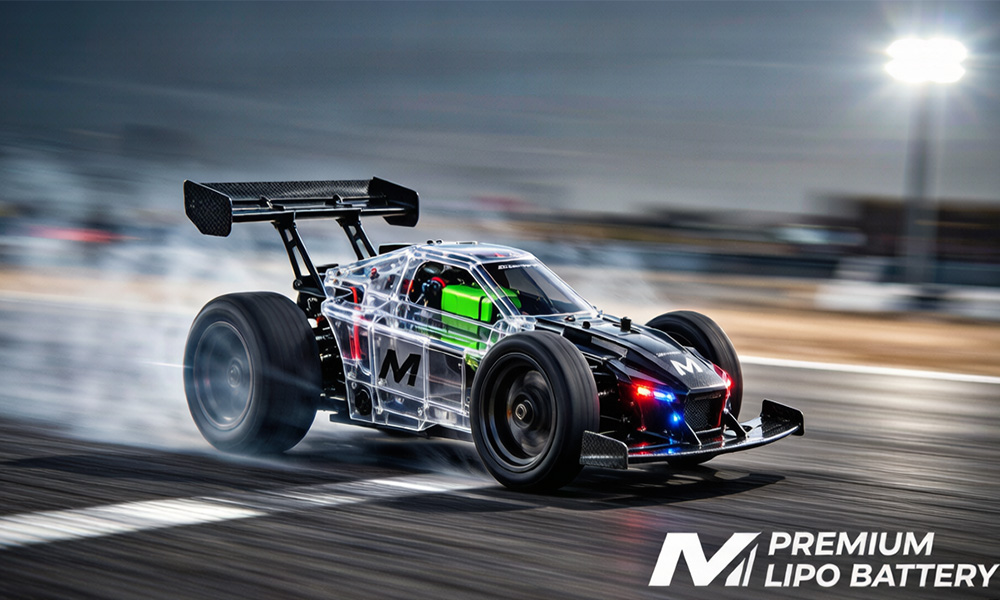
The first time I started paying attention to RC drag racing batteries, I assumed the answer was simple.
Bigger battery.
More power.
Faster car.
That sounds reasonable until you spend a few weekends at a no-prep drag event.
Then things start looking a little different.
You’ll see cars that launch like rockets using battery packs that look surprisingly small. Meanwhile, another car carrying a larger pack struggles to leave the line cleanly. Same class. Similar motors. Similar electronics.
Yet one consistently runs quicker passes.
At first, it’s tempting to blame tuning, tires, or driving. Those things matter, of course. But after watching enough races, you begin to realize the battery plays a much bigger role than many newcomers expect.
And not for the reasons most people think.

Three Seconds Changes Everything
A lot of RC enthusiasts come from different corners of the hobby.
Maybe they started with bashers.
Maybe they race touring cars.
Maybe they’re used to crawling or speed runs.
Those categories all reward different things.
Drag racing is unusual because the entire race is often over before you’ve had time to process what happened.
We’re talking about a few seconds.
Sometimes less.
That changes how you think about batteries.
In a trail truck, battery capacity matters because you’re driving for an hour.
In a drag car, the battery only needs enough energy to survive a handful of passes.
The focus shifts away from runtime and toward one question:
How much power can the battery deliver instantly when the trigger is pulled?
That’s where races are often won or lost.
The Strange Trend Most New Racers Notice
Spend enough time in staging lanes and you’ll eventually notice something.
Many competitive drag racers are not carrying the highest-capacity battery available.
Actually, some deliberately avoid it.
That seems backward.
After all, larger packs store more energy.
But energy storage and race performance aren’t always the same thing.
Every extra gram becomes something the chassis has to accelerate.
Every extra gram affects weight transfer.
Every extra gram influences how the rear tires react when the motor hits.
One racer explained it to me in a way that stuck.
He said:
“You’re not trying to power the car for half an hour. You’re trying to survive one violent launch.”
That mindset changes battery selection completely.
Why 2S Batteries Dominate Drag Racing
New racers often ask why so many successful drag cars still use 2S setups.
The assumption is that more voltage automatically creates faster elapsed times.
Sometimes it does.
Sometimes it creates wheelspin.
That’s the problem.
Drag racing isn’t simply about producing power.
It’s about applying power.
A car making huge horsepower numbers means very little if the tires can’t use it.
Most competitive classes have evolved around 2S systems because they provide a balance between speed, control, and consistency.
A well-tuned 2S setup launching cleanly can beat a more powerful car that spends half the run fighting traction issues.
That’s one reason you’ll see experienced racers obsessing over chassis setup, tire prep, and battery quality instead of chasing voltage alone.

Not All 5000mAh Batteries Feel the Same
On paper, two batteries might look nearly identical.
Same voltage.
Same capacity.
Same advertised C rating.
Yet one consistently runs quicker times.
Why?
Because specification sheets rarely tell the entire story.
Real-world performance often comes down to factors that aren’t obvious when shopping online.
Cell matching.
Internal resistance.
Voltage stability.
Manufacturing consistency.
Heat management.
A battery can look impressive in a product description and still struggle when subjected to the sudden current demands of a drag launch.
Experienced racers learn this quickly.
The stopwatch usually tells the truth.
The C Rating Debate Never Really Ends
Ask ten racers about C ratings and you’ll probably get ten different opinions.
Some swear by extremely high-discharge packs.
Others think manufacturers exaggerate the numbers.
The truth probably sits somewhere in the middle.
What matters on the track isn’t the number printed on the label.
What matters is whether the battery can maintain voltage under load.
A battery that delivers stable voltage throughout a launch often performs better than one advertising massive discharge numbers but suffering noticeable voltage sag.
That explains why many racers spend more time checking internal resistance than discussing marketing claims.
Performance tends to reveal itself pretty quickly once the car hits the strip.
A Battery Can Lose the Race Before the Car Moves
This sounds dramatic, but it happens.
Imagine two drivers lining up.
Both batteries are freshly charged.
Both show full voltage.
Everything appears equal.
The tree drops.
One car explodes off the line.
The other hesitates just enough to lose momentum.
From the driver’s stand, it looks minor.
The timing system often disagrees.
Tiny voltage drops during launch can translate into measurable differences in elapsed time.
Fractions of a second decide races.
That’s why serious competitors monitor battery health obsessively.
A pack may still function perfectly for casual driving while already giving away performance in competition.

Weight Distribution Is Part of Battery Selection
Most hobbyists view batteries as power sources.
Drag racers often see them as tuning tools.
Battery placement can dramatically change how a car launches.
Move the pack slightly forward.
The front end stays planted.
Move it rearward.
Traction characteristics change again.
There isn’t one perfect solution.
Different chassis respond differently.
Different track surfaces demand different setups.
This flexibility is one reason compact drag racing batteries remain popular.
They allow racers to experiment with balance and weight transfer without redesigning the entire vehicle.
Hard Case or Soft Case?
This discussion has probably started thousands of arguments at tracks around the world.
Hard-case batteries offer obvious advantages.
They provide additional protection.
They handle transportation better.
They generally survive accidental impacts more easily.
Soft-case packs bring their own benefits.
Lower weight.
More installation options.
Greater flexibility for tight chassis layouts.
Many dedicated drag racers lean toward soft-case configurations because every gram matters.
Others prefer the durability and peace of mind offered by hard cases.
Neither choice is universally correct.
The better option usually depends on the class, chassis, and driving environment.
Something Manufacturers Don’t Talk About Enough
Consistency.
Most product descriptions focus on maximum specifications.
Maximum discharge.
Maximum capacity.
Maximum power.
The problem is racers don’t compete on paper.
They compete over multiple passes.
A battery that launches identically ten times in a row is often more valuable than a battery that produces one exceptional run and then fades.
This is particularly important for racing clubs, hobby stores, and distributors purchasing inventory.
Customers remember consistency.
It’s what creates repeat business.
What Wholesale Buyers Should Actually Look For
When sourcing RC drag racing batteries for resale, it’s easy to focus on headline numbers.
Many experienced distributors eventually shift their priorities.
They start asking different questions.
How consistent is cell matching?
What is the average internal resistance?
How stable is production quality between batches?
Can the supplier provide connector customization?
Can dimensions be adjusted for specific chassis designs?
Are OEM and private-label services available?
These questions tend to matter far more in the long run than chasing the highest advertised specification.
For businesses serving racers, reliability becomes part of the product itself.

Looking Beyond the Label
The funny thing about RC drag racing batteries is that most racers eventually stop shopping by numbers alone.
They stop chasing the biggest capacity.
They stop obsessing over marketing claims.
Instead, they start paying attention to what happens at the starting line.
Does the car launch consistently?
Does the voltage stay stable?
Does performance remain predictable pass after pass?
Those answers matter far more than anything printed on the packaging.
For hobby shops, racing teams, distributors, and brands looking for dependable battery solutions, the same principle applies.
A battery that helps customers win races will always outsell one that simply looks impressive on a specification sheet.
Whether you’re building a competitive no-prep drag car or sourcing batteries for your brand, choosing the right pack is less about chasing numbers and more about delivering consistent power where it matters most—the first few feet off the line.
-

12V 4400 mah Lithium ion 3S2P 18650 Battery Pack
-

18650 2000mAh 3.7 volt Lithium-ion Battery
-

18650 20V 3.0Ah Cordless Drill battery
-

18650 22.2V 7.8Ah 2600Mah 6S3P Rechargeable Battery Pack
-

18650 2600mAh Rechargeable Lithium-Ion Battery 3.7V
-

18650 3.7V 10Ah Li-Ion Power Battery Pack
-

18650 3.7V 3300mah Rechargeable Lithium ion Battery
-

18650 7S7P 24V 14Ah Lithium ion Electric Scooter Battery Pack
-

18650 battery 3.7V 1500mAh Lithium-Ion Battery
-

18650 Battery 3500 mah Rechargeable Battery Cells
-

18650 Electric Scooter 48V 13000mAh Lithium Battery
-

2600mAh 3S1P 11.1V 18650 Battery Packs
-

3.7V Li ion Rechargeable 3000mah 18650 Battery Cell
-

36V 5200mAh 10S2P 18650 Battery Pack
-

48v 4400mah 13S2P 18650 Rechargeable Battery Pack
-

7S2P 24V 18650 Lithium Battery Pack
-

Electric Scooter 36V 4400mAH 10S2P 18650 Battery Pack
-

ICR 18650 Battery 2200mah 3.7V
Leave a Reply