
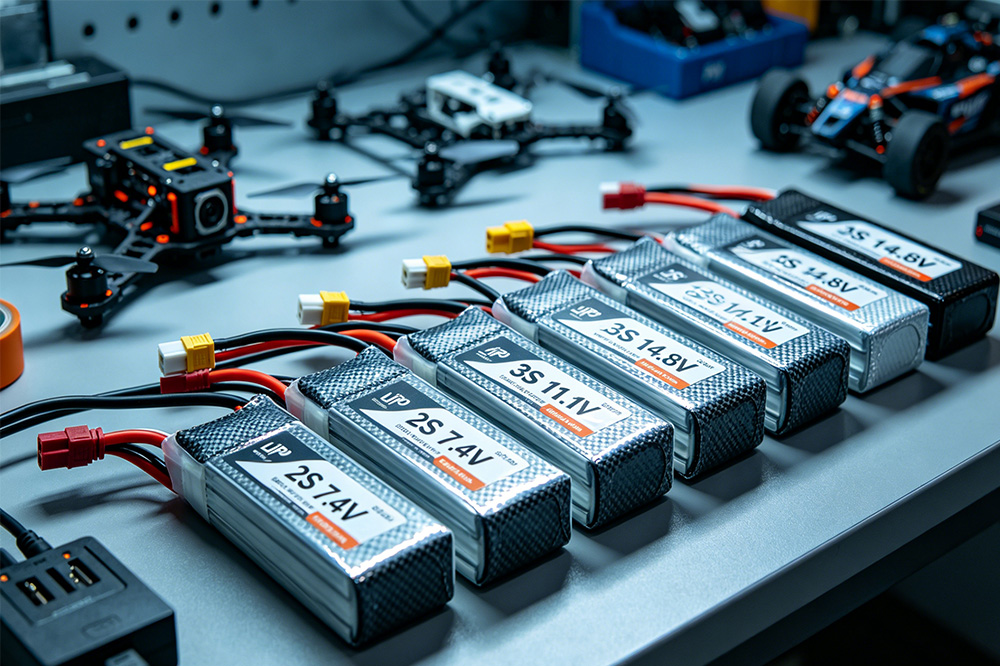
If you’ve ever been around drones, RC cars, or FPV racing setups, you’ve probably heard people talk about LiPo batteries like they’re both amazing and slightly dangerous at the same time.
That’s not far from the truth.
But once you strip away the jargon, a LiPo battery is actually pretty straightforward.
It’s a lithium-based rechargeable battery that uses a polymer-style electrolyte and comes in a soft, flexible pouch instead of a rigid metal case. That single design change is what makes it so different from the typical cylindrical lithium-ion cells you see in everyday electronics.
Same chemistry family. Different packaging. Very different behavior.
Why LiPo Batteries Dominate Drones and RC Devices
There’s a reason Lithium LiPo batteries are basically the default choice in FPV and RC industries.
It’s not just about performance on paper—it’s about how they behave in real use.
From what you usually see in the field, three things stand out:
They deliver power very fast.
When you hit the throttle, there’s almost no delay. That instant response is exactly what pilots want.
They’re lightweight.
In anything that flies, weight is always the enemy. Less weight usually means better agility and longer flight time.
They can be shaped flexibly.
Because of the pouch structure, manufacturers can design them to fit tight or unusual spaces inside frames.
That combination is hard to beat, even if it comes with some trade-offs.

Understanding LiPo Voltage Without Overthinking It
One of the first confusing things for beginners is voltage labeling like “3S 11.1V” or “4S 14.8V”.
In reality, it’s just stacking single cells together.
A single Lithium LiPo cell behaves like this:
Nominal voltage: 3.7V
Fully charged: 4.2V
Safe lower limit: around 3.3V per cell
So when you see 3S or 4S, it simply means how many cells are connected in series.
You can think of it like this:
V
total
=n×3.7V
So:
2S ≈ 7.4V
3S ≈ 11.1V
4S ≈ 14.8V
Higher voltage usually means more aggressive power delivery—but also higher stress on motors and ESCs. That’s why pilots don’t just “go higher voltage” blindly.

C Rating: Real Capability or Just Marketing?
If you’ve browsed Lithium LiPo batteries before, you’ve definitely seen numbers like 30C, 50C, or even 100C.
In simple terms, C rating describes how much current a battery can safely deliver.
The basic idea is:
I
max
=C×Capacity
For example:
A 2200mAh 40C battery theoretically supports about 88A continuous current.
But here’s the part people only learn after some experience:
The number on the label doesn’t always reflect real-world performance.
What matters more in practice:
Voltage sag under load
Internal resistance
Temperature rise during discharge
That’s why experienced users often trust behavior more than specs.
What Makes Lithium LiPo Batteries Attractive
In actual use, LiPo batteries feel “direct”.
No delay. No softness in response.
Some of the practical advantages:
Very fast power delivery
Lightweight compared to many alternatives
Flexible pouch design fits compact builds
High discharge capability for short bursts
That’s why they’re widely used in:
FPV racing drones
RC cars and planes
Lightweight robotics
Custom portable power setups
The Trade-Offs People Don’t Ignore
LiPo batteries are powerful—but they require discipline.
They are not the kind of battery you can just forget in a drawer.
Common realities include:
Over-discharge risk
If voltage drops too low, the cell can be permanently damaged.
Overcharge sensitivity
Anything above 4.2V per cell increases risk significantly.
Physical vulnerability
Puncturing or swelling is a real safety concern.
Maintenance requirements
Users typically need to:
Balance charge cells
Store at correct voltage (“storage mode”)
Avoid full charge storage for long periods
Let batteries cool after use
Most LiPo issues in the field come from handling mistakes, not manufacturing defects.
LiPo vs Li-ion: Are They the Same?
This question comes up a lot, especially in forums.
The simple answer:
LiPo is a type of lithium-ion battery.
The real difference is structural:
LiPo uses soft pouch packaging
Standard Li-ion often uses rigid cylindrical or prismatic cells
LiPo favors high discharge and lightweight design
Li-ion usually favors energy density and stability
So it’s not “which is better”, but more “which fits the application”.
Understanding LiPo Battery Cells
When people talk about LiPo battery, they’re often referring to the complete battery pack. In reality, that pack is made up of one or more LiPo battery cells connected together to achieve the required voltage and capacity.
Each cell has a nominal voltage of around 3.7V, so the number of cells determines the overall battery voltage. A single-cell pack is commonly used in small consumer electronics, while multi-cell configurations are found in drones, RC models, portable medical devices, and other equipment that needs higher power output. Although the cells are lightweight and flexible in shape, they still need proper protection during charging and discharging to maintain safety and service life.
For product designers and OEM manufacturers, selecting the right LiPo battery cells involves more than choosing a capacity. Cell thickness, discharge rate, cycle life, and dimensional consistency all affect the final product. That’s why custom battery projects usually begin with cell selection before moving on to connector design, protection circuits, and enclosure development.

Where LiPo Batteries Are Actually Used
Beyond drones and RC hobby gear, LiPo batteries also appear in:
FPV racing systems
Custom robotics builds
Portable electronics prototypes
Lightweight UAV systems
Compact power modules
In many cases, engineers choose LiPo not because it’s perfect, but because it fits space and power constraints better than alternatives.
A Small Real-World Observation
If you watch how FPV pilots handle LiPo batteries, you’ll notice something interesting.
They rely on them heavily—but they never treat them casually.
Some will store them in fire-resistant bags.
Some monitor voltage after every flight.
Some even check temperature before packing up.
It’s a mix of trust and caution at the same time.
That tension pretty much defines how LiPo batteries are used in real life.
Looking for a more technical overview before selecting battery supplier? We also created a practical guide that explains what is a LiPo battery, including its internal structure, common applications, advantages, limitations, and the questions OEM buyers usually ask before placing an order. It’s a helpful resource if you’re evaluating custom lithium polymer batteries for commercial or industrial projects.
-

12.8V 8Ah LiFePO4 Power Wall Battery
-

12V 100Ah LiFePO4 Solar Battery
-

12V 4400 mah Lithium ion 3S2P 18650 Battery Pack
-

18650 2000mAh 3.7 volt Lithium-ion Battery
-

18650 20V 3.0Ah Cordless Drill battery
-

18650 22.2V 7.8Ah 2600Mah 6S3P Rechargeable Battery Pack
-

18650 2600mAh Rechargeable Lithium-Ion Battery 3.7V
-

18650 3.7V 10Ah Li-Ion Power Battery Pack
-

18650 3.7V 3300mah Rechargeable Lithium ion Battery
-

18650 7S7P 24V 14Ah Lithium ion Electric Scooter Battery Pack
-

18650 battery 3.7V 1500mAh Lithium-Ion Battery
-

18650 Battery 3500 mah Rechargeable Battery Cells
-

18650 Electric Scooter 48V 13000mAh Lithium Battery
-

2600mAh 3S1P 11.1V 18650 Battery Packs
-

3.2V 280ah Lifepo4 Battery Cell
-

3.2V 320Ah LifePo4 Battery Cell
-

3.7V Li ion Rechargeable 3000mah 18650 Battery Cell
-

36V 5200mAh 10S2P 18650 Battery Pack
-

48V 200Ah LiFePO4 Battery Solar Power Wall
-

48v 4400mah 13S2P 18650 Rechargeable Battery Pack
-

7S2P 24V 18650 Lithium Battery Pack
-

Electric Scooter 36V 4400mAH 10S2P 18650 Battery Pack
-

ICR 18650 Battery 2200mah 3.7V
-

IP67 48V 100Ah Solid State LiFePO4 Battery
Leave a Reply