
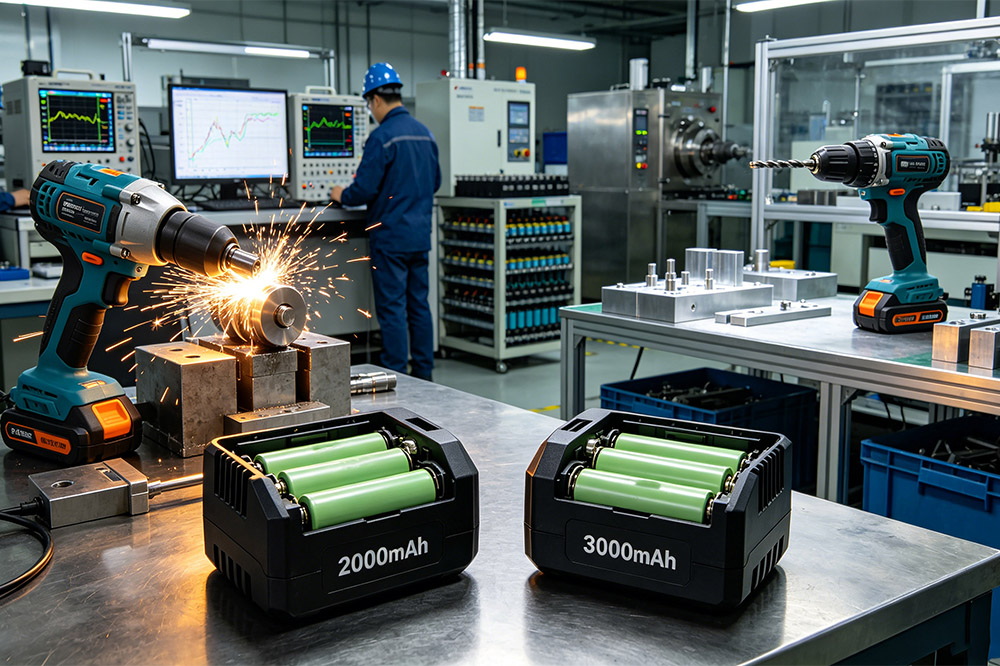
In factories and job sites, there is a question that comes up again and again.
“Should we use 2000mAh or 3000mAh 18650 cells?”
On paper, it sounds like a simple capacity decision.
But once these cells are placed inside real power tools—impact wrenches, angle grinders, or circular saws—the answer becomes less straightforward.
Sometimes higher capacity does not mean better performance. And sometimes lower capacity performs more consistently under load.
Capacity looks simple, but real usage is not
In laboratory testing, 3000mAh usually means longer runtime.
However, power tools do not operate in a stable environment.
They behave more like dynamic load systems rather than steady devices.
For example:
- Cordless drills: intermittent bursts
- Impact wrenches: high-current pulses
- Angle grinders: continuous heavy load
- Circular saws: mixed acceleration and load cycles
Because of these different working patterns, capacity alone cannot describe real performance.

2000mAh cells: often more stable under heavy load
In many OEM battery pack designs, 2000–2200mAh cells are still widely used.
Not because they are outdated, but because they often offer better performance under high discharge conditions.
Typical characteristics include:
- Lower internal resistance in many grades
- More stable voltage under heavy load
- Better thermal control
- Reduced voltage sag during high current output
In impact wrench applications, where current spikes are frequent, this stability can be more important than runtime.
Some field feedback is surprisingly direct:
“It doesn’t last longer, but it feels stronger.”
3000mAh cells: better runtime, but higher stress under load
3000mAh 18650 cells are often chosen for applications where runtime is the priority.
They perform well in:
- Light-duty drilling
- Household tools
- Intermittent use devices
However, in heavy-duty tools, their behavior can vary depending on load conditions.
Under high discharge demand, they may show:
- Faster voltage drop
- Higher heat generation
- Slightly weaker sustained output
This is not a fixed rule, but it is often observed in industrial usage scenarios.

Tool type matters more than capacity
One of the most common misunderstandings in procurement is focusing only on mAh.
OEM engineers usually ask a different question first:
“What type of tool is this battery powering?”
Because the load profile changes everything:
- Angle grinders → continuous high load
- Impact wrenches → pulse discharge
- Cordless drills → balanced load cycles
- Circular saws → mixed high and sustained load
The same 18650 cell can behave very differently depending on the tool.
OEM selection logic: stability over maximum capacity
In real battery pack production, engineers rarely choose the highest capacity cell as the default option.
Instead, they evaluate:
- Discharge capability
- Internal resistance consistency
- Thermal behavior under load
In many OEM projects, 2000mAh and 3000mAh are not direct competitors, but different solutions for different use cases.

Real-world usage scenario
In a maintenance workshop, technicians often switch between tools:
- Impact wrench for removing bolts
- Drill for assembly work
Even within the same environment, battery behavior feels different.
For impact wrench users, the key concern is whether power drops suddenly under load.
For drill users, the priority is runtime efficiency.
This is why procurement decisions often evolve from “which capacity is better” to “which configuration fits each tool.”
What OEM buyers actually care about
For wholesale and OEM buyers, mAh is usually not the final decision factor.
More important questions include:
- Is batch consistency stable?
- Can the factory maintain long-term supply?
- How does the battery perform under high load?
- Can the pack be customized for different tools?
Capacity is only one part of the equation.
A practical conclusion
If we simplify field experience:
- 2000mAh: better stability under heavy discharge
- 3000mAh: better runtime in light to medium load
- Tool type matters more than capacity number
- Discharge behavior matters more than rated mAh
But in real OEM projects, the boundary is often not clear.
Selection is usually about balance, not extremes.
-

12V 4400 mah Lithium ion 3S2P 18650 Battery Pack
-

18650 2000mAh 3.7 volt Lithium-ion Battery
-

18650 20V 3.0Ah Cordless Drill battery
-

18650 22.2V 7.8Ah 2600Mah 6S3P Rechargeable Battery Pack
-

18650 2600mAh Rechargeable Lithium-Ion Battery 3.7V
-

18650 3.7V 10Ah Li-Ion Power Battery Pack
-

18650 3.7V 3300mah Rechargeable Lithium ion Battery
-

18650 7S7P 24V 14Ah Lithium ion Electric Scooter Battery Pack
-

18650 battery 3.7V 1500mAh Lithium-Ion Battery
-

18650 Battery 3500 mah Rechargeable Battery Cells
-

18650 Electric Scooter 48V 13000mAh Lithium Battery
-

2600mAh 3S1P 11.1V 18650 Battery Packs
-

3.7V Li ion Rechargeable 3000mah 18650 Battery Cell
-

36V 5200mAh 10S2P 18650 Battery Pack
-

48v 4400mah 13S2P 18650 Rechargeable Battery Pack
-

7S2P 24V 18650 Lithium Battery Pack
-

Electric Scooter 36V 4400mAH 10S2P 18650 Battery Pack
-

ICR 18650 Battery 2200mah 3.7V
Leave a Reply