
People usually notice runtime first.
“How long does it last?”
But in power tools, that question is only half of the story.
Inside factories, workshops, and construction sites, engineers often care about something less visible but far more important — continuous discharge current.
It sounds technical, but in practice it simply decides whether a tool feels strong or weak when it is actually working.
And sometimes, the difference is more noticeable than capacity itself.
Continuous discharge is not about peak power
A common misunderstanding is mixing peak discharge with continuous discharge.
Peak current only happens for a short moment.
Continuous discharge is what the battery can safely deliver over time without overheating, voltage collapse, or internal stress.
In real power tools, this matters a lot more than people expect.
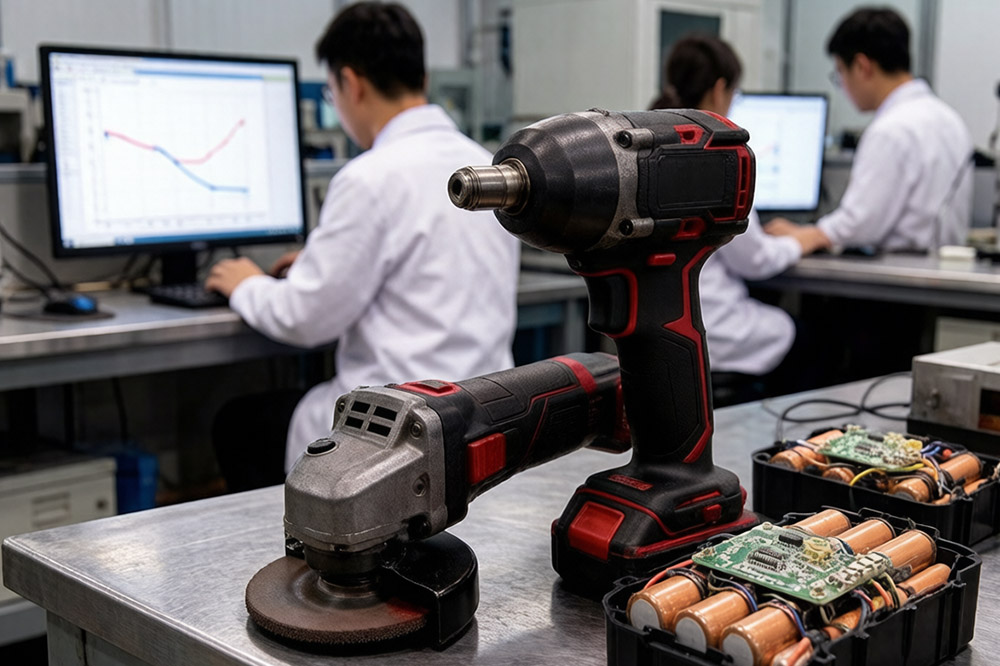
A cordless drill might survive with average discharge performance, but an angle grinder or impact wrench will quickly expose weak cells.
Why power tools stress the battery differently
Not all tools behave the same way.
- Cordless drills: intermittent load
- Impact wrenches: repeated high-current pulses
- Angle grinders: sustained high-load operation
- Circular saws: mixed load with acceleration peaks
Each of these creates a different demand pattern on the battery pack.
Continuous discharge current becomes especially important when the load does not stop.
An angle grinder cutting metal, for example, can hold a near-constant high current draw for several minutes.
If the cell cannot maintain output, performance drops gradually instead of suddenly — which is actually harder for users to notice at first.

What happens when continuous discharge is too low
In real field use, the symptoms are quite familiar:
- Tool loses power under load
- Cutting speed becomes inconsistent
- Battery pack heats up quickly
- Runtime feels unstable
Most users don’t say “low continuous discharge rating.”
They usually describe it in simple terms:
“The tool feels weak when I push it.”
That weakness often comes from voltage sag under sustained current.
Once voltage drops too far, the tool control system may also reduce output to protect itself.
Internal resistance is part of the story
Continuous discharge current is not an isolated parameter.
It is closely tied to internal resistance.
Lower internal resistance generally allows:
- Higher stable current output
- Less heat generation
- Reduced voltage drop
- Better long-term stability
In OEM production, engineers often test cells under real load curves rather than relying only on datasheet values.
Because two cells with the same rated current can behave very differently in real tools.
Why 18650 cells are still widely used in power tools
Even with newer formats appearing in the market, 18650 cells remain widely used in industrial tools.
There are practical reasons behind it:
- Mature supply chain
- Stable manufacturing consistency
- Flexible pack configurations (series/parallel)
- Proven high-drain variants available
- Easy replacement in OEM systems
For manufacturers, predictability often matters more than novelty.
OEM battery pack design depends on current stability
Inside an OEM factory, selecting a cell is only one step.
Engineers also design the full system around it:
- Cell matching based on resistance
- Nickel strip thickness and welding quality
- BMS current protection settings
- Thermal spacing inside the pack
- Load balancing across cells
Even a strong 18650 cell can underperform if the pack design cannot support sustained discharge.
This is why OEM engineering experience often matters more than single-cell specifications.
A real-world observation from workshop usage
In one maintenance workshop, technicians used identical cordless tools for different tasks.
At first, everything seemed normal.
But after repeated use, a pattern appeared.
Tools used for grinding tasks showed earlier fatigue compared to tools used for drilling — even though the same battery model was used.
The difference was not obvious at the beginning.
It only appeared after continuous load exposure over time.
This is exactly where continuous discharge capability becomes visible in real life, not in lab data.
Continuous discharge vs capacity: a practical trade-off
In battery selection, engineers often balance two factors:
- Higher capacity (longer runtime)
- Higher continuous discharge (stronger load performance)
Sometimes increasing capacity slightly reduces discharge stability.
Other times, lower capacity cells perform better under stress.
So OEM decisions are rarely based on one number.
They are based on how the battery behaves under real load conditions.

What wholesale buyers usually overlook
From a procurement perspective, buyers often focus on:
- mAh rating
- price per unit
- delivery time
But experienced buyers start asking different questions:
- What is the continuous discharge rating under real conditions?
- How stable is the voltage curve?
- How does the pack behave after repeated cycles?
- Is batch consistency reliable across production runs?
Because in industrial applications, failure is not just a technical issue — it becomes downtime.
Final thought
Continuous discharge current is one of those specifications that sounds technical but becomes very practical once tools are used in real environments.
It does not show itself in idle conditions.
It shows up when the tool is under stress — cutting, tightening, drilling, or grinding.
For OEM manufacturers and wholesale buyers, understanding this parameter is less about numbers on a datasheet and more about how the battery behaves when work becomes demanding.
That is usually where the real difference between cells appears.
-

12V 4400 mah Lithium ion 3S2P 18650 Battery Pack
-

18650 2000mAh 3.7 volt Lithium-ion Battery
-

18650 20V 3.0Ah Cordless Drill battery
-

18650 22.2V 7.8Ah 2600Mah 6S3P Rechargeable Battery Pack
-

18650 2600mAh Rechargeable Lithium-Ion Battery 3.7V
-

18650 3.7V 10Ah Li-Ion Power Battery Pack
-

18650 3.7V 3300mah Rechargeable Lithium ion Battery
-

18650 7S7P 24V 14Ah Lithium ion Electric Scooter Battery Pack
-

18650 battery 3.7V 1500mAh Lithium-Ion Battery
-

18650 Battery 3500 mah Rechargeable Battery Cells
-

18650 Electric Scooter 48V 13000mAh Lithium Battery
-

2600mAh 3S1P 11.1V 18650 Battery Packs
-

3.7V Li ion Rechargeable 3000mah 18650 Battery Cell
-

36V 5200mAh 10S2P 18650 Battery Pack
-

48v 4400mah 13S2P 18650 Rechargeable Battery Pack
-

7S2P 24V 18650 Lithium Battery Pack
-

Electric Scooter 36V 4400mAH 10S2P 18650 Battery Pack
-

ICR 18650 Battery 2200mah 3.7V
Leave a Reply