
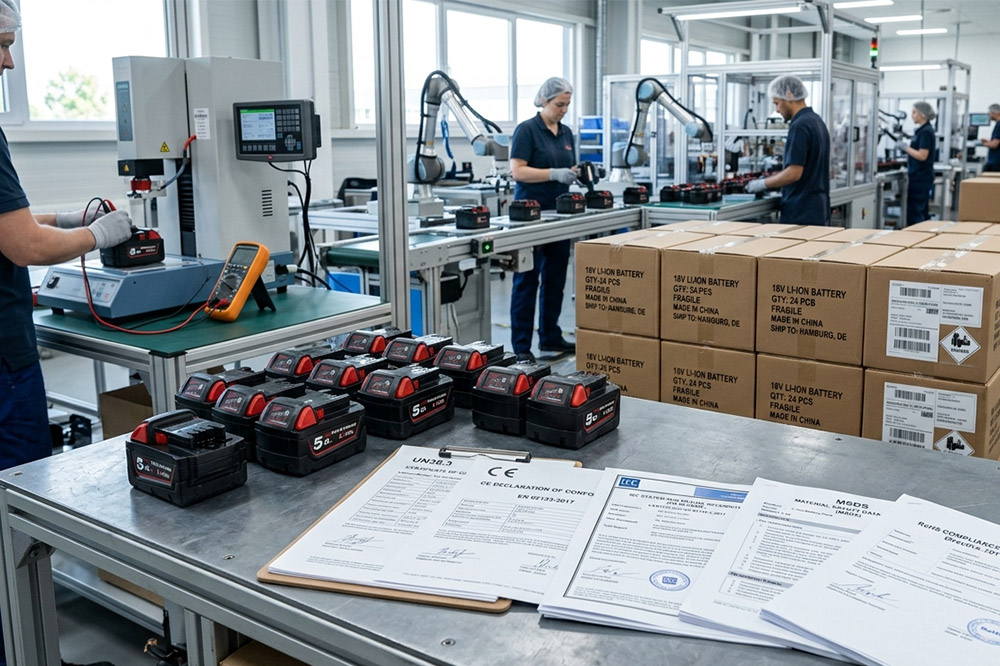
The first time I joined a meeting about exporting power tool batteries, I expected people to spend most of the discussion talking about capacity, cycle life, or pricing.
Instead, nearly half the meeting revolved around paperwork.
Someone asked, “Do you have UN38.3?”
Another buyer wanted the latest IEC 62133 report.
A freight forwarder requested MSDS before even discussing shipping costs.
That’s when it became obvious that exporting lithium batteries isn’t only about making a good product. Sometimes the documents determine whether the shipment leaves the warehouse at all.
If you’re sourcing OEM power tool batteries from China, understanding these certifications early can save weeks of unnecessary delays.
Not Every Certificate Has the Same Purpose
One misunderstanding I see fairly often is buyers collecting every certificate they can find, assuming more documents always mean better compliance.
It doesn’t quite work like that.
Some certificates are related to product safety.
Others exist purely for transportation.
A few are required only in certain countries.
Before requesting dozens of reports from a supplier, it’s worth asking one simple question:
Who is asking for this document?
The answer could be customs, your customer, the shipping company, or local regulators—and each may need something different.
UN38.3: Usually the First Document Everyone Asks About
For lithium battery exports, UN38.3 is probably the most familiar certification.
Strictly speaking, it isn’t a quality certificate.
It’s a transportation safety test.
The batteries must pass several tests designed to simulate conditions they might experience during shipping.
These include:
- Altitude simulation
- Thermal testing
- Vibration
- Shock
- External short circuit
- Impact
- Overcharge
- Forced discharge
If a battery pack hasn’t successfully completed these tests, many freight companies simply won’t accept the shipment.
I’ve seen projects where production finished on time, packaging looked perfect, but shipping was delayed because the customer forgot to confirm whether the battery configuration already had a valid UN38.3 report.
That kind of delay feels avoidable in hindsight.

CE Marking: Important for the European Market
If your batteries are entering Europe, CE marking is usually part of the conversation.
However, it’s worth mentioning that CE itself isn’t one single laboratory test.
Instead, it shows that the product complies with applicable European directives covering safety and other regulatory requirements.
For power tool batteries, manufacturers typically prepare technical documentation, perform required testing, and issue a Declaration of Conformity.
Some buyers assume every battery carrying a CE mark has gone through identical procedures.
In reality, documentation can vary depending on the product design and applicable regulations.
That’s one reason experienced importers often request supporting test reports instead of relying only on the logo printed on the label.
IEC 62133 Is Becoming Increasingly Important
Among professional buyers, IEC 62133 appears more frequently than it did several years ago.
This international safety standard focuses on rechargeable lithium batteries used in portable equipment.
Testing covers areas such as:
- Electrical safety
- Mechanical integrity
- Environmental reliability
- Charging performance
- Abuse testing
If your battery pack will be integrated into branded power tools, distributors may specifically request this report before approving suppliers.
Even when regulations don’t explicitly require it, many procurement teams treat IEC 62133 as evidence that a manufacturer follows recognized safety practices.
MSDS Helps During Transportation
People sometimes confuse MSDS with certification.
Technically, it isn’t.
An MSDS (Material Safety Data Sheet) explains the battery’s composition, handling instructions, transportation guidance, storage recommendations, and emergency measures.
Think of it as an information document rather than a compliance certificate.
Shipping companies often ask for it because they need to understand how to transport lithium batteries safely.
Without it, freight booking can become surprisingly complicated.

RoHS Matters More Than Some Buyers Expect
RoHS restricts hazardous substances in electrical products.
For European markets especially, it’s commonly requested together with CE documentation.
RoHS limits materials such as:
- Lead
- Mercury
- Cadmium
- Hexavalent chromium
- Certain flame retardants
In practice, reputable battery manufacturers usually prepare RoHS reports alongside other export documents, especially for OEM customers selling branded products.
Other Certifications You May Encounter
Depending on your destination market, additional certificates may also be requested.
These could include:
| Certification | Typical Purpose |
|---|---|
| UL2054 | North American battery safety |
| CB Scheme | International certification acceptance |
| PSE | Japan |
| KC | South Korea |
| UKCA | United Kingdom |
| FCC | Electronic products containing communication modules |
| REACH | Chemical compliance for Europe |
Not every shipment requires every certificate.
Actually, asking for unnecessary reports sometimes slows the quotation process because suppliers first need to determine whether those documents even apply to your battery model.
A Real Purchasing Scenario
Imagine you’re importing 5,000 custom 20V power tool battery packs for distribution in Germany.
Your factory finishes production exactly on schedule.
Everyone expects shipment next week.
Then your freight agent asks for:
- UN38.3 Test Report
- MSDS
- Packing Declaration
- Dangerous Goods information
Meanwhile, your customer requests:
- CE Declaration
- RoHS Report
- IEC 62133 Test Report
Production wasn’t the bottleneck.
Documentation became the critical path.
This situation happens more often than many first-time importers expect.

Don’t Wait Until Production Is Finished
One habit I’ve noticed among experienced buyers is that they discuss certifications before placing the order—not after.
That changes the entire process.
Instead of asking,
“Can you provide UN38.3?”
they ask,
“Is the UN38.3 report issued for this exact battery configuration?”
There’s a subtle difference.
Changing battery capacity, cell brand, battery pack structure, or BMS design may require updated testing.
Assuming one report covers every version can become an expensive mistake later.
Choosing an OEM Battery Supplier Beyond Certifications
Certificates are essential, but they shouldn’t be the only factor when selecting a manufacturer.
A supplier that responds quickly, keeps documentation organized, updates reports when product designs change, and understands international shipping regulations usually makes the export process much smoother.
From my experience, buyers rarely remember the supplier with the cheapest quotation.
They remember the one whose shipment cleared customs without unexpected problems.
For wholesale power tool battery projects, having complete and up-to-date documentation is just as valuable as having stable battery performance. If you’re planning an OEM order, discussing certification requirements at the quotation stage is often the easiest way to avoid delays later—and it gives both sides a clearer picture of the project before production even begins.
-

12V 4400 mah Lithium ion 3S2P 18650 Battery Pack
-

18650 20V 3.0Ah Cordless Drill battery
-

18650 22.2V 7.8Ah 2600Mah 6S3P Rechargeable Battery Pack
-

18650 2200Mah 10S3P 36V 6.6Ah Electric Scooter Lithium Battery
-

18650 2600Mah 10S3P 36V 7.8ah Scooter Battery
-

18650 3.7V 10Ah Li-Ion Power Battery Pack
-

18650 36V 5.2Ah Electric Bicyle Battery
-

18650 7S7P 24V 14Ah Lithium ion Electric Scooter Battery Pack
-

18650 Electric Scooter 48V 13000mAh Lithium Battery
-

1S2P 3.7V 1600mAh 14500 Lithium Battery
-

2000Mah 18650 Battery Cell 6Ah 36V Scooter Battery
-

21700 3.7V 4800mAh Rechargeable Lithium-Ion Battery
-

2600mAh 3S1P 11.1V 18650 Battery Packs
-

3.7V 21700 Rechargeable Lithium Battery Cells 5000mah
-

3.7V 5000mah 26650 Battery
-

32140 LiFePO4 Battery Cell 3.2V – 10000mAh / 15000mAh
-

32700 Lifepo4 3.2V 6000mah Lithium Battery
-

36V 5200mAh 10S2P 18650 Battery Pack
-

48V 15ah 720wh Ebike Battery
-

48v 4400mah 13S2P 18650 Rechargeable Battery Pack
-

60V 21Ah 18650 16S7P E Bike Battery
-

7S2P 24V 18650 Lithium Battery Pack
-

Customized 48V-72V Triangle Ebike Lithium Battery Pack | 52V 30Ah
-

Electric Scooter 36V 4400mAH 10S2P 18650 Battery Pack
Leave a Reply