
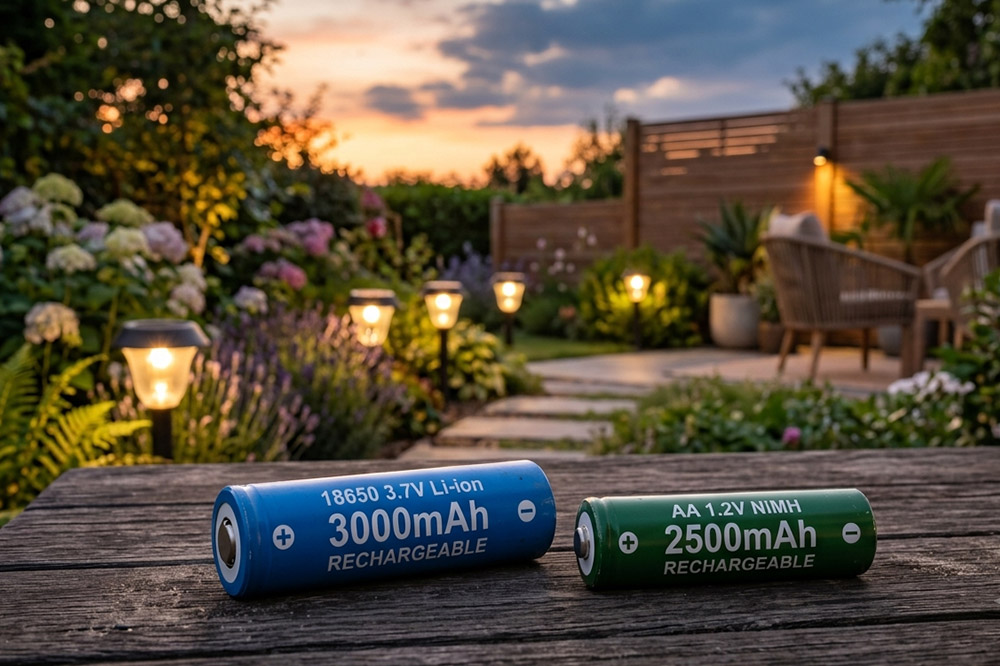
If you’ve sourced solar lights from different factories, you’ve probably noticed something interesting.
Two products may look almost identical on the outside, yet one uses Lithium rechargeable batteries while the other still relies on NiMH cells.
Many buyers immediately ask which battery is “better.” Personally, I don’t think the answer is always that straightforward.
It depends on where the lights will be installed, how often they’re used, and perhaps most importantly, what kind of customers you’re selling to.
I’ve seen distributors replace thousands of NiMH batteries every two years, while another customer running premium landscape lighting hasn’t touched their lithium-powered products for years.
That difference isn’t only about battery chemistry. It’s about choosing the right solution for the job.
Understanding the Two Battery Types
Most solar lights today use one of these rechargeable battery technologies.
Lithium Batteries
Usually found in premium solar lights, smart lighting systems, security lights and commercial outdoor products.
Common formats include:
- 18650 Lithium-ion
- 14500 Lithium-ion
- Lithium Iron Phosphate (LiFePO4)
These batteries store more energy while remaining relatively compact.

NiMH Batteries
Nickel Metal Hydride batteries have been used in solar garden lights for many years.
The most common sizes are:
- AA NiMH
- AAA NiMH
They’re inexpensive, easy to replace and compatible with many existing solar light designs.
Even now, many supermarkets still sell replacement NiMH batteries specifically for garden lights.
Capacity Isn’t the Whole Story
A lot of buyers compare only the mAh rating.
That can actually be misleading.
For example, a 2000mAh NiMH battery doesn’t necessarily provide the same usable energy as a 2000mAh lithium battery because the operating voltage is different.
In practical outdoor lighting, lithium batteries generally deliver:
- Longer illumination time
- More stable brightness
- Better efficiency during discharge
I’ve noticed that customers upgrading from NiMH often say the lights simply “look brighter for longer,” even though the LED itself hasn’t changed.
Cold Weather Changes Everything
One issue that doesn’t get enough attention is temperature.
Solar lights installed in Canada, Northern Europe or mountainous regions often experience freezing nights.
That’s where lithium batteries usually have an advantage.
NiMH batteries can lose usable capacity in cold conditions, meaning shorter lighting hours overnight.
Lithium batteries also lose performance in very low temperatures, but high-quality cells generally recover better and maintain more consistent output.
For customers living in warm climates, this difference may never become noticeable.
For cold regions, it definitely does.

Charging Speed Depends on Sunlight
Here’s something I’ve heard from installers.
Some solar lights receive direct sunlight all day.
Others are mounted beside fences, under trees or close to buildings where sunlight only lasts a few hours.
When charging time is limited, lithium batteries often convert available solar energy more efficiently.
That means even on cloudy days they may still collect enough energy for overnight lighting.
NiMH batteries work perfectly well under normal sunlight, but partial shade tends to expose their limitations a little sooner.
Cost Still Matters
Let’s be realistic.
If you’re purchasing 50,000 batteries for an OEM solar light project, even a small price difference becomes significant.
NiMH batteries remain the lower-cost option.
That’s one reason they’re still popular in:
- Budget garden lights
- Promotional products
- Seasonal decorations
- DIY retail kits
Lithium batteries cost more initially.
However, commercial buyers sometimes discover that fewer warranty claims and longer replacement cycles offset part of that higher purchase price.
It’s not always easy to calculate beforehand, but experienced distributors usually pay attention to total ownership cost instead of only unit price.
Which Battery Fits Different Solar Light Projects?
| Application | Better Choice |
|---|---|
| Decorative garden lights | NiMH |
| Residential pathway lighting | Lithium |
| Commercial landscape lighting | Lithium |
| Solar security lights | Lithium |
| Budget retail products | NiMH |
| Smart IoT solar lighting | Lithium |
| Municipal lighting projects | Lithium |
| OEM customized products | Depends on project requirements |
No battery wins every category.
The “best” option is often the one that matches the customer’s expectations rather than the highest specification on paper.
What Wholesale Buyers Usually Ask First
Interestingly, battery chemistry isn’t always their first concern.
Most importers ask questions like:
- Can you customize battery capacity?
- Is UN38.3 certification available?
- Can you supply matched battery cells?
- What’s the expected cycle life?
- Can the battery pack be customized for our solar light housing?
Those questions usually have a much bigger impact on long-term product quality than simply choosing Lithium or NiMH.
Final Thoughts
After talking with solar light manufacturers over the years, one thing has become fairly clear.
The market isn’t moving entirely away from NiMH. It still has a place, especially in cost-sensitive projects where easy replacement is important.
At the same time, lithium batteries continue to dominate higher-end solar lighting because buyers increasingly expect brighter lights, longer service life and lower maintenance.
If you’re sourcing rechargeable batteries for solar lights in bulk, it may be worth discussing your target market with the battery supplier before deciding. A distributor serving European landscaping companies may reach a very different conclusion from one supplying discount retailers in tropical regions.
Sometimes the battery itself isn’t the biggest decision—the application is.
-

12.8V 8Ah LiFePO4 Power Wall Battery
-

12V 100Ah LiFePO4 Solar Battery
-

18650 2000mAh 3.7 volt Lithium-ion Battery
-

18650 2600mAh Rechargeable Lithium-Ion Battery 3.7V
-

18650 3.7V 3300mah Rechargeable Lithium ion Battery
-

18650 battery 3.7V 1500mAh Lithium-Ion Battery
-

18650 Battery 3500 mah Rechargeable Battery Cells
-

3.2V 280ah Lifepo4 Battery Cell
-

3.2V 320Ah LifePo4 Battery Cell
-

3.7V Li ion Rechargeable 3000mah 18650 Battery Cell
-

48V 200Ah LiFePO4 Battery Solar Power Wall
-

ICR 18650 Battery 2200mah 3.7V
-

IP67 48V 100Ah Solid State LiFePO4 Battery
Leave a Reply