
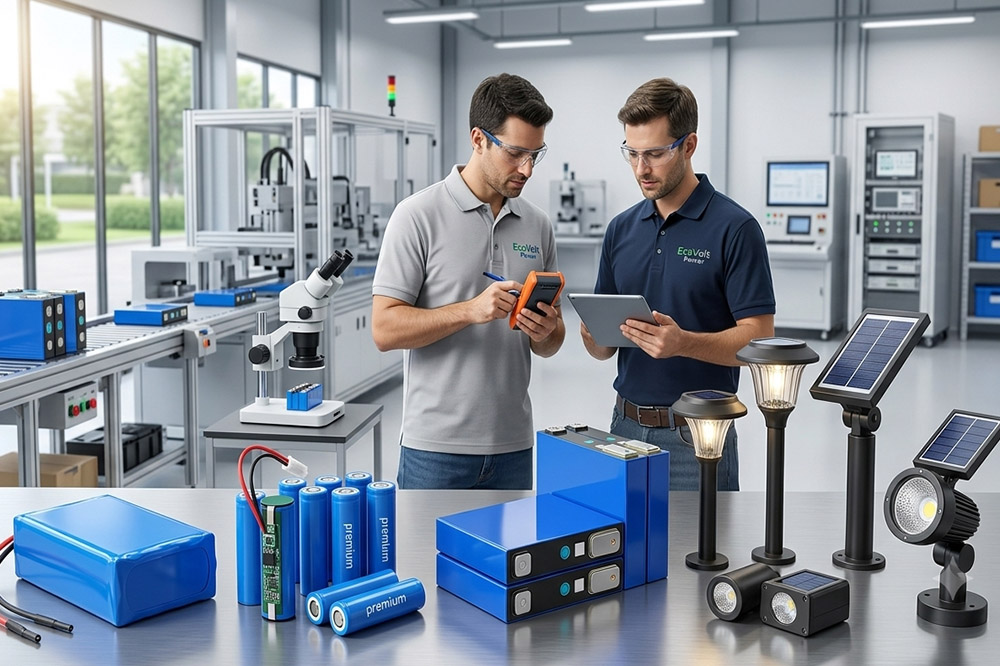
If you’ve ever compared two solar garden lights that look almost identical, you’ve probably noticed something a little strange. One keeps shining until sunrise, while the other starts fading after midnight. From the outside, they seem to use the same LED, the same solar panel, and nearly the same housing.
So what creates the difference?
In many cases, it isn’t the LED at all. It’s the battery hidden inside.
Over the years, we’ve spoken with buyers developing private-label solar lighting for Europe, Australia and North America. Interestingly, the conversation rarely starts with battery chemistry. Instead, they usually describe a problem.
“Our current model doesn’t last through cloudy weather.”
“The brightness drops too quickly after six months.”
“We need something that survives winter without increasing product size.”
Those comments tell us much more than a specification sheet ever could.
That is exactly why more lighting manufacturers are choosing custom battery packs for solar garden lights instead of buying standard batteries that happen to fit the enclosure.
Not Every Solar Garden Light Needs the Same Battery
One thing that’s easy to overlook is that “solar garden light” covers a surprisingly wide range of products.
A decorative pathway light outside a small home might only run for six or seven hours each night. A landscape spotlight installed in a hotel garden may operate until sunrise every single day. Commercial parks, villas and public walkways all create different demands.
Trying to power every one of these products with the same battery usually leads to compromise.
Sometimes the battery is oversized, increasing cost without adding much value. Other times it’s simply too small, which customers quickly notice after several cloudy days.
That’s why OEM battery design has become much more common than it was a few years ago.
Instead of asking, “Which battery do you sell?”, many buyers now ask, “Which battery should we build?”
That small change in thinking often leads to a much better product.
Why the 18650 Battery Cell Still Makes Sense
Battery technology changes every year, and there are certainly newer cell formats available today. Even so, the 18650 battery cell continues to appear in countless solar lighting projects.
There are practical reasons for that.
Production technology is mature. Quality cells are widely available. Performance is predictable, which matters a lot when manufacturing thousands of lights rather than dozens.
We’ve seen customers replace cheaper cells with premium 18650 cells during product upgrades. Interestingly, they didn’t change the LED or the solar panel. Yet warranty claims dropped because battery consistency improved.
That’s something many purchasing managers don’t immediately consider.
A battery isn’t only measured by capacity. Consistency between thousands of cells is often even more valuable during mass production.
For many OEM projects, the familiar 18650 format still provides an excellent balance between cost, cycle life and reliability.

When Custom 18650 Battery Packs Become the Better Choice
Single cells work perfectly well for compact decorative lighting.
However, once the application becomes more demanding, custom 18650 battery packs often become the smarter solution.
Take a solar bollard light installed along a park pathway.
It may need to operate for twelve hours during winter, survive frequent charging cycles and continue working after several rainy days. A single cell may no longer provide enough capacity.
That’s where battery pack customization starts making sense.
Rather than forcing engineers to redesign the lighting electronics, increasing battery capacity through a multi-cell configuration can often solve the problem much more efficiently.
Depending on the project, OEM battery packs may include:
- Integrated BMS protection
- Waterproof PVC or ABS housing
- Customized connectors
- Temperature monitoring
- Cell balancing
- IP65 or IP67 sealing
None of these features sounds particularly exciting on paper.
Yet together they usually determine whether the product performs reliably after two years outdoors instead of just the first few months.

LiFePO4 Battery Isn’t Always the Replacement—Sometimes It’s Simply the Better Fit
Many people assume lithium-ion and LiFePO4 battery technology compete directly.
From our experience, that’s only partly true.
For compact garden lights where size matters, traditional lithium-ion batteries often remain the preferred option because of their higher energy density.
On the other hand, projects involving larger solar landscape lighting or commercial outdoor installations increasingly move toward LiFePO4 batteries.
Why?
The answer usually comes down to durability rather than capacity.
LiFePO4 batteries generally tolerate deeper charge cycles, perform well across a wider temperature range and offer excellent thermal stability. Those advantages become much more noticeable when products stay outdoors year after year.
We’ve worked on projects where customers originally planned to use lithium-ion cells but switched to LiFePO4 after discussing the installation environment. The battery became slightly larger, yet the expected service life improved enough to justify the change.
That’s not always the right answer, of course.
Every project has different priorities.
Sometimes reducing product cost matters more.
Sometimes maximizing runtime is the primary goal.
And occasionally the available installation space decides everything before battery chemistry even becomes part of the discussion.

OEM Battery Customization Is About More Than Capacity
One question comes up surprisingly often.
“Can you just copy our current battery pack?”
Sometimes the answer is yes. More often, though, we suggest changing one or two details after reviewing the application. Those adjustments are usually small, but they can make manufacturing easier and improve long-term performance.
A typical OEM project may include:
Battery Capacity
- 1200mAh
- 1800mAh
- 2200mAh
- 2600mAh
- 3000mAh
- 3500mAh
- 5000mAh and above
The target isn’t simply to choose the largest battery. An oversized pack increases both cost and charging time, while an undersized one may leave the light dim before sunrise. Finding the right balance usually delivers the best value.
Voltage Options
Depending on the lighting system, custom battery packs can be designed for:
- 3.2V
- 3.7V
- 6V
- 12V
- Customized multi-cell configurations
Housing and Waterproof Design
Outdoor products naturally face moisture, dust and temperature changes.
For this reason, many OEM customers request:
- PVC shrink wrapping
- ABS plastic housing
- Waterproof sealing
- IP65 protection
- IP67 protection
Even connector selection deserves attention. A poor connector can become the weakest point of an otherwise reliable battery pack.
Protection Circuit Design
Modern battery packs commonly integrate:
- Overcharge protection
- Over-discharge protection
- Short-circuit protection
- Temperature protection
- Smart BMS
- Cell balancing
These features work quietly in the background, yet they often determine how long the entire lighting system remains dependable.
Different Solar Garden Lights, Different Battery Solutions
One thing we’ve learned from OEM projects is that battery selection usually begins with the installation environment rather than the product catalog.
For example:
- Garden pathway lights often prioritize compact size.
- Decorative landscape lighting usually focuses on appearance and moderate runtime.
- Solar fence lights need stable charging despite changing weather.
- Park lighting and community walkways typically require larger battery capacity and longer operating hours.
- Solar spotlights demand higher discharge performance because brightness is more important than decorative lighting.
Even within the same project, customers sometimes use different battery configurations across multiple product models. That approach keeps manufacturing flexible while allowing each light to perform as expected.
From an Idea to Mass Production
Developing a custom battery pack isn’t nearly as complicated as many buyers imagine.
Most OEM projects follow a straightforward process.
First, the engineering team reviews the lighting application, installation environment and expected operating time.
Next comes battery configuration. At this stage, engineers evaluate capacity, voltage, battery chemistry, connector type and available installation space.
Prototype samples are then produced for functional testing. This stage often reveals small improvements that are difficult to predict from drawings alone.
After sample approval, batteries undergo charging, aging and safety testing before moving into mass production.
It isn’t unusual for customers to adjust connector positions or cable lengths after evaluating the first sample. These small refinements usually prevent larger production issues later.
Questions Buyers Usually Ask
Before placing an OEM order, purchasing managers tend to focus on practical questions rather than technical jargon.
Can the battery dimensions be customized?
Yes. Battery packs can be designed to match available installation space.
Can our company logo be printed?
OEM labels, branding and packaging are available for most projects.
Do you support waterproof battery packs?
Yes. Waterproof designs are widely used for outdoor solar lighting.
Can you develop both lithium-ion and LiFePO4 battery solutions?
Absolutely. The recommended chemistry depends on the application, operating temperature and product requirements.
Do you provide UN38.3 certified batteries?
Yes. Certification and transportation compliance are available according to project requirements.
Looking Beyond the Battery Itself
Many buyers begin their search by comparing battery prices.
That’s understandable, but after enough projects, most realize that the battery itself is only part of the overall cost.
A more reliable battery often means fewer warranty claims, fewer product returns and happier end users. Those savings rarely appear on the initial quotation, yet they become obvious after products reach the market.
At ANPS Global, we support OEM and ODM customers developing solar garden lights, pathway lighting, landscape lighting, decorative outdoor lamps and commercial solar lighting systems.
Whether your project requires a single high-quality 18650 battery cell, fully customized 18650 battery packs, or a long-life LiFePO4 battery solution, our engineering team works with you to design a battery that matches your product instead of forcing your product to fit a standard battery.
If you’re planning a new solar lighting project or upgrading an existing product line, we’d be happy to discuss your requirements and recommend a battery solution that balances performance, reliability and manufacturing cost.
-

12.8V 8Ah LiFePO4 Power Wall Battery
-

12V 100Ah LiFePO4 Solar Battery
-

12V 4400 mah Lithium ion 3S2P 18650 Battery Pack
-

18650 20V 3.0Ah Cordless Drill battery
-

18650 22.2V 7.8Ah 2600Mah 6S3P Rechargeable Battery Pack
-

18650 2200Mah 10S3P 36V 6.6Ah Electric Scooter Lithium Battery
-

18650 2600Mah 10S3P 36V 7.8ah Scooter Battery
-

18650 3.7V 10Ah Li-Ion Power Battery Pack
-

18650 36V 5.2Ah Electric Bicyle Battery
-

18650 7S7P 24V 14Ah Lithium ion Electric Scooter Battery Pack
-

18650 Electric Scooter 48V 13000mAh Lithium Battery
-

1S2P 3.7V 1600mAh 14500 Lithium Battery
-

2000Mah 18650 Battery Cell 6Ah 36V Scooter Battery
-

21700 3.7V 4800mAh Rechargeable Lithium-Ion Battery
-

2600mAh 3S1P 11.1V 18650 Battery Packs
-

3.2V 280ah Lifepo4 Battery Cell
-

3.2V 320Ah LifePo4 Battery Cell
-

3.7V 21700 Rechargeable Lithium Battery Cells 5000mah
-

3.7V 5000mah 26650 Battery
-

32140 LiFePO4 Battery Cell 3.2V – 10000mAh / 15000mAh
-

32700 Lifepo4 3.2V 6000mah Lithium Battery
-

36V 5200mAh 10S2P 18650 Battery Pack
-

48V 15ah 720wh Ebike Battery
-

48V 200Ah LiFePO4 Battery Solar Power Wall
-

48v 4400mah 13S2P 18650 Rechargeable Battery Pack
-

60V 21Ah 18650 16S7P E Bike Battery
-

7S2P 24V 18650 Lithium Battery Pack
-

Customized 48V-72V Triangle Ebike Lithium Battery Pack | 52V 30Ah
-

Electric Scooter 36V 4400mAH 10S2P 18650 Battery Pack
-

IP67 48V 100Ah Solid State LiFePO4 Battery
Leave a Reply