
When people search for how to make 24V 18650 battery pack, they usually have one of two goals.
Some want to build a battery for their own electric scooter, robot, solar project, or portable device.
Others are actually looking for something different — a reliable battery supplier who can provide hundreds or thousands of packs with stable quality.
The difference between these two situations is bigger than many people expect.
A small DIY project may focus on getting the voltage right. A commercial project needs to think about cell consistency, BMS protection, production repeatability, and long-term reliability.
A 24V 18650 lithium battery pack is not simply putting cells together. The design behind the pack decides whether it works smoothly or becomes a maintenance problem later.
First, Understand What “24V 18650 Battery Pack” Really Means
A common misunderstanding is that a 24V battery pack must output exactly 24 volts.
For lithium-ion 18650 cells, this is not how engineers normally design it.
A single 18650 cell usually has a nominal voltage of 3.6V–3.7V.
To create a 24V-class battery pack, manufacturers normally use a 7S configuration.
7S means:
- 7 cells connected in series
- Voltage: around 25.9V nominal
- Full charge voltage: 29.4V
The parallel number depends on the required capacity and discharge current.
For example:
7S2P 24V 18650 battery pack
- 14 cells total
- 7 groups in series
- 2 cells connected parallel in each group
This configuration is widely used because it balances size, cost, and output power. Apsenx also provides a 7S2P 24V 18650 lithium battery pack solution for applications requiring compact lithium power systems.

Basic Steps to Build a 24V 18650 Battery Pack
1. Choose the Right 18650 Cells
This is where many DIY builds go wrong.
A cheap cell may look attractive at first, but battery packs are not only about capacity numbers.
For example:
Two cells may both claim 3000mAh, but their internal resistance and discharge performance can be completely different.
For a production battery pack, manufacturers normally select:
- Same model cells
- Same capacity range
- Similar internal resistance
- Same production batch when possible
This becomes especially important when the pack is used in electric scooters, robots, medical equipment, or industrial devices.
2. Decide the Series and Parallel Structure
The design depends on the application.
A small portable device may only need:
7S1P
Lower capacity, smaller size.
An electric mobility device may need:
7S4P or 7S7P
Higher capacity and longer runtime.
For example, a 7S7P 24V 14Ah 18650 lithium battery pack uses more parallel cells to increase capacity and is commonly considered for higher energy demand applications.
Before selecting the structure, buyers usually need to answer:
- How much running time is required?
- What is the peak current?
- How much space is available?
- What charging method will be used?
Sometimes the smallest battery is not the best choice. A slightly larger pack can reduce stress on cells and improve service life.
3. Add a Suitable BMS Protection Board
The BMS is one of the most important parts of the battery pack.
A lithium battery without proper protection is not suitable for real-world products.
A BMS normally manages:
- Overcharge protection
- Over-discharge protection
- Over-current protection
- Short circuit protection
- Cell balancing
One common mistake we see is selecting the BMS only according to voltage.
Actually, the current rating matters just as much.
A battery used for a motor application may need a different BMS compared with a low-power electronic device.
4. Cell Welding and Pack Assembly
Professional battery packs normally use spot welding instead of directly soldering cells.
Why?
Because excessive heat can damage internal battery structures.
The assembly process usually includes:
- Cell sorting
- Spot welding nickel strips
- Connecting BMS wires
- Adding insulation materials
- Installing housing
- Testing charge and discharge performance
For commercial orders, these steps are repeated thousands of times, so production consistency becomes more important than simply making one working pack.
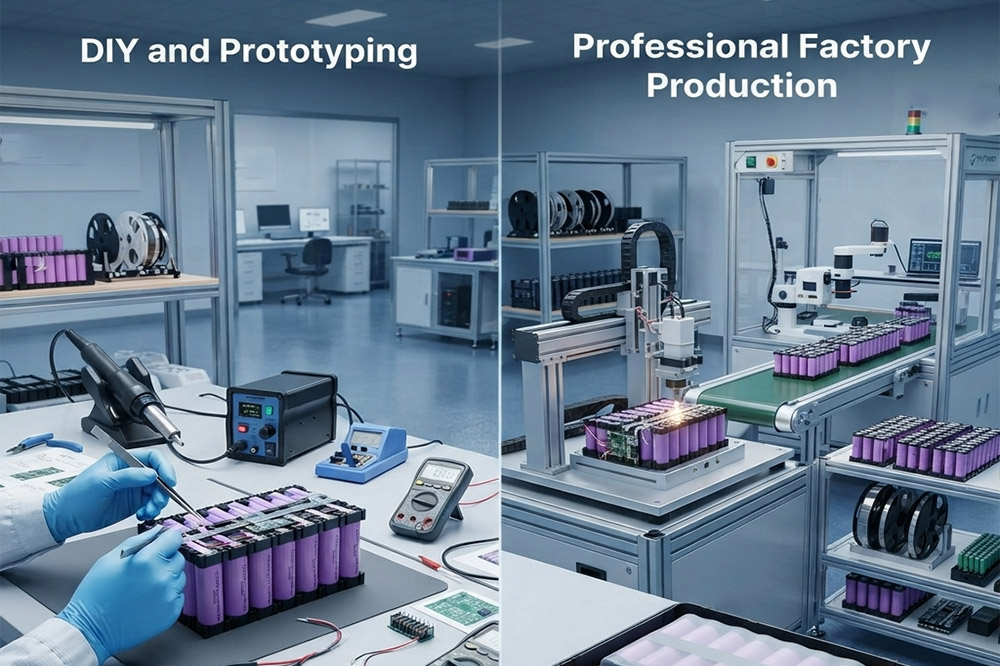
DIY Battery Pack vs Factory-Made 24V 18650 Battery Pack
Building one battery pack yourself can be interesting.
You learn how series and parallel connections work. You understand battery design better.
But for companies developing products, the situation changes.
Imagine a small electric equipment company launching 500 units.
If even 5% of batteries have inconsistent performance, the replacement cost, customer complaints, and lost time can easily exceed the initial savings.
That is why many companies choose OEM battery pack manufacturers instead.
A professional supplier can provide:
- Customized voltage and capacity
- Different BMS options
- Connector customization
- Battery housing design
- Bulk production support
Apsenx focuses on customized 18650 lithium battery packs for applications such as electric vehicles, tools, portable equipment, and energy storage projects.

Where Are 24V 18650 Battery Packs Used?
A 24V lithium battery pack is commonly found in:
Electric Mobility
Electric scooters, wheelchairs, mobility devices, and small electric vehicles often replace traditional lead-acid batteries with lithium packs.
The main reasons are simple:
Less weight.
More usable energy.
Longer replacement intervals.
Robotics and Automation
Small robots and AGV systems often require compact batteries with stable discharge.
A 24V 18650 pack fits many control systems because 24V is already common in industrial electronics.
Portable Equipment
Outdoor equipment, inspection tools, and professional devices often need rechargeable power without adding too much weight.

If you are planning a DIY battery project, you can also read our previous guide:
“How to Make Your Own 18650 Battery Pack: A Complete DIY Guide”
That article explains the basic battery pack construction process, including cell arrangement, safety considerations, and common mistakes beginners make.
After understanding the basics, this 24V 18650 battery pack guide focuses more on voltage design, wholesale purchasing decisions, and production considerations.
Choosing the Right 24V 18650 Battery Supplier
The biggest challenge in battery purchasing is usually not finding a battery.
It is finding a battery that performs the same way from the first batch to the thousandth batch.
For OEM and wholesale buyers, important questions include:
- What cell brands are available?
- What capacity options can be customized?
- What BMS current ratings are supported?
- Can connectors and casing be modified?
- What certifications are available?
A good battery design is a balance between cost, performance, safety, and production stability.
For small experiments, DIY assembly can be a useful learning process.
For commercial products, working with an experienced 18650 battery manufacturer is usually the safer path.
Need custom 24V 18650 battery pack for your project?
Apsenx provides OEM and wholesale 18650 lithium battery solutions with customized capacity, voltage, BMS, connectors, and packaging options.
Contact us for bulk pricing and engineering support.
-

12V 4400 mah Lithium ion 3S2P 18650 Battery Pack
-

18650 2000mAh 3.7 volt Lithium-ion Battery
-

18650 20V 3.0Ah Cordless Drill battery
-

18650 22.2V 7.8Ah 2600Mah 6S3P Rechargeable Battery Pack
-

18650 2600mAh Rechargeable Lithium-Ion Battery 3.7V
-

18650 3.7V 10Ah Li-Ion Power Battery Pack
-

18650 3.7V 3300mah Rechargeable Lithium ion Battery
-

18650 7S7P 24V 14Ah Lithium ion Electric Scooter Battery Pack
-

18650 battery 3.7V 1500mAh Lithium-Ion Battery
-

18650 Battery 3500 mah Rechargeable Battery Cells
-

18650 Electric Scooter 48V 13000mAh Lithium Battery
-

2600mAh 3S1P 11.1V 18650 Battery Packs
-

3.7V Li ion Rechargeable 3000mah 18650 Battery Cell
-

36V 5200mAh 10S2P 18650 Battery Pack
-

48v 4400mah 13S2P 18650 Rechargeable Battery Pack
-

7S2P 24V 18650 Lithium Battery Pack
-

Electric Scooter 36V 4400mAH 10S2P 18650 Battery Pack
-

ICR 18650 Battery 2200mah 3.7V
Leave a Reply