
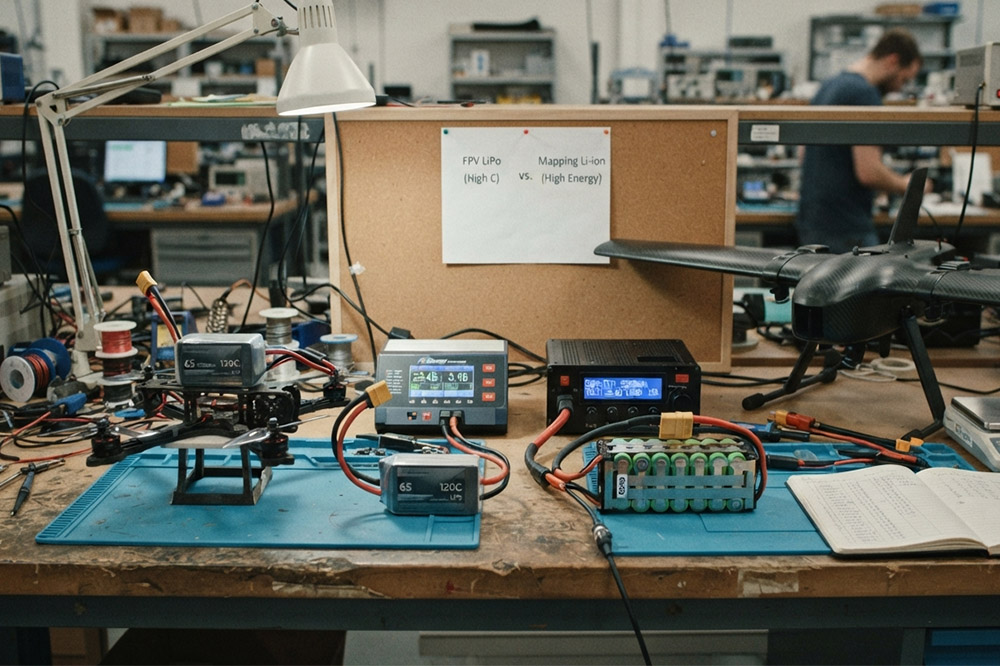
When a drone battery needs to be replaced or developed from scratch, the discussion often starts with a simple question:
LiPo or Li-ion?
There is no universal winner.
For an FPV pilot looking for quick acceleration, the answer can be quite different from an agriculture drone manufacturer trying to improve operating time. A mapping UAV may have another set of priorities again.
This is where battery discussions sometimes become confusing. LiPo batteries are often associated with high discharge performance, while Li-ion batteries are known for higher energy density. Both statements are generally true, but they do not tell you which battery is right for a particular UAV.
The better question is:
What does the drone actually need from its battery?
LiPo and Li-ion Are Built for Different Priorities
LiPo and Li-ion batteries are both lithium-based rechargeable batteries, but their characteristics can be quite different.
A typical LiPo battery used in drones is designed to provide relatively high current from a compact pack. This makes it popular for applications where the motors demand a lot of power in a short period.
Li-ion cells, especially modern cylindrical cells such as 18650 and 21700 formats, can offer higher energy density in many applications.
That can become interesting when flight time matters more than extreme peak power.
But there is a trade-off.
A battery with excellent energy density may not be the ideal choice if the drone repeatedly demands very high current.
LiPo vs Li-ion Drone Battery at Glance
| Feature | LiPo Battery | Li-ion Battery |
|---|---|---|
| Peak discharge | Usually higher | Usually lower |
| Energy density | Good | Often higher |
| Weight efficiency | Good | Often very good |
| High-power response | Excellent | Depends on cell |
| Long endurance | Good | Often attractive |
| FPV racing | Very common | Less common |
| Mapping UAV | Application dependent | Often attractive |
| Agriculture UAV | Common | Depends on power demand |
| Cycle life | Depends on cell and use | Often favorable |
| Custom pack design | Yes | Yes |
These are general tendencies rather than fixed rules.
The actual cell specification matters more than the label printed on the battery.

FPV Drone: LiPo Usually Has the Advantage
Let’s start with FPV because this is probably the easiest application to understand.
An FPV racing drone may go from hovering to full throttle almost instantly.
The motors can demand a large amount of current, particularly during acceleration, rapid direction changes, or aggressive flying.
This is where LiPo batteries have traditionally been strong.
A high-discharge LiPo pack can deliver the current needed by the motors without the voltage dropping excessively under load.
For an FPV drone, a battery with slightly higher energy density but insufficient discharge capability may actually feel worse in flight.
The drone may become less responsive.
So if the priority is:
- Fast acceleration
- High peak current
- Aggressive flying
- Motor response
LiPo is usually the more practical starting point.
For racing or freestyle applications, I would not choose a battery simply because its Wh/kg number looks impressive.
The drone has to perform in the air.

Agriculture Drones Are a Different Story
Agriculture drones have a very different job.
They are not normally flying around simply for speed.
They may carry several kilograms of liquid, fly repeated routes, land frequently, and operate for long periods during a working day.
Here, battery capacity and overall system efficiency become much more important.
LiPo batteries are widely used in agriculture UAVs because they can provide substantial power for takeoff and spraying operations.
However, for certain designs, high-energy-density Li-ion cells can also be worth considering.
The answer depends heavily on the aircraft.
If the drone has a large payload and needs strong power during takeoff, a high-discharge LiPo solution may remain the better choice.
If the aircraft has a more moderate power requirement and the main goal is endurance, Li-ion becomes more interesting.
This is one of those cases where testing is more useful than making a decision from a battery datasheet alone.

Mapping Drones: Energy Density Starts to Matter More
Mapping and surveying UAVs often have a different flight pattern.
They may spend a long time flying relatively stable routes while carrying cameras, positioning equipment, or other sensors.
The drone may not need the same aggressive power output as an FPV racing drone.
That changes the battery calculation.
A Li-ion battery can be attractive when the project is focused on:
- Longer flight time
- Lower battery weight
- Higher energy density
- Efficient cruising
Of course, this does not mean every mapping drone should use Li-ion.
If the UAV has high takeoff power requirements or needs significant peak current, LiPo may still be the better fit.

What About Flight Time?
This is where many buyers compare batteries too quickly.
Suppose you have:
Battery A: high-discharge LiPo
Battery B: high-energy-density Li-ion
If both batteries have similar nominal voltage, Battery B may store more energy for its weight.
That sounds like an easy decision.
But the drone also has to deliver the required current.
If the Li-ion pack is operating too close to its current limit, voltage sag and heat can become concerns. The theoretical energy advantage may not translate into the expected flight performance.
For long-endurance UAVs, the useful number is not simply the battery’s advertised capacity.
The whole power system needs to be considered.
C Rating Is Particularly Important for LiPo
One of the reasons LiPo batteries are so common in drones is their high discharge capability.
You will often see specifications such as:
- 20C
- 30C
- 50C
- 100C
However, buyers should be careful when comparing C ratings between manufacturers.
The advertised C rating is not always a perfect representation of continuous real-world performance.
For an OEM project, I would want to know the actual continuous current requirement and peak current before deciding what C rating is necessary.
A battery with a huge C rating may simply add cost if the aircraft never uses that capability.
Li-ion Can Be Interesting for Long-Endurance UAVs
For a mapping or inspection UAV, the priorities may look more like this:
More energy → less weight → longer operation
Modern 21700 Li-ion cells, for example, can offer a useful combination of capacity and weight.
This makes Li-ion battery packs worth considering for certain long-endurance drone platforms.
But there is a catch.
The battery pack has to be designed around the discharge requirement.
A high-capacity cell with poor high-current performance may not be suitable for a drone that requires strong power during takeoff.
So when a customer asks us for a “high-capacity Li-ion drone battery,” the first thing I would want to know is the aircraft’s current demand.
Which Battery Should a Drone Manufacturer Choose?
A simple way to think about it is:
Choose LiPo when:
- High discharge is important
- The drone needs strong acceleration
- Peak power demand is high
- Weight and power response are major concerns
- The application resembles FPV or high-performance UAV operation
Consider Li-ion when:
- Flight endurance is a priority
- Energy density matters
- The aircraft has moderate current demand
- The drone spends a lot of time cruising
- Long-range or mapping applications are involved
And then there are projects that sit somewhere in between.
Those are often the most interesting ones.

What I Would Check Before Ordering a Battery
For a commercial UAV project, I would not send a purchase order based only on:
Voltage + Capacity + Price
I would also check:
- Maximum continuous current
- Peak current
- Battery weight
- Pack dimensions
- Cell model
- Connector
- Operating temperature
- Expected cycle life
- Charging method
A sample battery should ideally be tested on the actual aircraft before moving to mass production.
This is especially important if you are changing from LiPo to Li-ion. The battery may fit physically but still behave differently under load.
Custom Battery Packs for Commercial UAVs
For industrial drone manufacturers, the battery is often designed around the aircraft rather than selected from an existing shelf product.
For example, a mapping drone may need a long, narrow battery because the available space under the fuselage is limited.
An agriculture UAV may need a larger pack with high current capability.
An inspection drone may need a lighter pack because it already carries expensive sensors.
These requirements can lead to different battery designs even when the drones have similar nominal voltage.
ANPS provides custom UAV battery solutions for different drone applications, including capacity, voltage, dimensions and pack configuration.
You can view the UAV Battery product category when looking for battery options for commercial drone projects.
A Practical Way to Make the Decision
If you are still unsure between LiPo and Li-ion, start with the aircraft rather than the battery.
Ask:
How much current does the drone actually need?
Then:
How much energy does it need for the target flight time?
After that, look at weight, available space, operating temperature and expected cycle life.
That approach usually gives a more realistic answer than simply asking which chemistry is “better.”
For an FPV racing drone, I would normally start with LiPo.
For a long-endurance mapping platform, I would give Li-ion serious consideration.
For agriculture drones, I would want to see the payload and power requirements before making the call.
FAQ
Is LiPo better than Li-ion for drones?
Not in every application. LiPo is generally strong where high discharge and peak power are important, while Li-ion can be attractive for applications where energy density and endurance are priorities.
Is Li-ion good for FPV drones?
It can work for some FPV applications, but traditional high-performance FPV drones usually favor high-discharge LiPo batteries because of their power requirements.
Are Li-ion batteries better for long-range drones?
They can be. If the UAV has moderate current demand, the higher energy density of some Li-ion cells can help extend flight time.
Which battery is better for agriculture drones?
It depends on the drone’s payload, motor system and current demand. High-power agricultural UAVs may favor LiPo, while some endurance-focused designs may benefit from Li-ion.
Capacity alone does not tell you whether a battery will perform well on a UAV. Our guide to drone battery capacity, mAh, voltage and C rating explains how these specifications should be read when comparing battery suppliers.
Before deciding between LiPo and Li-ion, it helps to understand the wider battery selection process. Our LiPo Battery for Drone: Complete Guide for UAV Manufacturers and Buyers covers voltage, capacity, discharge requirements and custom battery design.


Leave a Reply