
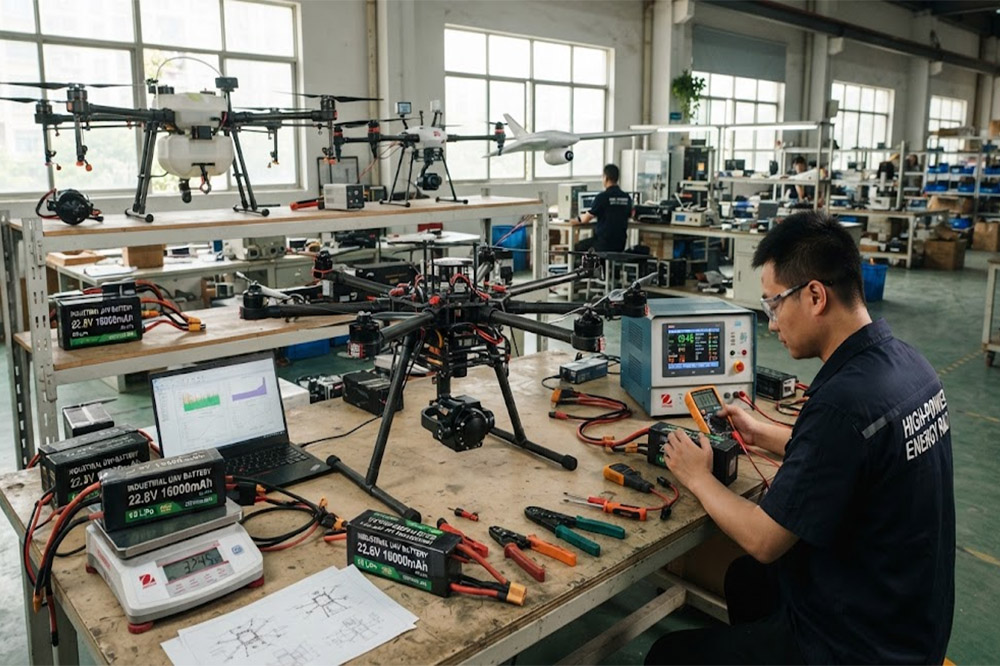
industrial drone battery has a much harder job than simply keeping a drone in the air.
A commercial UAV may spend hours moving between inspection points, carrying cameras and sensors, flying over farmland, or following a pre-planned mapping route. In some cases, the drone is working every day, not just being flown on weekends.
That changes how the battery should be selected.
For a B2B buyer, the cheapest battery with the right voltage and capacity on paper may not be the best choice. Battery weight, discharge performance, cycle life, charging time and pack reliability can all affect the operating cost of the drone.
This is especially noticeable when a company operates a fleet.
One battery that performs well is useful. Hundreds of batteries that perform consistently are much more valuable.
Industrial UAV projects usually require more than a standard battery specification. For an overview of LiPo battery chemistry, capacity, voltage, discharge performance and custom UAV battery design, see our LiPo Battery for Drone: Complete Guide for UAV Manufacturers and Buyers.
What Does Industrial UAV Battery Need to Do?
There is no single specification for an industrial UAV battery.
A power inspection drone may need a relatively lightweight battery because it already carries cameras and sensors.
An agriculture drone may need high power because it carries a significant payload.
A mapping UAV may care more about energy density and endurance.
So the battery should be matched to the mission.
The main specifications usually include:
- Nominal voltage
- Capacity
- Maximum continuous current
- Peak current
- Battery weight
- Dimensions
- Cell chemistry
- Connector
- Cycle life
- Operating temperature
It sounds like a long list, but these specifications are connected.
Increasing capacity, for example, normally increases weight. Increasing discharge capability can affect cell selection and pack design. Changing voltage can affect the motors and ESC.
Agriculture Drones Need Power and Endurance
Agricultural UAVs are a good example of why commercial drone batteries cannot be selected from capacity alone.
Imagine an agriculture drone starting its morning with a full spray tank.
The battery is not only lifting the aircraft.
It is lifting the frame, motors, electronics, battery, liquid tank and the liquid itself.
As the drone becomes lighter during spraying, the power requirement changes again.
This makes battery design a little more complicated than simply saying:
“We need a 20Ah battery.”
A high-discharge LiPo battery can be attractive for agriculture UAVs because of its ability to provide substantial current.
But depending on the aircraft design, battery weight and flight profile, another chemistry or pack configuration may make more sense.
For a manufacturer developing a new agriculture drone, sample testing is usually more useful than trying to settle the entire question from a datasheet.

Power Inspection Drones Have Different Priorities
Power line and infrastructure inspection drones often carry expensive equipment.
A typical platform may have:
- High-resolution camera
- Thermal imaging camera
- Zoom camera
- GPS or positioning equipment
- Communication equipment
The payload can become surprisingly heavy.
At the same time, the operator wants enough flight time to inspect a useful section of infrastructure before returning to change the battery.
This is where commercial drone battery design becomes a balancing exercise.
A heavier battery can provide more energy, but it also reduces the payload margin.
For inspection companies, a lightweight battery with good energy density can sometimes be more useful than simply increasing capacity.
There is also the issue of reliability.
If a battery starts behaving differently from the rest of the fleet, the operator may have to remove it from service. For a professional inspection operation, that is more than an inconvenience.
For UAV manufacturers focused on longer endurance, battery weight and energy density become particularly important. See what is the best battery for long range drone for a more detailed look.

Mapping UAVs Often Care About Energy Density
Mapping drones normally follow planned routes at relatively stable speeds.
The aircraft may carry a mapping camera, LiDAR equipment or other sensors, depending on the project.
Compared with an FPV racing drone, the power demand may be less aggressive.
That can make energy density especially interesting.
A battery with a good Wh/kg ratio allows the UAV to carry more useful energy without adding as much weight.
For long-duration mapping missions, this can have a noticeable effect.
But again, there is no magic number.
The drone still needs sufficient current during takeoff, climbing and changes in flight conditions.

LiPo or Li-ion for Industrial UAVs?
Both can have a place in commercial UAV applications.
High-discharge LiPo batteries are useful when the aircraft needs substantial power, especially during takeoff or heavy-load operation.
Li-ion batteries can be attractive when endurance and energy density are higher priorities and the current demand is moderate.
For example, a lightweight mapping or inspection platform may have a good reason to consider high-energy-density Li-ion cells.
A heavy agriculture UAV with demanding takeoff power may lean more toward a high-discharge LiPo design.
The correct choice comes from the aircraft’s power profile, not simply from the battery chemistry name.
For a more detailed comparison, see our guide to LiPo vs Li-ion drone batteries.
The choice between LiPo and Li-ion can change depending on whether the UAV is designed for high power or long endurance. Our guide to LiPo vs Li-ion drone battery compares the two for different UAV applications.
Battery Weight Is Often Underestimated
One thing I would pay close attention to during UAV development is battery weight.
It is easy to focus on capacity:
“Can we increase the battery from 15Ah to 20Ah?”
But the more useful question might be:
“How much additional energy do we gain for the extra weight?”
Suppose a new battery adds 500Wh of energy but also adds 1.5kg.
The aircraft has to carry that extra 1.5kg during the entire flight.
Depending on the drone, that may be worthwhile—or it may produce less additional endurance than expected.
For industrial UAVs, battery optimization is usually about the complete pack rather than the cell capacity alone.
What About Battery Cycle Life?
A commercial UAV fleet can put a lot of cycles on its batteries.
If one drone flies five missions a day, battery aging becomes a practical business issue.
Operators may track:
- Charge cycles
- Internal resistance
- Full-charge voltage
- Flight time
- Battery temperature
- Capacity loss
A battery that originally provides 35 minutes but gradually falls to 25 minutes under the same operating conditions may need closer inspection.
For fleet operators, predictable battery aging can be almost as important as initial battery capacity.
Designing the Battery Around the Drone
This is where custom battery development can become useful.
Suppose a commercial UAV has a battery compartment that is:
300mm long × 90mm wide × 65mm high
A standard battery might fit, but perhaps the connector is in the wrong position or some of the available space is wasted.
A custom battery can be designed around the actual compartment.
Other requirements might include:
- Specific cell configuration
- Custom voltage
- High peak discharge
- Lightweight construction
- Particular connector
- Longer cable
- Communication or monitoring functions
- Specific charging requirements
For a prototype, a standard pack can be perfectly reasonable.
For a production UAV, custom packaging may make more sense.
What Should B2B Buyers Ask UAV Battery Supplier?
When requesting samples or quotations, I would provide as much aircraft information as possible.
At minimum:
Application: agriculture / inspection / mapping
Nominal voltage: required system voltage
Capacity: target Ah or Wh
Continuous current: normal operating demand
Peak current: takeoff or maximum load
Battery weight: maximum acceptable weight
Dimensions: available battery space
Connector: required type
Quantity: sample and production quantity
This gives the battery supplier something useful to work with.
It also avoids the common situation where three suppliers quote three batteries that all say “10,000mAh” but have noticeably different weight, dimensions and discharge performance.
Commercial UAV Battery Supply Is More Than Cell Selection
For a B2B customer, the battery supplier’s production capability matters too.
You may need hundreds or thousands of packs rather than five prototypes.
At that point, consistency becomes important.
The supplier should be able to manage:
- Cell matching
- Pack assembly
- Welding quality
- Electrical testing
- Capacity testing
- Connector installation
- Batch consistency
- Sample approval
- Production orders
A battery can look good during the first prototype stage and still become difficult to manage when production volume increases.
That is why I would test samples under actual UAV operating conditions before confirming a large order.
Industrial UAV Battery for Different Applications
A simple comparison looks like this:
| Application | Main Battery Priority | Possible Battery Direction |
|---|---|---|
| Agriculture | Power + endurance | High-discharge LiPo / customized pack |
| Power inspection | Weight + endurance | LiPo or high-energy Li-ion |
| Mapping | Energy density + flight time | Li-ion or optimized LiPo |
| Heavy-lift UAV | Peak power + safety margin | High-discharge LiPo |
| Long-endurance inspection | Energy density + weight | High-energy Li-ion |
These are starting points, not fixed rules.
The actual aircraft specifications should decide the final battery.

Building Commercial Drone Battery With a Manufacturer
For companies developing their own UAV platform, working with a battery manufacturer early can save some back-and-forth later.
Battery dimensions affect the mechanical structure.
Battery voltage affects the powertrain.
Battery weight affects payload.
Battery discharge capability affects motor and ESC selection.
So the battery should not always be the last component added to the design.
ANPS develops customized UAV battery packs for commercial and industrial applications, including different capacities, voltages, dimensions and discharge requirements.
You can explore the UAV Battery product category for battery solutions and OEM/ODM applications.
FAQ
What is an industrial UAV battery?
An industrial UAV battery is a rechargeable battery pack designed for commercial or professional unmanned aircraft applications such as agriculture, inspection, surveying and mapping.
What battery is commonly used in commercial drones?
LiPo and Li-ion batteries are both used. High-discharge LiPo is useful for power-intensive UAVs, while high-energy-density Li-ion can be attractive for some long-endurance applications.
What is important when choosing a commercial drone battery?
Capacity, voltage, weight, discharge capability, energy density, dimensions, cycle life and operating conditions should all be considered.
Can an industrial UAV battery be customized?
Yes. Commercial UAV battery packs can be customized around voltage, capacity, dimensions, connectors, weight targets and application-specific discharge requirements.


Leave a Reply